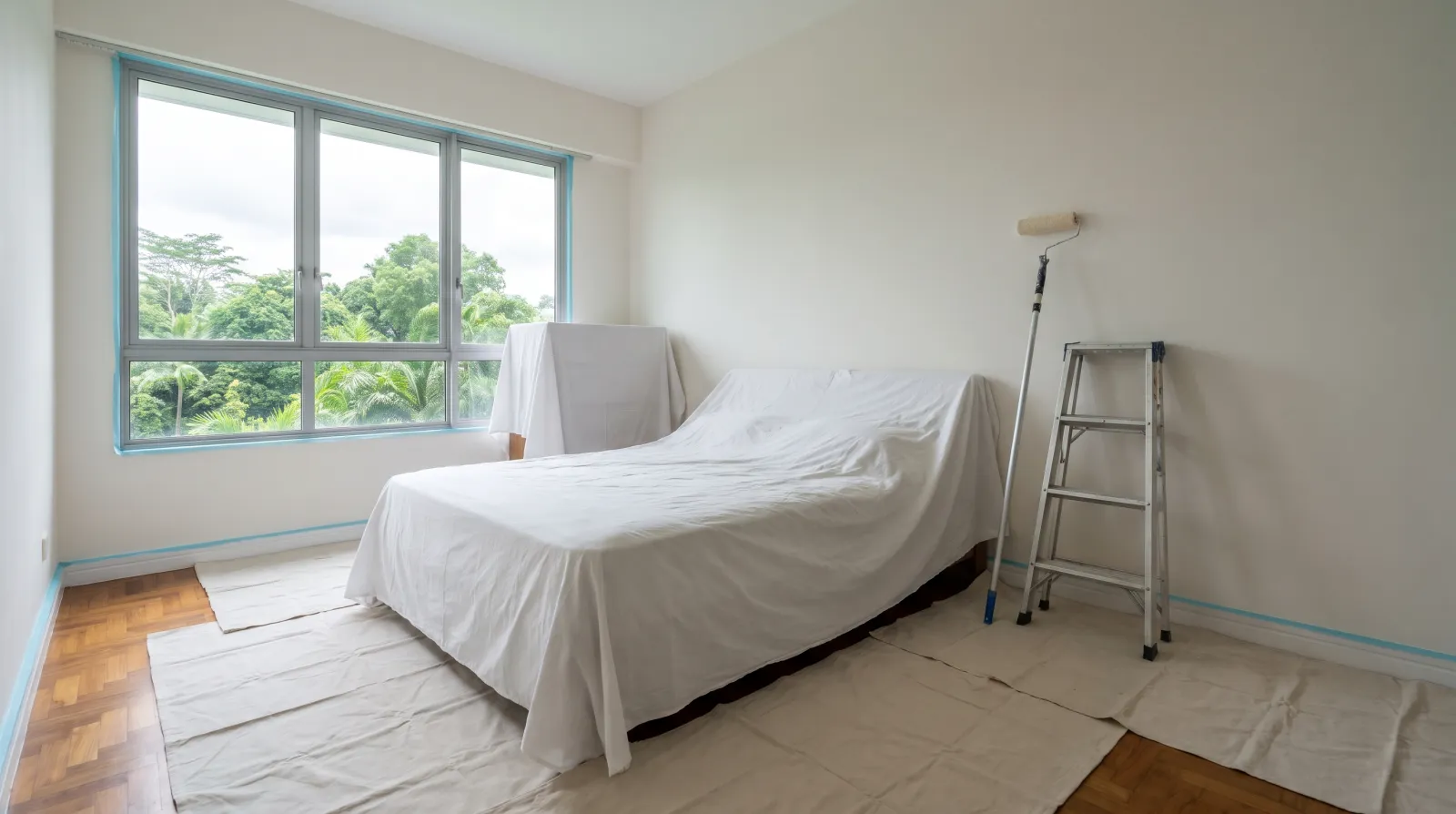
The price of painting your condo, landed house, office or shop comes down to how much wall and ceiling there is, what the walls need before any paint goes on, and which paint the quote names. Cracks, peeling paint, mould and damp patches have to be dealt with first, and they're the part of the job a photo can't show.
So before you ask for prices, look closely at your walls, decide when the work fits around moving in, a renovation or handing a unit back, and get the rules your estate or landlord sets. If you'd rather have one contractor assess the walls, send a fixed-price quote and supervise our specialist painters through to handover, that's what our painting service is for.
This guide takes the questions in the order you'll meet them: what a painting job covers, when to paint, preparing the walls, choosing the paint and reading its data sheet, what Singapore's rules and green labels say about lead, formaldehyde and volatile organic compounds (VOCs), living through the work, what drives the price, and how to brief a painter.
What a painting job covers, and what it doesn't
An interior painting job covers the walls, ceilings, doors and their frames, grilles and exposed pipes inside. It also covers the repairs that have to happen before paint goes on, and covering everything that stays in the room.
List every surface you want painted, room by room. Anything left off the quote is either not done or done later as an extra, so check that doors, frames, grilles and pipes are each on it if you want them painted.
The outside of a house is a separate job, with its own access, weather and waterproofing questions. If you want the outside walls of a landed house painted, that's our facade and exterior service.
In a condo, the outside face of the building isn't yours to paint. The Building and Construction Authority (BCA) counts even the external walls of your unit as common property, which your management corporation (MCST) manages. Generally, everything inside your unit is yours, though some structures and systems in it are common property too, and your strata title plan shows where your unit ends.
Housing and Development Board (HDB) flats have their own renovation rules, which this guide doesn't cover.
When to paint, and where it fits in a renovation
Paint goes on most easily in an empty room, and it belongs after the dusty work. Where it fits for you depends on why you're painting.
Before you move in
An empty home is the simplest job, with no furniture to move or cover and every room free at once. If you can, paint before the furniture arrives.
In a new condo, inspect first and report defects to your developer before any paint covers them. BCA says the Defects Liability Period (DLP) is the period when defects caused by substandard workmanship or defective materials must be reported, and any defect reported during it remains the developer's responsibility if it's still unsolved after the period ends. Photograph cracks and stains before anyone paints over them.
With a renovation
We recommend painting after the dusty trades, such as hacking, wiring, false ceilings and carpentry. Each of them marks or cuts into walls, and painting first means painting twice. Leave a final touch-up until the built-ins and fittings are in. Our condo renovation guide sets out the whole order of works.
Before you sell or rent out
Whether a repaint is worth it before you sell or let is your call. If you do it, put right the damp, cracks and peeling first, so the fresh paint isn't hiding a problem the next occupant will find, and finish before viewings start.
Handing a rented unit back
Your lease decides what goes back and in which colour. Read its reinstatement or handover clause before you book anyone, and ask your landlord in writing which walls return to which colour and finish.
Some landlords set out their own process. If you lease from JTC, the government agency that leases industrial land and premises, for example, JTC says you are required to reinstate your premises before returning it on the lease expiry date, and it contacts you to arrange a joint site inspection approximately 6 months before your lease expires, then tells you the reinstatement requirements, taking into account the obligations in your lease. If your lease asks for more than paint, such as partitions or flooring taken out, our commercial renovation service can quote the whole reinstatement.
When you're painting, and what to settle first
Scroll across to compare all columns →
| Why you're painting | Settle this first | Then |
|---|---|---|
| Moving into a new condo | Defects reported to your developer during the Defects Liability Period | Paint once the defects you reported have been dealt with |
| Moving into a resale home | Damp, cracks and peeling found, and the cause of any damp fixed | Paint the rooms while they're empty |
| Renovating | The dusty trades, such as hacking, wiring, false ceilings and carpentry | Paint, then touch up once the built-ins and fittings are in |
| Selling or renting out | Damp, cracks and peeling put right | Repaint before viewings start |
| Handing back a rented unit | Your lease's reinstatement clause, and your landlord's list in writing | Repaint to what the lease and your landlord ask for |
Fix the walls first, then paint
Paint needs a wall that's sound, clean and dry. What's wrong with the wall decides what happens before the first coat, and whether painting is the fix at all.
Cracks
Fine hairline cracks are filled before painting, and a paint's data sheet can list the filler it expects among its suggested surface treatments. A crack that opens again after it's been filled, or keeps widening, is a question for an engineer rather than a painter, and that's who we arrange to look at it.
Peeling, flaking and bubbling
Loose and peeling paint is scraped back until what's left is firmly stuck, because new paint holds only as well as the layer under it. Peeling or bubbling that keeps coming back on the same patch can point to water behind the paint, so look for the source before repainting.
Stains and mould
Grease is cleaned off and the wall left to dry. Mould is washed off and treated before painting, but treatment only deals with what you can see. If the wall stays damp, the mould can come back through the new paint.
Damp patches
A damp wall needs its source found and fixed, and the wall dried, before it's painted. A paint's data sheet can set how dry the surface must be, and paint over a wet wall doesn't stop the water.
In a condo, where the water comes from changes who you talk to. If damp is coming through an external wall, tell your management office before you paint. BCA's strata guide quotes the law's definition of common property, which includes the waterproof membrane attached to an external wall or a roof whether or not it's inside a unit, and the MCST manages the common property.
A stain on your ceiling under another unit's bathroom is different. BCA's strata guide lists, among an owner's duties, investigating the cause of an inter-floor leak jointly with the other unit's owner, and says both should settle the cost and method of repair privately. It adds that the leak is presumed to come from the upper floor unit unless that unit's owner or occupier can prove otherwise. Our article on whether a leak below a bathroom means removing the tiles explains how the source is found.
In a landed house, damp on an inside wall can start outside. Our article on damp walls after painting explains how to find the cause before recoating.
Watch out
Don't let anyone paint over a damp patch just to make a room look finished. Once it's covered, the next sign of the leak is the new paint failing.
Choosing the paint, and reading its data sheet
Choose a paint by what its data sheet says it does, not by the name on the tin. Ask for the data sheet of every paint your quote names before you accept it.
Finishes run from flat or matt, with almost no shine, through soft sheen and eggshell to semi-gloss and gloss, which reflect more light. A paint's data sheet can give its finish, what it's made for, such as washability, stain resistance or mould resistance, and which surfaces it suits.
Your quote should name the paint for each surface, by product name, so you can check each one against its sheet. These are the parts of a data sheet to look for.
Sealer and the number of coats
A sealer is a first coat that goes on before the finish coats, and whether a paint needs one is set by the painting system on its data sheet. If the data sheet names the sealers that suit the paint, check the sealer on your quote is one of them.
If the system calls for a sealer, check the quote includes it, and if it's missing, ask why. The number of finish coats is set the same way, so compare the quote with the sheet rather than with another painter's habit.
Brands
We don't rank paint brands. Paints from different makers can suit the same wall, and the data sheet and any certification label are what to compare.
What to look for on a paint's data sheet
| On the data sheet | What it can tell you |
|---|---|
| Uses | Which surfaces the paint is made for, and whether that matches the walls and ceilings it's quoted for |
| Surface preparation | What the wall needs first, such as peeling paint removed, grease cleaned off, mould treated and hairline cracks filled, and how dry it must be |
| Painting system | Whether a sealer coat goes on first, and how many finish coats |
| Drying and recoat times | How long before the next coat can go on. Neither is a time for using the room again |
| Coverage | Roughly how much wall a litre covers, which depends on the surface and how the paint is applied |
| Precautions | Any advice on ventilation while the paint goes on and dries, and where to find the product's safety data sheet |
What Singapore's rules and green labels say about lead, formaldehyde and VOCs
Singapore limits lead in paint sold for local use and formaldehyde in interior paint. A green label tells you more about a paint's VOCs.
Lead
Since 3 January 2022, the National Environment Agency (NEA) has not allowed paints over 90 parts per million of total lead to be made, imported or sold for local use, except zinc-based anti-corrosion and copper-based anti-fouling paints, which must be labelled for local sale and are restricted to industrial use. Stock made or imported before that date may be sold until it runs out.
Formaldehyde
In its advisory updated in April 2026, NEA says that from 1 January 2026, interior paints with formaldehyde at 0.01% of their weight or more aren't allowed to be made, imported or sold for local use. The Ministry of Sustainability and the Environment (MSE) had announced the limit in a reply to Parliament on 6 August 2024, and said then that interior paints with no added formaldehyde were already on sale in Singapore.
The limit is for paint used indoors. NEA says industrial paints and paints for outdoor use are excluded, but if they contain formaldehyde at 0.01% of their weight or more, their label must say so and that they're for industrial and outdoor uses only. So check that every paint on your quote is an interior paint for the walls it's going on.
VOCs and green labels
VOCs are chemicals that evaporate from some paints as they dry. If you want a certified paint, look for the Singapore Green Labelling Scheme (SGLS), run by the Singapore Environment Council. Its paint standard asks for low VOC content within limits that vary by coating type and application, with formaldehyde and heavy metals, lead among them, non-detectable. It's a certification a maker applies for, not a rule every paint meets.
MSE also points to the Singapore Green Building Product certification, run by the Singapore Green Building Council, and says interior paints certified with either label are required to have no formaldehyde.
Airing the rooms
Keep the rooms ventilated while the paint goes on and dries, as paint data sheets can ask. Where products containing formaldehyde are installed indoors, MSE advises improving ventilation by opening doors and windows where possible, and using fans and ventilation systems, which can help dilute the formaldehyde.
Living through the work, and what your building sets
Painting goes room by room, so you may not need to move out, but each room is out of use while it's painted and while the paint dries.
Furniture, floors and rooms out of use
Furniture is moved away from the walls or out of the room, and the floor and anything staying are covered. Agree in the quote who moves the furniture, where it goes, and how floors, built-ins and switches are protected.
Agree which rooms are painted on which days, so you know which ones you can use. The drying and recoat times on a data sheet are times for the next coat, not for moving back in, so keep the room aired and ask your painter when it can be used again.
In a condo
Your estate's by-laws and renovation guidelines are where the painting rules sit, because condo units are managed by their own MCST. Read them for whether you apply before work starts, the working days and hours, and how the lift and corridor are protected.
BCA also says you should check with the developer or the MCST and the Sale and Purchase Agreement about renovation restrictions before carrying out any work. Any approval your estate asks for is yours to apply for, and we give you the details of the work its form asks about.
In an office, shop or factory
Your lease and your landlord's rules come first. They can set the colours and finish, and whether the unit is repainted when you leave. The building's management may also set when work can be done, so get its rules before you agree dates, and we plan the painting around those hours.
If your staff need part of the space while the work goes on, plan the painting in zones, and agree when each zone can be used again.
What drives the price, and how to compare two quotes
Your price is set by how much there is to paint and what the walls need first. That's why we give a fixed price only after seeing the walls, never from a photo.
What makes one job cost more than another
- Area and height. The floor area and number of rooms set how much wall and ceiling there is, and a high ceiling or stairwell needs a platform or scaffold.
- Surfaces beyond the walls. Doors, frames, grilles and pipes, each one more item to prepare and paint.
- Colours and paint. Each extra colour, a feature wall, and a higher-grade or specialist paint.
- The painting system. A sealer coat, and the number of finish coats the data sheet sets.
- Repairs. Filling cracks, scraping off peeling paint, treating mould, and fixing a leak before any of it.
- A furnished home. Moving and covering what stays in the rooms.
- Building rules. Protection for the lift and corridors, and the working hours your estate or landlord allows.
Comparing two quotes
Two quotes only compare when they price the same job. Give both painters the same room-by-room list, then check that each names the paint for every surface, whether a sealer is included, the number of coats, the repairs, the protection and who moves the furniture.
A lower price that leaves out the sealer or the repairs is a smaller job, not a cheaper one. Our article on what to check in a painting quote goes through it line by line.
How long the job takes is set by the same things: the rooms, the repairs, the drying and recoat times on the data sheet, and your building's working hours. We set out the plan after the site assessment.
How to choose and brief a painter
Choose the painter whose answers you can check. A quote you can rely on names the paint, points you to its data sheet, and lists the repairs and what's protected.
Questions to ask every painter
- Which paint goes on each surface, and can I see its data sheet? The answer should name the product, its finish and its recommended painting system.
- What will you do about the cracks, stains and damp? Repairs belong on the quote, and a damp patch needs its source fixed first.
- Who moves the furniture, and how are floors and fittings covered? Get it in writing, room by room.
- Which rooms are painted on which days? So you know which rooms you can use while the work goes on.
- What does your warranty cover, and for how long? Ask for the terms in writing before you accept the quote.
- Who supervises the painters? Someone should walk every painted room with you before handover.
What to give them
Give every painter the same brief, with the rooms and surfaces you want painted, the colours and finish, what stays in the rooms, and your estate's renovation guidelines in a condo, or the lease clauses on finishes and handover in a rented unit. Once the job's done, keep the product names and colour codes, so a later touch-up matches.
Start with a site assessment
We start with a free site assessment, where we look at every wall and ceiling you want painted and note the cracks, stains, mould and damp. You get a fixed-price quote within 3 to 5 working days of the visit, never from a photo. Our specialist painters do the work, and we arrange and supervise them through to handover. If a leak has to be fixed or a crack needs an engineer's look first, we arrange that too, and the work comes with our warranty and after-care. Tell us about your rooms through our painting service.
Regulatory compliance
Check which requirements apply to your proposed scope. Agree the responsible qualified professionals, submissions and inspections before work begins.
NEA (National Environment Agency)
Since 3 January 2022, paints over 90 parts per million of total lead may not be made, imported or sold for local use, except zinc-based anti-corrosion and copper-based anti-fouling paints, which must be labelled for local sale and are restricted to industrial use. Stock made or imported before that date may be sold until it runs out. NEA's advisory on formaldehyde in interior building products, updated in April 2026, says that from 1 January 2026, interior paints with formaldehyde at 0.01% of their weight or more aren't allowed to be made, imported or sold for local use, while industrial and outdoor paints are excluded but must be labelled if they contain formaldehyde at that level or more.
Primary source: www.nea.gov.sg/our-services/pollution-control/chemical-safety/hazardous-substancesMSE (Ministry of Sustainability and the Environment)
In a reply to Parliament on 6 August 2024, MSE announced that from 1 January 2026, interior paints with formaldehyde at 0.01% of their weight or more would not be allowed for sale in Singapore, with formaldehyde in paint regulated as a hazardous substance under the Environmental Protection and Management Act.
Primary source: www.mse.gov.sg/latest-news/oral-reply-to-pqs-on-indoor-formaldehyde-levelsBCA (Building and Construction Authority)
In a condo, common property includes even the external walls of your unit, and you should check with the developer or the MCST and the Sale and Purchase Agreement about renovation restrictions before any work. A defect reported during the Defects Liability Period remains the developer's responsibility if it's still unsolved after the period ends. BCA's strata guide quotes the law's definition of common property, which includes the waterproof membrane attached to an external wall.
Primary source: www1.bca.gov.sg/home-and-building-owners/condo-strata/condo-living-be-condo-savvy/what-to-know-as-a-condo-ownerGlossary
- Sealer
- A first coat that goes on before the finish coats. Whether a paint needs one is set by the recommended painting system on its data sheet.
- Data sheet
- The maker's technical sheet for one paint. It can give what the paint is made for, the surface preparation, the painting system, drying and recoat times and precautions.
- Recoat time
- How long one coat needs before the next can go on, as the paint's data sheet states it.
- Finish
- How much shine the dried paint has, from flat or matt to gloss.
- VOCs
- Volatile organic compounds, chemicals that evaporate from some paints as they dry. Paints certified under the Singapore Green Labelling Scheme keep them within set limits.
- SGLS
- The Singapore Green Labelling Scheme, a certification run by the Singapore Environment Council. Its paint standard's requirements include limits on VOCs, formaldehyde and heavy metals.
- Common property
- The parts of a condo estate that don't belong to any one unit, such as gardens and even the external walls of your unit. The MCST manages it.
- Reinstatement
- Putting a rented unit back the way your lease asks before you hand it back.
Frequently asked questions
Are ceilings and balcony walls part of a condo repaint?
Ceilings are, if they're on your quote, so list them room by room. Check balcony walls with your management office first, because BCA counts even the external walls of your unit as common property. Ask which balcony surfaces you may paint, and in which colour.
What happens if a neighbour complains while my condo is being painted?
In a condo, NEA says residents affected by renovation noise may give their feedback to the estate's MCST, so expect a complaint to reach your management office. Working within the estate's permitted hours and its lift and corridor protection rules leaves less to complain about.
How do I know when it's time to repaint?
Look at the walls rather than the calendar. Peeling, flaking, bubbling, stains that won't wash off, mould and cracks are all signs, and peeling, bubbling and mould are also signs to look for damp before you choose a paint.
Is it cheaper to paint it myself?
High ceilings and stairwells are work at height, so leave those to a contractor with proper access equipment. On walls you can reach from the floor, doing it yourself saves the labour, but the preparation is still yours to do. Cracks are filled, peeling paint scraped off, mould treated and any damp fixed first, and the paint's data sheet still sets the sealer, coats and drying times.
Does my landlord have to agree before I repaint an office or shop?
Check your lease first. It can set the colours and finish and say which works need your landlord's approval, so ask your landlord in writing before you book painters. If the building has its own management, get its rules on working hours too.
If you read nothing else
Talk through the options for your home or unit
Tell us what you want to change, how you use the space and when you hope to start. Share photos or plans on WhatsApp if you have them.
Browse all painting services articles →
Go deeper: painting services articles
In-depth pieces that expand on the sections above: real costs, brand and system comparisons, the installation process, and the edge cases most homeowners hit.
Still deciding? Compare options & estimate cost
Side-by-side comparisons and an instant cost estimate for your Singapore home.
Related guides
Buying Guide
How to plan a condo renovation in Singapore
What's yours to change in a condo unit, what to get from your estate, who approves each kind of work and how to brief a contractor.
Buying Guide
How to plan a commercial renovation in Singapore
What to settle with your landlord before you sign, who approves which works, how each trade works in an office, shop or factory unit, and how to compare fit-out quotes.
Buying Guide
Does your landed home need a facade inspection?
What a thorough check involves, which defects to repair before painting, and how to weigh repainting, replastering and cladding quotes.