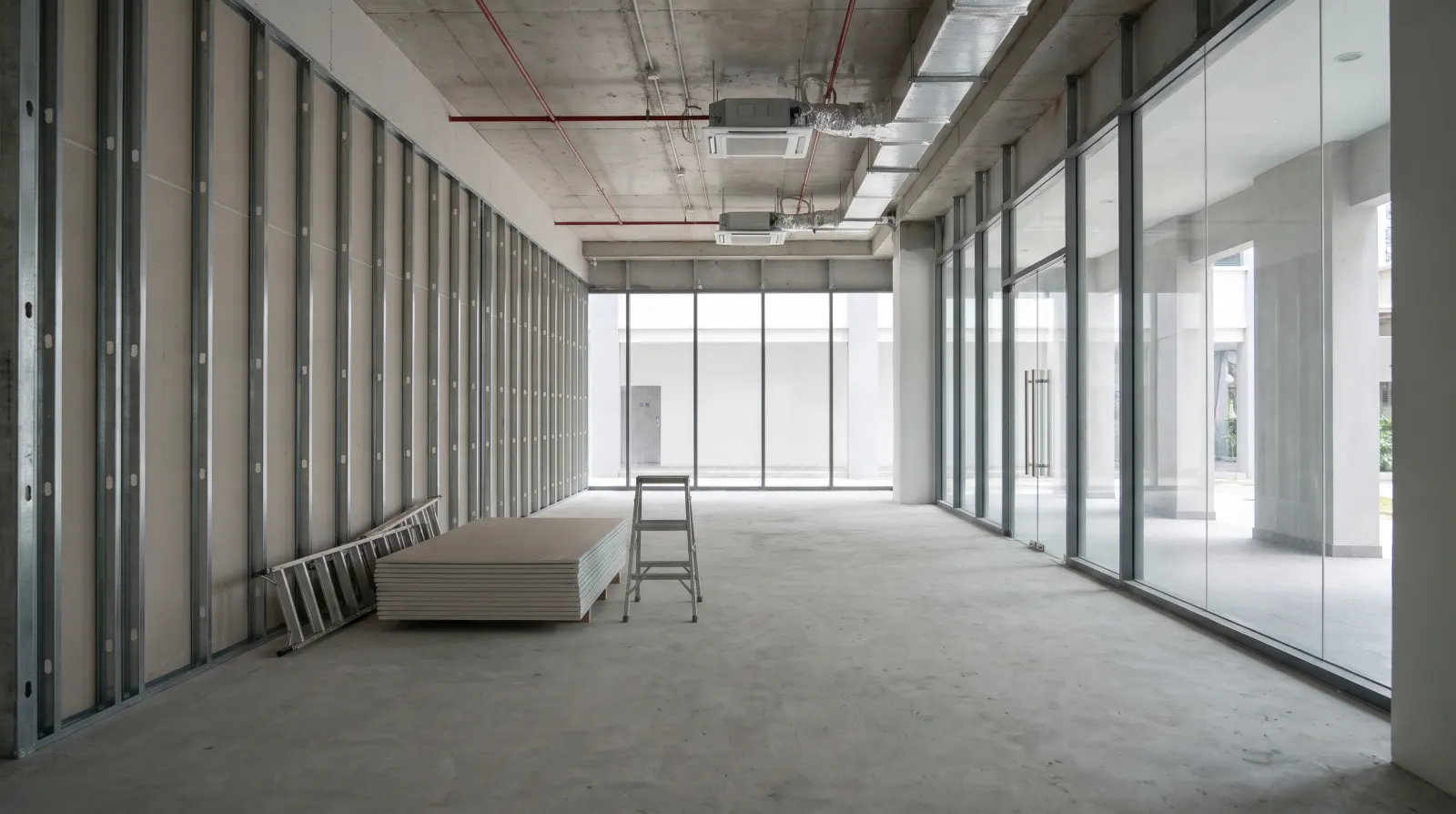
A commercial renovation in Singapore starts with your lease and your landlord's fitting-out guide, which set what you may change and what goes back when you leave. Moving sprinklers, exit signs or fire alarm panels needs plans approved by the Singapore Civil Defence Force (SCDF), unless the works are exempt or minor works that may go ahead after a lodgement.
A new use for the unit may need planning permission from the Urban Redevelopment Authority (URA). A cafe or restaurant applies to the Singapore Food Agency (SFA) for a food shop licence. Structural work needs a civil or structural Professional Engineer to apply for structural plan approval from the Building and Construction Authority (BCA). And in JTC premises (JTC is the government agency that leases industrial land and space), all fitting-out works need JTC's and the relevant authorities' approval before they start.
If you'd rather have one firm visit and measure, do the trade work with its specialists, arrange any Qualified Person or engineer the works need, and supervise the job through to handover, that's what our commercial renovation service is for. This guide takes the questions in the order you'll meet them: what to settle before you sign, who approves what, what each kind of job and each trade involves, the order of works and what holds it up, what drives the cost, how to compare two quotes and how to brief a contractor.
What to settle before you sign a lease or take a unit
Your lease decides what condition the unit comes in, what you may change and what goes back at the end. So read it, and the landlord's fitting-out guide, before you commit to the unit or the design.
Check the use first. URA says changing the use of a property may require planning permission, and URA tells you to find out whether you need permission before committing to a tenancy or starting renovation works. URA's online map, URA SPACE, shows the allowable and last approved uses of shophouses and selected commercial and industrial properties, which makes it a quick first check on a unit you're considering.
If you do need permission, URA advises you not to commit to a tenancy or renovation works before you receive its decision, because an application may be approved or disapproved. For a food business, SFA's food shop checklist says the same: make sure the relevant planning permission is obtained prior to signing any tenancy agreement and investing in renovation or equipment.
Ask the landlord for these before you sign
- The handover condition. What the unit comes with on the day you take it: a bare floor and ceiling, or the last tenant's partitions, ceiling, lighting and aircon. We recommend getting it in writing with photos, because it's the record to look back at when the lease ends.
- The fitting-out guide. Ask what it says about which works need the landlord's approval, the drawings it wants, working hours, protecting the common areas, and whether any trade has to use the building's own contractor.
- The reinstatement clause. What has to come out when the lease ends and the condition the unit goes back in. If it says "original condition" or "bare shell", ask the landlord to set out in writing what that means for your unit, because your lease, not a general rule, decides it.
- What the landlord provides. Whether anything is supplied or upgraded before you move in, and how long any rent-free or fitting-out period in the lease runs, so the works can be planned around it.
- The approved use. What the unit is approved for. If your business is a different use, URA's change of use rules come in, as the next section explains.
Watch out
We recommend you don't sign the tenancy or pay for renovation or equipment for a use the unit isn't approved for until you have URA's decision. URA says a change of use application may be approved or disapproved, which is why both URA and SFA advise against committing first.
Who approves what, and who applies
Start with your landlord or building management, because your lease and the landlord's fitting-out guide say which works need their approval. A government approval comes in when the work or the use calls for one, and each has its own applicant.
The table at the end of this section sums up each approval and who applies for it. The step by step for each approval is in our article on the approvals a commercial renovation needs, including whether a mezzanine or storage platform needs approval and what happens if you renovate without approval.
Who files the URA and SFA applications
For a change of use, URA says a change of use application can be submitted by the business owner, landlord, consultant or a Qualified Person (QP) through GoBusiness, the government's business licensing portal. URA asks for a floor plan of the proposed layout, a location plan showing where your unit sits if it's in a development such as a shopping centre or flatted factory, and the owner's letter of consent. If the premises are leased from the Singapore Land Authority, the Housing & Development Board or JTC, URA asks for their letter of consent as land owner.
For a food shop, SFA's page has you log into the GoBusiness portal with SingPass or CorpPass, the government's personal and business logins, to apply, with a layout plan drawn to a metric scale. SFA's checklist asks for a letter of authorisation if a filer is appointed to submit the application on your behalf. SFA lets you upload some documents after you apply, while the renovation is underway, such as a copy of URA's change of use approval and the tenancy agreement with its stamp duty certificate from the Inland Revenue Authority of Singapore (IRAS), but it closes the application if they aren't in within 2 months of applying.
When we take on the work, we give you, or whoever files, the scope and details of the works the forms ask about.
Fire safety and structure go through a Qualified Person
SCDF says plans for fire safety works must be prepared and submitted by a Qualified Person (QP), a registered architect or professional engineer, on your behalf as the building's owner or occupier. Works covered by the Fire Safety (Exemption) Order need no plan submission, and minor works on SCDF's list may go ahead after a lodgement that a Qualified Person makes before the works start, with the building owner's or management corporation's consent. If you can't tell which applies, SCDF advises approaching it for a free consultation.
For structural work, BCA says only a Qualified Person who is a registered Professional Engineer in the civil or structural discipline can apply for structural plan approval, and a permit is needed before the structural works start. Where your works need a Qualified Person or an engineer, we arrange one; the plan submission to SCDF or BCA is theirs.
In JTC premises
JTC says all fitting-out and renovation works, temporary or permanent, need to be approved by JTC and the relevant authorities before works can start. You must engage a consultant, who can be a professional engineer, registered architect or Qualified Person, and submit an application for JTC's consent as landowner. With that consent, your consultant submits your plans to the relevant authorities, which JTC says include URA, SCDF's Fire Safety and Shelter Department (FSSD) and the National Environment Agency (NEA), and your consultant should advise you which approvals you need.
Once those approvals are in, JTC says to check with its facility management team whether you are required to engage the building's appointed contractor for the works. JTC then says your contractor must raise a request for works to commence with that team, and JTC's fitting-out page, last updated 16 November 2026, says the assessment of a permit to work typically takes less than 20 days from submission to the final decision.
Who approves which works and who applies, from the SCDF, URA, BCA, JTC and SFA pages linked in this section
Scroll across to compare all columns →
| Approval | When it applies | Who applies |
|---|---|---|
| Your landlord or building management | Whatever your lease and the fitting-out guide say needs their approval | You, as the tenant or owner, through the building's own process |
| SCDF plan approval | Fire safety works, such as moving sprinklers, fire alarm panels, exit signs or fire doors, layout changes that affect escape routes, and aircon or ventilation works for non-residential use, unless the works are exempt or lodged as minor works | A Qualified Person, on your behalf as the building's owner or occupier |
| SCDF minor works lodgement | Minor alterations or additions on the list in the fire safety regulations, which may then go ahead without plan approval | A Qualified Person, before the works start; you need the building owner's or management corporation's consent |
| URA change of use | A new use for the unit, which may need planning permission | The business owner, landlord, a consultant or a Qualified Person, through GoBusiness |
| BCA structural plan and permit | Structural work; BCA needs a permit for all building works except insignificant building works | A Qualified Person who is a civil or structural Professional Engineer applies for structural plan approval; BCA says the permit is applied for jointly by the developer, the Qualified Person and the builder who will carry out the works |
| JTC consent | All fitting-out and renovation works in JTC premises, temporary or permanent | You, through a consultant you must engage: a professional engineer, registered architect or Qualified Person |
| SFA food shop licence | Opening a cafe, restaurant or other food shop | You, through GoBusiness, or a filer you appoint with a letter of authorisation |
What each kind of job involves
An office, a shop or eatery and a factory unit each bring different rules into play, and a reinstatement takes a fit-out back out again.
An office fit-out or renovation
An office fit-out is the partitions, ceiling, wiring, lighting, aircon, flooring and finishes that turn a unit into your workplace. On planning, URA's list of works that don't need its permission says internal partitioning, re-partitioning or re-arrangement of approved uses within tenanted areas of a non-residential unit can be exempted, as long as it doesn't change the primary use, its quantum or the floor area, or affect the common areas.
URA's list doesn't apply to national monuments or conservation buildings, or to buildings in conservation areas, central areas and other areas where URA has its own planning guidelines, so ask the Qualified Person whether your building is one of them.
Planning is also only one rulebook. A new partition can change an escape route, and moving a sprinkler, exit sign or fire alarm panel to suit the new layout is fire safety work in SCDF's terms, which needs SCDF's plan approval unless the work is exempt or lodged as minor works. That's why the layout should reach the Qualified Person before anything is built.
Office reinstatement and "original condition"
Reinstatement puts the unit back the way your lease says it goes back: taking out what the lease lists, such as partitions, ceilings, wiring or flooring you added, and making good what stays. "Original condition" and "bare shell" mean what your lease and the handover records say, so get the landlord's list in writing before anyone prices the work.
Ask early whether the landlord will accept anything left in place, such as a floor that's still in good condition, and get the answer in writing too. A reinstatement quote should price that list and nothing else, so two quotes compare only when they price the same list.
If you hold a lease from JTC, JTC says you are required to reinstate your premises before returning them on the lease expiry date. JTC emails a reminder a year before the lease expires, arranges a joint site inspection about 6 months before, and then tells you the reinstatement requirements, taking into account the obligations in your lease. If the reinstatement isn't finished before the expiry date, or you stay on past it, you're liable to pay JTC double rent from the expiry date. JTC adds that you may need an Environmental Site Assessment before returning the premises if your business activities involve pollutive materials.
Other leases and tenancy agreements set their own terms, so read yours for the deadline and for what happens if the work runs past it.
A shop, cafe or restaurant fit-out, including the shopfront
In a shopping centre and some other commercial blocks, but not party-walled shophouses or shopflats, URA says no planning permission is required to convert between showroom, restaurant and shop in approved commercial premises, if the unit was approved for commercial use and counted as commercial floor area, the development has no special planning conditions on its use, the change is for one unit rather than the whole building, and you've met the agencies' licensing requirements before the new use starts. SCDF, separately, counts a change of use as fire safety work where the new use affects fire safety requirements, giving a shop converted to an eating establishment as its example, so it needs SCDF's plan approval unless the works are exempt or lodged as minor works.
A food kitchen is built to SFA's food shop checklist. Among its design requirements are a kitchen of at least 10 square metres excluding the servery (16 square metres if you also cater), a floor trap in the food preparation area with the floor graded to it, coved edges where the walls meet the floor, and preparation and servery walls lined with glazed tiles or another impervious material to at least 1.5 m. The checklist also keeps manholes, grease traps and overhead waste pipes out of the areas where food is prepared, cooked, stored or served.
Your licence application includes a layout plan showing the kitchen equipment, exhausts, sinks and wash basins, and SFA says that once SFA has approved your application, you may proceed with the renovation, setting up to the submitted layout. We recommend settling the equipment list before the layout is drawn, because the plan SFA approves is the one you build to.
For the shopfront, ask what the landlord's fitting-out guide allows for the frontage, the sign and any shutter before you design them. On planning, URA's exemption list includes signs and advertisements, except on the facade of national monuments or buildings in a conservation area, and a roller shutter or grille door fitted to an approved or existing door, within the same areas the list covers.
Works in a factory or industrial unit
In JTC premises, everything in the JTC part of the approvals section applies, temporary works included. Inside the unit, SCDF counts works involving combustible materials, or air-conditioning or ventilation systems, for non-residential use as fire safety works, which need its plan approval unless they're exempt or lodged as minor works, so tell the Qualified Person what the unit will hold and run as well as what you'll build.
JTC's rules while the works run are its own, for its buildings: noisy or disruptive works can only be carried out after working hours, no works should be carried out on weekends or public holidays without JTC's prior approval, your contractors work only within your unit, and the common areas are protected, with joint inspections of them with your contractor before and after the works. Any repairs or cleaning the works cause in the common areas are borne by you or your contractor.
When the works are finished, JTC says your consultant must apply for a Temporary Occupation Permit (TOP) and/or a Certificate of Statutory Completion (CSC) with the relevant authorities before you can move in, and you send JTC a complete set within one month of receiving them.
What each trade means in a commercial unit
The trade work itself is the same as anywhere. What changes in a commercial unit is who may do it, which agency counts it, and what the building lets your contractor do around it.
Electrical work and the Licensed Electrical Worker
The Electricity Act 2001 makes it an offence to do electrical work unless you're a Licensed Electrical Worker or supervised by one, and a business that provides electrical work must make sure it's carried out by Licensed Electrical Workers or people they supervise. The Act's electrical work includes installing or repairing an installation, altering its structure, and replacing or adding any part of it. Its exceptions, subject to any other written law, include replacing a lamp connected in your own installation.
The licence class depends on the size of the installation. Under the Electrical Workers Regulations, and subject to the conditions on each licence, an electrician may work on installations of up to 1,000 volts and 45 kVA (kilovolt-amperes) of approved load, and may install, repair, maintain and operate larger ones up to 500 kVA only under an electrical technician's supervision. A technician's licence covers installations of up to 1,000 volts and 500 kVA (designing them only up to 150 kVA), and an electrical engineer's covers any installation. Our electrical works service covers the work itself.
Aircon and ventilation
URA's list of works that don't need its planning permission includes any air-conditioning works, within the areas the list covers. That's planning only: SCDF counts works involving air-conditioning or ventilation systems for non-residential use as fire safety works, which need its plan approval unless they're exempt or lodged as minor works.
In a kitchen, SFA's checklist adds enough make-up air with negative pressure while the hood runs, and air ducts of non-combustible material that are smooth and easy to clean, with inspection openings. Our aircon service covers installation, and our aircon buying guide explains the system choices.
Fire safety works
Sprinklers, fire alarm panels, hose reels, exit signs and fire doors are fire protection systems in SCDF's terms, and installing, adding, altering, removing or relocating any of them is fire safety work. So is a layout change that affects escape routes, or works affecting fire compartments, including replacing a fire door.
A Qualified Person prepares and submits the plans, unless the works are exempt under the Fire Safety (Exemption) Order or are minor works that may go ahead after a lodgement.
Partitions, ceilings and hacking
Partitions of lightweight material in a non-residential building, and replacing a false ceiling with lightweight material, are on URA's list of works that don't need planning permission, within the areas it covers. For a minor works lodgement, SCDF asks for details of partitions, including the type of construction and materials used, so give the Qualified Person your partition specification early. Our ceiling and lighting guide covers false ceilings and lighting together.
Hacking a wall that may be structural is a different matter. Only a civil or structural Professional Engineer can apply for BCA's structural plan approval, and a permit is needed before the structural works start. For walls that aren't structural and for finishes, including in a reinstatement, see our hacking and demolition service.
Flooring
Replacing existing floor and wall finishes is on URA's exemption list too, within the areas it covers. In a kitchen, the floor is part of SFA's checklist: graded to a floor trap in the food preparation area and coved where it meets the wall. At the end of a lease, the reinstatement list says whether your flooring stays or goes. Our flooring guide compares floor types, and our flooring service covers the work itself.
Painting
Inside, ask whether the fitting-out guide sets the colours or finishes before you choose. Painting the exterior of a building is on URA's exemption list, within the areas it covers, but in a building you share, ask your landlord before anyone paints outside your unit. At the end of the lease, ask what colour and finish the walls go back in, so the repaint matches what the lease expects. See our painting service.
The order of works, and what holds a job up
Plan the order before you ask for quotes, because each approval has to be in before the work it covers starts, and each trade has to finish before the next one covers it up. This is the sequence we recommend:
From lease to opening day
- 1. The unit and its use. The approved use checked, and any change of use decided by URA, before you commit to the tenancy.
- 2. Layout and drawings. The layout drawn, then checked by the Qualified Person for fire safety works and by an engineer for anything that may be structural.
- 3. Approvals. Your landlord's approval where your lease or fitting-out guide asks for it, and SCDF's, BCA's, JTC's or SFA's where your works need them, each in before the work it covers.
- 4. Strip-out and hacking. Old partitions, ceilings and finishes out, with any structural work only under its approved plan and permit.
- 5. Hidden services. Wiring by the Licensed Electrical Worker, aircon and ventilation, plumbing and floor traps, and any sprinkler or alarm changes under the Qualified Person's approved plans or lodgement, unless they're exempt.
- 6. Partitions and ceilings. Built once the services behind and above them are in.
- 7. Floors, walls and joinery. Kitchen floors and wall linings to SFA's checklist, then flooring, carpentry and painting.
- 8. Fittings and handover. Lights, fittings and equipment in, then a walk through of every light, switch, power point, tap, door and aircon unit before handover.
- 9. Before you open. In JTC premises, the TOP or CSC your consultant applies for; for a food shop, SFA's pre-licensing inspection, which may be a virtual inspection or a submission of photos.
What holds a job up
Approvals run on their own clocks, and the table at the end of this section gives the times the agencies publish. Your landlord sets its own review time, so ask for it when you get the fitting-out guide. An incomplete submission slows things too: URA may need more time to assess it, and SFA rejects an incomplete food shop application, so you'd have to submit a new one.
Made-to-order items hold a job up too. A kitchen hood and its ducting, a shopfront or built-in counters can only be ordered once the layout is settled, so ask each supplier for their lead time when you collect quotes. We set the schedule with you once the scope and the approvals are known, because both decide it.
Processing times as each agency's page states them, checked on 24 November 2026
Scroll across to compare all columns →
| Approval | What the agency's page says | As stated on |
|---|---|---|
| URA change of use | It generally takes 10 working days to assess an application; more time may be required if the submission is incomplete or URA needs to consult other agencies | URA change of use page, last updated 6 November 2026 |
| SFA food shop licence | Completed applications are reviewed within 7 working days; an application needing rectification or clarification may take longer | SFA licence application page, last updated 23 November 2026 |
| SFA virtual pre-licensing inspection | A time slot has to be booked at least 5 working days in advance | SFA licence application page, last updated 23 November 2026 |
| BCA structural plan and permit | Plans without an accredited checker's certificate are processed within 7 working days of complete documents, and the permit within 7 working days; an application needing more extensive evaluation may take longer; a project submitted through CORENET X is processed within 20 working days as a joint review with other agencies | BCA structural plan page, last updated 20 August 2026 |
| JTC permit to work | The assessment typically takes less than 20 days from submission to the final decision | JTC fitting-out page, last updated 16 November 2026 |
What drives the cost of a commercial renovation
Your bill comes down to what the unit comes with, what has to change, and what the building and the agencies ask for along the way.
What moves the price
- The handover condition. A bare unit needs everything; one with usable ceilings, lighting or aircon from the last tenant needs less, if your lease lets you keep them.
- Partitions and ceilings. How many rooms you build, and whether the ceiling has to come down for the services above it.
- Fire safety changes. Moving sprinklers, alarm panels or exit signs for your layout brings in a Qualified Person's plans or lodgement, and SCDF's plan or lodgement fee in the table below, unless the works are exempt.
- Power and data. New circuits, power points and lighting, and whether the installation needs a higher class of Licensed Electrical Worker.
- Aircon and ventilation. New units or ducting, and for a kitchen, fumes extracted and treated with an air cleaning system before they're exhausted outdoors.
- Wet areas and kitchens. Floor traps, graded and coved floors, impervious wall linings, sinks and wash hand basins.
- Structural work. A civil or structural Professional Engineer's plans and BCA's permit for anything that cuts into the structure.
- The building's rules. Working hours, common area protection and any trade the building requires its own contractor for. In JTC buildings, noisy or disruptive works can only be carried out after working hours.
- The end of the lease. What the reinstatement clause will have you take out later. Anything you build now that has to come out later is paid for twice: once to put in and once to remove.
The agencies' own fees
The agencies publish their fees, so you can check them on a quote. These are the agencies' own charges, separate from a Qualified Person's or contractor's fees, and the table lists each as its page states it.
URA also notes that the Singapore Land Authority (SLA) may collect a Land Betterment Charge for a change of use, so ask about it before you commit to the unit.
Agency fees as each agency's page states them, checked on 24 November 2026
Scroll across to compare all columns →
| Fee | Amount | As stated on |
|---|---|---|
| SCDF plan fee: change of use, or additions and alterations to existing fire safety works, with no increase in floor area | $90 per storey | SCDF plan approval page, last updated 8 October 2026 |
| SCDF plan fee: new fire protection or mechanical ventilation works, or additions and alterations to them, such as sprinklers, automatic detection or smoke control | $90 per storey | SCDF plan approval page, last updated 8 October 2026 |
| SCDF minor works lodgement | $90 for each submission | SCDF minor works page, last updated 16 March 2025 |
| URA change of use processing fee, not refundable | $500 | URA change of use page, last updated 6 November 2026 |
| SFA food shop licence, valid for 1 year | $195 | SFA licence application page, last updated 23 November 2026 |
How to compare two fit-out quotes
Two quotes compare only if they price the same work. Give every contractor the same layout, the same list of works and your landlord's fitting-out guide, then read each quote against this table.
What to check on each fit-out or reinstatement quote
| Check | What to look for |
|---|---|
| Same scope | Both priced from the same layout and list of works, room by room |
| Every trade priced | Partitions, ceilings, electrical, aircon, fire safety changes, flooring, painting and hacking as separate lines |
| Qualified Person and engineer | Whether their fees are included, and which works the quote treats as exempt, lodged as minor works or needing full plan approval |
| Agency fees | Whether SCDF's, URA's or SFA's fees are in the quote or left to you |
| Common areas | Protection of the lift, corridor and floors the way the building asks, and who pays for repairs or cleaning afterwards (in JTC buildings, you or your contractor) |
| Debris and making good | Taking the debris out of the building, and making good walls, floors and ceilings after the work |
| Working hours | Whether the price allows for the building's hours, such as JTC's rule that noisy or disruptive works run after working hours |
| Exclusions | Furniture, signage, IT equipment, kitchen equipment and anything you'll buy yourself, listed as left out |
| Reinstatement | For a reinstatement, every item on the landlord's list priced line by line, with nothing on it missing |
Practical tip
If one quote is much lower than the other, run down this table before you compare totals. The gap may be a line one of them leaves out.
How to choose and brief a contractor
Before you compare prices, compare who will do the licensed parts of the job and how each contractor plans to work within your building's rules.
Questions to ask every contractor
- Which works need SCDF's plan approval, a lodgement, or neither? And who the Qualified Person will be. You want that answer before you sign, not after the landlord's review.
- Who does the electrical work, and in which licence class? A Licensed Electrical Worker, or someone working under one's supervision, whose licence class covers your installation. The trades part above sets out the classes.
- Do I have to use the building's own contractor for any trade? In JTC buildings, JTC says to check with its facility management team. In any other building, ask your landlord.
- How will the common areas be protected? The answer should match what the building asks for.
- What happens if the ceiling or walls hide a surprise? Who stops the work and calls in the engineer, and how a change is priced and agreed before it's done.
- What will you give me for the landlord's and the agencies' forms? The scope and the details of the works those forms ask about.
What to give them
Give every contractor the same pack: the lease's works and reinstatement clauses, the landlord's fitting-out guide, the floor plan, a list of what you want built, and a list of the equipment and furniture you'll buy yourself. For a food shop, add the kitchen equipment list, because the layout SFA approves shows it. Our article on who's responsible for fittings you supply explains why that last list matters.
Ceilings and walls can hide things that only show once they're opened, so keep a contingency. Our article on contingency for unknown conditions in additions and alterations works explains how to set one.
Start with a site assessment
We start with a free site assessment at your unit, where we measure up and go through what you want done and what your lease and fitting-out guide ask for. You get a fixed-price quote within 3 to 5 working days of that visit, never from a photo.
Our specialists do the trade work, we arrange the Qualified Person or engineer where the works need one, and we supervise the work and hand it over. Any approval your landlord asks for, and any change of use or licence application, aren't ours to file. We give you the scope and details of the works the forms ask about. The work comes with our warranty and after-care. Tell us about your unit through our commercial renovation service.
Regulatory compliance
Check which requirements apply to your proposed scope. Agree the responsible qualified professionals, submissions and inspections before work begins.
SCDF (Singapore Civil Defence Force)
Under the Fire Safety Act 1993, anyone intending to carry out fire safety works, such as moving sprinklers, fire alarm panels, exit signs or fire doors, changing a layout that affects escape routes, or aircon or ventilation works for non-residential use, must first get SCDF's approval of plans, prepared and submitted by a Qualified Person. Works under the Fire Safety (Exemption) Order need no plan submission, and listed minor works may go ahead after a Qualified Person's lodgement, with the building owner's or management corporation's consent.
Primary source: www.scdf.gov.sg/fire-safety-services-listing/plans-submission-process/plan-approvalURA (Urban Redevelopment Authority)
Changing the use of a property may require planning permission; URA advises not committing to a tenancy or renovation works before its decision, generally takes 10 working days to assess an application, though more time may be required if the submission is incomplete or other agencies are consulted, and, on its page last updated 6 November 2026, charges a $500 processing fee. Internal partitioning in a non-residential unit, lightweight partitions, false ceilings, air-conditioning works and new finishes are on its list of works that don't need planning permission, which doesn't apply to national monuments or conservation buildings, or in conservation areas, central areas and some other planning areas.
Primary source: www.ura.gov.sg/guidelines/property-and-business-owners/business-owners/change-use-of-property-for-businessBCA (Building and Construction Authority)
A permit is required for all building works except insignificant building works. Only a Qualified Person who is a civil or structural Professional Engineer can apply for structural plan approval, and a permit is needed before structural works start.
Primary source: www1.bca.gov.sg/safety-and-standards/applications-and-licenses/structural-plan-submissionJTC (JTC Corporation)
In JTC premises, all fitting-out and renovation works, temporary or permanent, need JTC's and the relevant authorities' approval before they start, and you must engage a consultant for the application for JTC's consent. If you hold a lease from JTC, you're required to reinstate the premises before the lease expiry date, after a joint site inspection about 6 months before, and you're liable for double rent from the expiry date if the reinstatement isn't finished.
Primary source: www.jtc.gov.sg/get-help/development-and-renovation-works/fitting-out-and-renovation-worksSFA (Singapore Food Agency)
A food shop licence application through GoBusiness includes a scaled layout plan showing the kitchen equipment, exhausts, sinks and wash basins. Once SFA has approved the application, you may proceed with the renovation to that layout, and a pre-licensing inspection follows before you start operating. SFA's checklist advises getting the relevant planning permission before signing a tenancy agreement.
Primary source: www.sfa.gov.sg/food-retail/licence-permit/application-process-fees-for-licence-permit-for-food-retailEMA (Energy Market Authority)
The Electricity Act 2001 makes it an offence to do electrical work unless you're a Licensed Electrical Worker or supervised by one, with exceptions such as replacing a lamp in your own installation, subject to any other written law. The Electrical Workers Regulations set the voltage and approved load each licence class may work on.
Primary source: sso.agc.gov.sg/Act/EA2001?ViewType=PdfGlossary
- Fitting-out
- The works that turn a unit into your premises: partitions, ceilings, wiring, aircon, finishes and fittings. JTC's approval rule covers all fitting-out and renovation works, temporary or permanent.
- Reinstatement
- Taking out what your lease says has to go and putting the unit back in the condition it sets before you hand it back.
- Original condition
- The condition your lease says the unit goes back in. It means what your lease and the handover records say, so ask the landlord to set it out in writing.
- Change of use
- Using a property for something other than its approved use, such as a shop becoming a commercial school (URA's example). It may need URA's planning permission, and where the new use affects fire safety requirements, SCDF counts it as fire safety work.
- Qualified Person (QP)
- A registered architect or professional engineer who prepares and submits plans to SCDF or BCA. For structural plans, only a civil or structural Professional Engineer can apply.
- Fire safety works
- In SCDF's terms, work on fire protection systems such as sprinklers, fire alarm panels, exit signs and fire doors, layout changes affecting escape routes, aircon or ventilation works for non-residential use, and some changes of use.
- Minor works lodgement
- SCDF's route for the minor alterations or additions listed in the fire safety regulations: a Qualified Person lodges them before the works start, and the works may then go ahead without plan approval. SCDF calls it a minor additions and alterations (MAA) lodgement.
- Permit to work
- In JTC buildings, the approval from the facility management team before works start, after your contractor raises a request for works to commence.
- Licensed Electrical Worker (LEW)
- An electrician, electrical technician or electrical engineer licensed by the Energy Market Authority (EMA) to carry out or supervise electrical work, with the class set by the size of the installation.
- TOP and CSC
- The Temporary Occupation Permit and the Certificate of Statutory Completion. In JTC premises, your consultant applies for one or both of them with the relevant authorities after the fitting-out, before you can move in.
Frequently asked questions
Do I need URA's permission to put up partitions in my office?
Not if the work fits URA's exemption. URA's list of works that don't need planning permission says internal partitioning, re-partitioning or re-arrangement of approved uses within tenanted areas of a non-residential unit can be exempted if it doesn't change the primary use, its quantum or the floor area, or affect the common areas, and it also lists lightweight partitions in non-residential buildings. The list doesn't apply to national monuments or conservation buildings, or in conservation areas, central areas and some other planning areas, and it covers planning only: a partition that changes an escape route can still be fire safety work for SCDF. Check your landlord's fitting-out guide too, because it says which works need the landlord's approval.
Can I use my own contractor in a JTC building or a shopping mall?
In JTC premises, once JTC and the relevant authorities have approved the works, JTC says to check with its facility management team whether you are required to engage the building's appointed contractor. In a mall or any other building, ask your landlord what its fitting-out guide says about contractors before you sign with one.
What happens if I don't finish the reinstatement before my lease ends?
If you hold a lease from JTC, JTC says you are liable to pay double rent from the lease expiry date if the reinstatement works aren't completed before it, or if you stay on past it. Other leases and tenancy agreements set their own terms, so check yours for the deadline before you book the works.
Can I leave some of my fit-out behind for the next tenant?
Only if your landlord agrees, so ask in writing before you price the reinstatement. Your lease's reinstatement clause sets what comes out. If you hold a lease from JTC, JTC tells you the reinstatement requirements after a joint site inspection about 6 months before the lease expires, taking into account the obligations in your lease.
What do I need before I can move into a JTC unit after the fit-out?
JTC says that once the fitting-out is complete, your consultant must apply for a Temporary Occupation Permit (TOP) and/or a Certificate of Statutory Completion (CSC) with the relevant authorities before you can move in. You then submit a complete set to JTC within one month of receiving it.
How much does URA charge for a change of use, and how long does it take?
URA's change of use page, last updated on 6 November 2026, puts the processing fee at $500, which isn't refundable. URA generally takes 10 working days to assess an application, and more time may be required if the submission is incomplete or URA needs to consult other agencies.
Who can submit my SFA food shop licence application?
You can, by logging into the GoBusiness portal with SingPass or CorpPass, or a filer can submit it on your behalf with your letter of authorisation, which SFA's checklist lists. The application needs a layout plan drawn to a metric scale, showing the kitchen equipment, exhausts, sinks and wash basins and the boundaries of the refreshment area. SFA's licence page, last updated on 23 November 2026, says completed applications are reviewed within 7 working days, and one that needs rectification or clarification may take longer.
If you read nothing else
Talk through the options for your unit
Tell us what you want to change, how your business uses the space and when you hope to start. Share photos or plans on WhatsApp if you have them.
Browse all commercial renovation articles →
Go deeper: commercial renovation articles
In-depth pieces that expand on the sections above: real costs, brand and system comparisons, the installation process, and the edge cases most homeowners hit.
Still deciding? Compare options & estimate cost
Side-by-side comparisons and an instant cost estimate for your Singapore home.
Related guides
Buying Guide
Is ducted aircon right for your landed home?
Ducted aircon hides the unit in the ceiling but needs depth, a return air path and access doors. Here is when a cassette or wall-mounted unit suits better.
Buying Guide
How to choose the best vinyl flooring for your home
Know which vinyl to lay in each room, where tile or real parquet does the job better, and which old floors can stay underneath.
Buying Guide
Which type of false ceiling is best for your home?
Before a false ceiling goes up, settle whether a ceiling fan can hang from it, which LED lights work with your dimmer, and where the access panels for the aircon and drivers will go.