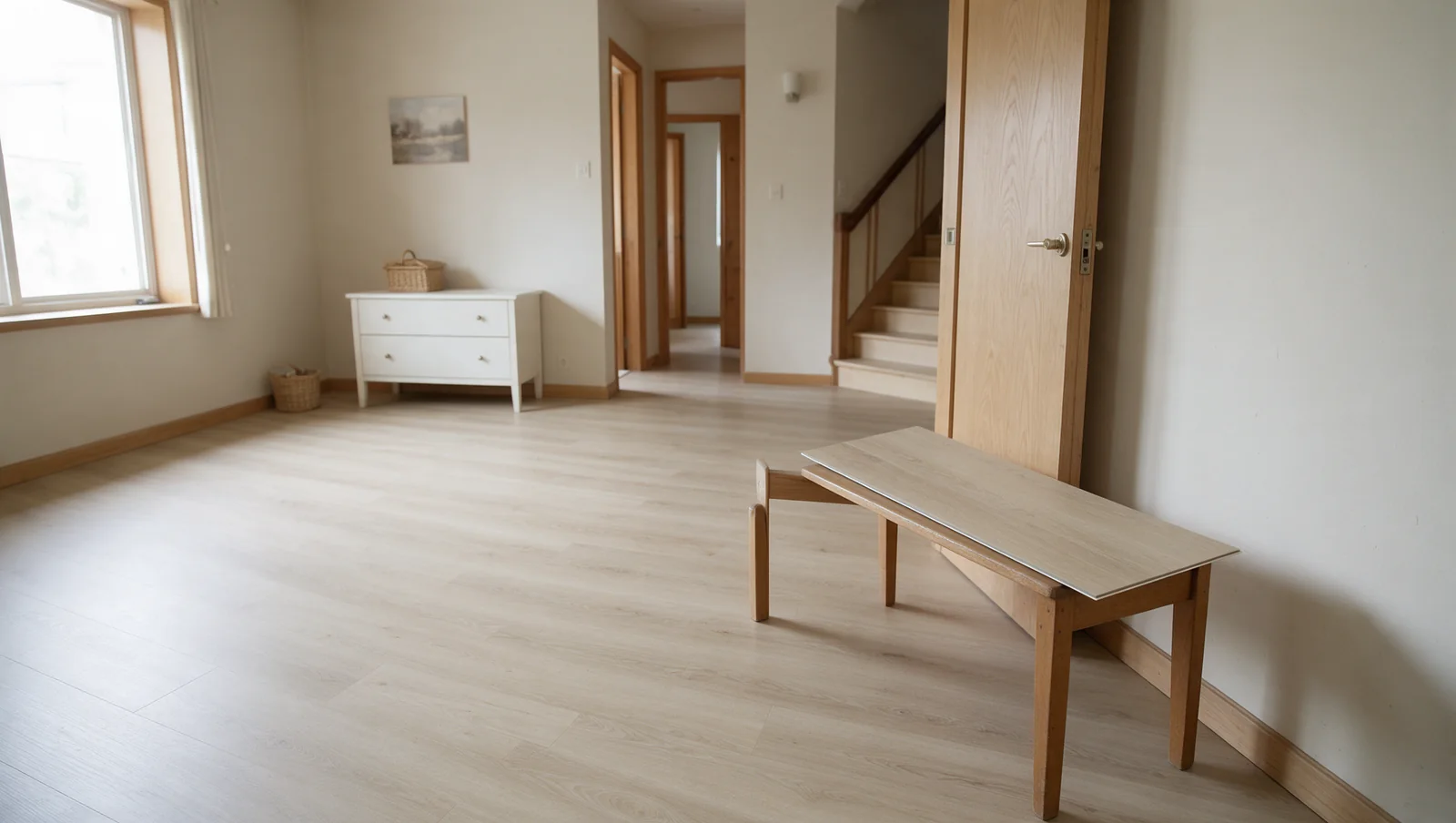
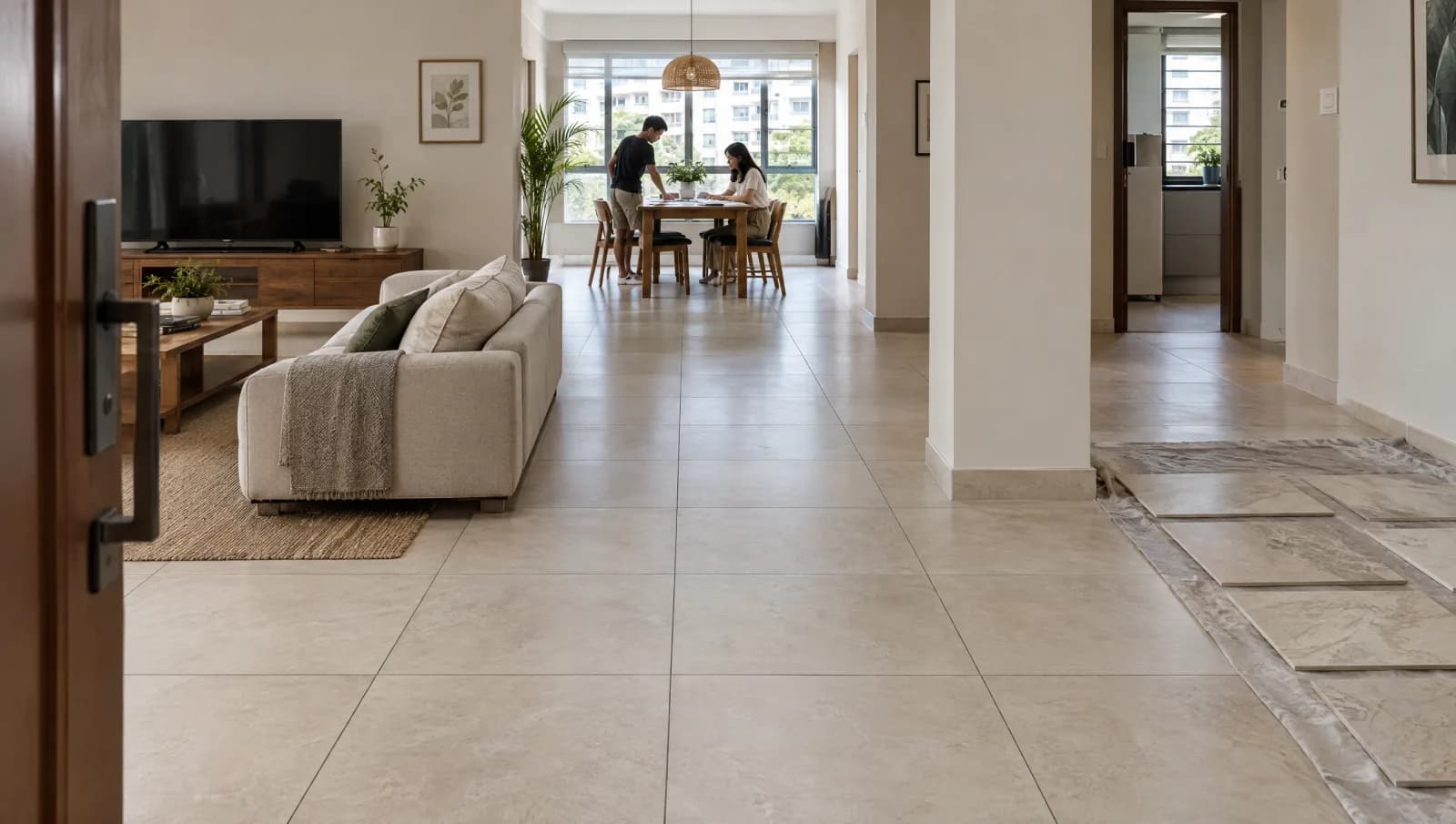
For bedrooms and living areas, rigid click vinyl (SPC is one kind) can float over firm ceramic tiles. Fit kitchen units first and stop the click floor short of them, or use glue-down vinyl where they must sit on top. In a bathroom with a floor trap, we’d lay tile instead.
The base matters as much as the plank. Quick-Step’s and Karndean’s installation guides both want it firm, flat and dry, so have a flooring contractor check the old floor, its levels and any damp before you choose a colour.
Vinyl isn’t the answer for every room either. If you want a wood floor that can be sanded and refinished when it wears, it has to be real timber, such as parquet, not a vinyl plank printed to look like it.
Map use and exposure first
Go through the house room by room and note what each floor has to cope with, such as wet shoes at the entrance, cooking spills, dining chairs pulled out every day, a bathroom floor trap, afternoon sun through glass doors or rain on a porch. Note what will stand on each floor too, because whether kitchen cabinets, an island or a built-in wardrobe will sit on it decides between click and glue-down vinyl.
Where the vinyl has to stop, for example at a bathroom door, plan the change of floor at the doorway. Agree the trim and any difference in level before laying starts, because both are hard to change once the planks are down. The table sums up what we’d do in each case.
| Where the floor goes | What we’d do |
|---|---|
| Bedrooms, living and dining areas | Rigid click vinyl over firm, level tiles, which saves hacking them out, with protected furniture feet against dents. |
| Kitchen with cabinets or an island | Fit the units first and stop a click floor short of them, or use glue-down vinyl if they must sit on it. |
| Bathroom, or a wet kitchen with a floor trap | Tile. A floor trap is a built-in drain, and one of the two installation guides rules vinyl out of those rooms. |
| Entrance or a kitchen floor that sees spills | Seal the edge gap where water could get in and wipe spills up promptly, as both guides ask. |
| Floor in strong sun through glass doors | Ask for the wider edge gap one installation guide sets for direct sun, or glue-down vinyl. Heat is a weak spot for vinyl. |
| Open porch or patio | Tile or another outdoor-rated floor. Both installation guides keep vinyl indoors. |
| Stairs and changes of level | Plan the trims and door clearance before laying. A click floor stops short of stairs and door frames with its expansion gap. |
Assess what is already there
Start with what is wrong with the floor you have now, such as cracked or hollow-sounding tiles, loose or lifting boards, stains and any past leaks. A worn surface doesn’t mean the floor has to go, and a neat one doesn’t prove the base under it is sound. Have hollow or cracked tiles assessed before deciding whether to cover, repair or remove them.
A real timber or parquet floor in sound condition can be renewed rather than replaced. A maker of timber-floor finishes lists a professional deep clean, a recoat that adds a new layer of finish once the floor has been deep cleaned, and a full refinish that repairs damage and can change the colour and finish, and says sanding and recoating may be needed every 5 to 8 years under heavy wear, or less often with good care. Vinyl can be cleaned, but it can’t be sanded and refinished like timber, so a worn vinyl plank is replaced.
Damp underneath is the other thing to settle first. One maker’s rigid vinyl instructions say a concrete floor laid directly on the ground must have an effective damp-proof membrane under the vinyl, and ask for the base’s moisture to be measured, recorded and kept. On the ground floor of a landed house, ask whether that membrane exists, and stop any active leak at its source before a new floor covers it.
Compare exact products and their compromises
Vinyl comes as rigid click planks, flexible planks and tiles, and sheet vinyl. For a landed home renovation, the choice that changes the job is rigid click or glue-down, and it turns on what is under the floor and what will stand on it.
Rigid click vinyl, including SPC
Rigid click vinyl has a stiff core, and its planks lock together and float without glue. SPC, short for stone plastic composite, is one kind. Polyflor, which makes vinyl flooring, describes SPC’s core as limestone and PVC, giving a thicker, denser plank of about 4 to 9 mm against 2 to 5 mm for flexible vinyl, with more defence against wear and dents and typically better scratch resistance. Rigid click vinyl isn’t normally glued down, because glue would stop it expanding and contracting.
Its strength is renovation. Both installation guides let it go over firm ceramic tiles once loose tiles are fixed and wide or deep grout lines are levelled, so the old floor doesn’t have to be hacked. A thicker plank still doesn’t excuse the base work, because both guides set flatness limits for the base.
The catch is that a floating floor has to stay free to move. Both guides leave an expansion gap of 5 to 8 mm at walls, pipes and fixed objects, and both have permanent fixtures such as kitchen units installed before the floor, so nothing heavy or fixed pins it down.
Glue-down vinyl
Glue-down vinyl is a thinner, flexible plank or tile stuck to the base with adhesive. Quick-Step’s flexible range can be glued down, and it says that suits large rooms, extra sound reduction and high-temperature spaces.
It is also that maker’s answer for kitchens. That maker’s rigid vinyl instructions say a kitchen, an island, built-in cabinets and heavy stoves act as a wall and should be installed first rather than placed on the floating floor, and that where the floor can’t stay floating, its glue-down vinyl should be used.
The trade-off is preparation. The same maker wants the base under its flexible floor perfectly level, with tile and grout joints smoothed out first.
Which type of vinyl to choose
Asking whether SPC or vinyl is better is really asking rigid or flexible, because SPC is vinyl with a limestone-filled core. We recommend rigid click vinyl for bedrooms, living and dining areas laid over firm, level tiles, where it saves hacking and the floor can move freely. Choose glue-down where kitchen units or an island would sit on the floor, in a large open space or where heat builds up, and allow for the levelling it needs.
The rigid plank is the reason we include living and dining rooms. A 2019 MoneySmart guide advised against vinyl in living rooms because it dents and scratches easily, but the thicker, denser SPC plank described above gives more defence against wear and dents than flexible vinyl. Vinyl is still a softer floor, so fit wide, protected furniture feet and soft castors or castor cups, as both installation guides ask.
The downsides of vinyl
Vinyl’s weak points come down to the base, water, weight, heat and wear, and they are also what shortens a vinyl floor’s life.
- Bumps show through. One maker warns that unevenness in the base can leave marks and gaps in its vinyl.
- Some wet rooms are out. Both installation guides rule out rooms that stay wet, and one also rules out rooms with built-in drains, which is what a floor trap is.
- A pinned floor opens up. A click floor trapped under kitchen units or an island can open at the joints, which is why both guides have fixed units fitted first.
- Rubber stains and burns. Both installation guides warn that rubber-backed mats can discolour vinyl, and one says very hot items can damage it permanently.
- It dents and scratches. One maker’s warranty describes vinyl as a softer flooring material and asks for soft castors and protected furniture feet. That 2019 MoneySmart guide warns that vinyl dents, stains and scratches easily, and advised against it in living rooms for that reason, which is why we recommend a rigid plank and protected furniture feet there.
- It can’t be sanded. Vinyl can be cleaned, but once the wear layer is worn through, the printed pattern underneath can’t be renewed the way timber can.
- Heat and VOCs. One maker’s rigid core guide says heat and prolonged direct sun may damage the floor, and asks for a wider 10 mm edge gap where sun comes through glass doors. VOCs, or volatile organic compounds, are gases some materials give off, and some may affect health. If that matters to your household, ask whether the product has passed an emissions test such as FloorScore, under which SCS Global Services tests finished floors, vinyl included, for 35 VOCs.
Vinyl or tile
Tile wins where water and wear are heavy. The 2019 MoneySmart guide also says vinyl’s durability can’t be compared to tiles, and calls tile and marble the best waterproof options for wet areas such as bathrooms and kitchens. Vinyl wins on comfort and speed. The same guide rates vinyl comfortable underfoot and tile hard underfoot, with grout that collects dirt and is hard to clean. A click floor can also go over firm old tiles without hacking them out.
In a landed home we’d use tile for bathrooms, a wet kitchen with a floor trap and outdoor areas, and consider rigid click vinyl for bedrooms, living and dining areas, with furniture feet protected. If the kitchen floor is washed down with water after heavy cooking, that points to tile too.
Parquet or vinyl
Parquet is real timber laid in a pattern of small blocks or strips, such as herringbone. Vinyl can copy the look, and one maker sells a herringbone rigid vinyl plank, so the pattern alone doesn’t tell you what a floor is made of.
Real parquet’s advantage is that it can be renewed with the deep clean, recoat or refinish described earlier. Its disadvantages here are local ones. The same 2019 guide notes that Singapore’s heat and humidity can make wood expand and shift, and that termites and unsealed spills cause problems. Vinyl won’t get termites or need its surface sealed, but it still moves with temperature, which is why click vinyl needs its expansion gap.
Quick-Step’s real wood floors go down one of two ways, floating on an underlay or glued, and it says floating is quicker and easier to lift, while planks from a glued floor lifted for a repair underneath will probably be unusable. Where a room sees big swings in temperature or moisture, it says glued may be the safer choice.
Choose parquet if you want real timber that can be refinished over the years and you’ll keep it sealed and maintained. Choose a parquet-look vinyl for a room with spills or heavy family use, accepting that worn planks are replaced.
Read wet-use and slip claims in context
“Waterproof” on a vinyl box describes the plank, not the room it can go in, and makers draw the line in different places. Quick-Step says its vinyl suits an occasionally wet bathroom but isn’t suitable for rooms with built-in drains like showers. Karndean’s rigid core guide allows ordinary home bathrooms, kitchens and laundries, but not outdoor use or rooms that stay wet. A bathroom with a floor trap has a built-in drain, so it fails the stricter rule, which is why we’d tile it.
For floors that see spills, such as a kitchen or a door to the garden, both guides seal the expansion gap where water could get in, and both say to wipe spills up promptly. Ask whether the quote includes that edge sealing.
For tile, ask which slip test was used and for what use. A tile maker’s guide to the US wet DCOF test cautions that its measurements shouldn’t be read as showing whether a slip can occur, and lists drainage, contaminants, footwear and maintenance as part of the judgement.
A wet sample in a showroom isn’t a controlled test, and don’t try a slippery walk yourself. Go by the documented rating and an assessment of the real room and the people who use it.
Treat overlay as a technical option
Laying vinyl over the old floor saves hacking, but only if what stays underneath is suitable. Both installation guides agree on the basics. Firm ceramic tiles can stay once loose ones are fixed and wide or deep grout lines are levelled, while carpet and other floating floors have to come out. Quick-Step’s list goes further. Glued laminate and parquet and fixed wood boards can stay, glued PVC, glued linoleum and glued oiled parquet need a PE foil between old and new, and cushion vinyl and floating laminate or parquet come out. Whatever stays must be stable and firmly fixed.
Hollow-sounding or cracked tiles may not be firmly fixed, so have them assessed before anything goes over them.
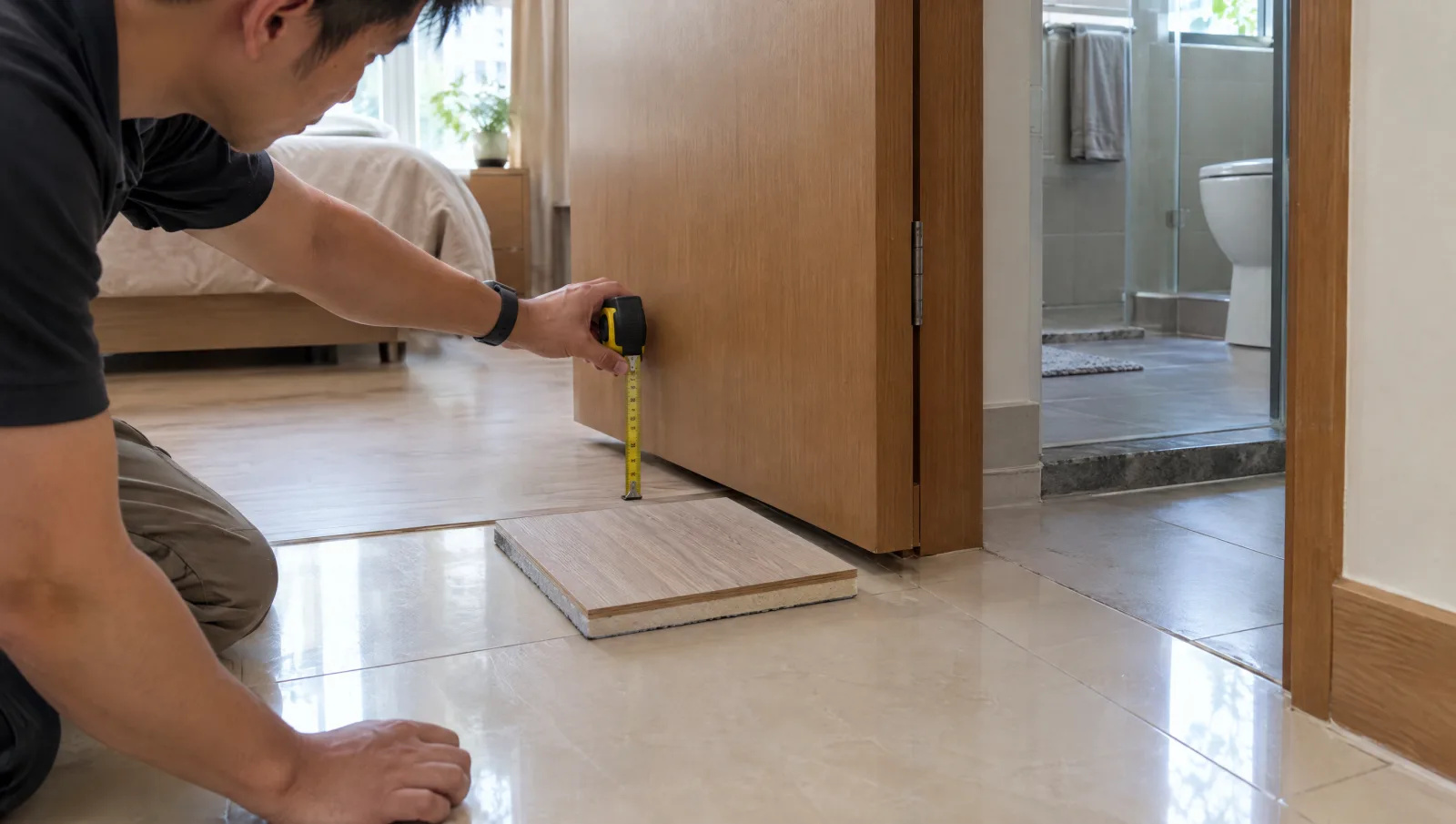
The new floor adds height. Check every door swing, threshold, sliding track, floor outlet and stair nosing against the new level, and agree the trim at each change of floor before laying starts. Both guides have door frames undercut, or a gap left, so the floor can still move. Our article on whether overlaying or hacking costs less overall works through the doors, stairs and damp that change the bill.
Heavy things matter for any floating floor, and a fridge is the one neither installation guide mentions. One maker’s instructions treat heavy objects like fixed ones, to be installed first and not placed on top of the floating floor, and a full-height fridge is a heavy object, so settle where it stands before laying. With floating click vinyl, either confirm the chosen product’s instructions allow it on the floor or plan glue-down vinyl for the kitchen.
When the fridge goes in, lift it rather than drag it, and give its feet wide, non-staining protectors. That maker’s published warranty also excludes water damage from leaking fridges, ice machines and dishwashers. The time to decide all this is when you fix the appliance list before the kitchen cabinets are made.
Approve a layout and representative appearance
Look at samples in the actual room, in daylight and under your own lights, and lay out several pieces to see the range of shade. Both guides have the planks checked in good light before laying, and under one maker’s warranty a visible defect in a plank that has been laid counts as accepted, with only hidden defects still covered. Record the product and finish codes so a substitute can be spotted.
Agree the laying direction or pattern, where cuts and narrow strips fall, and how the floor meets thresholds and retained floors. For tile, see how to plan joints and cuts for large floor tiles before laying starts.
Check the care advice against how your household cleans. Both installation guides allow damp mopping of rigid vinyl, but one rules out soap-based and abrasive cleaners and the other household and bleach-based ones.
Compare complete installation scope
Give every installer the same room list, product and layout so the quotes compare like for like. Ask for removal, levelling, underlay or glue, skirting, door and threshold trims, furniture moving and disposal as separate lines.
Levelling is where an overlay quote can grow. Ask how the old floor will be checked and how any extra levelling is priced and approved before it is done.
| Quote line | Question |
|---|---|
| Levelling | Which dips and tile joints are included, and how is extra levelling approved? |
| Trims and doors | Where does the new floor meet other floors, and who trims the doors? |
| Kitchen units | Do any units sit on the floor, and is the vinyl click or glue-down there? |
| Back in use | When can furniture go back under the product’s instructions? |
| Spare planks | How many spares from the same batch will be left with you? |
Keep the floor identifiable and maintainable
Before the installer leaves, open every door, check the trims and walk the floor for gaps or raised edges. Keep the care instructions and any moisture readings taken before laying.
Keep the end labels with the dated invoice. Under one maker’s published vinyl warranty, cover is for the first owner only and needs the original invoice, and an upheld claim is replaced from the range on sale at the time, so spare planks from your own batch are the surest match for a repair. Agree how many spares to keep with the installer.
Store the spares flat in a dry place and label them by room.
Glossary
- Subfloor
- The surface the new floor is laid on, such as existing tiles or a cement screed. How flat, firm and dry it is decides what can go on top.
- Floating floor
- A floor whose planks lock to each other but aren’t fixed to the subfloor, so it needs a gap at its edges to move.
- Glue-down vinyl
- Flexible vinyl planks or tiles stuck to a level subfloor with adhesive.
- SPC
- Stone plastic composite, a rigid vinyl core made with limestone and PVC, often with a click-lock system.
Frequently asked questions
How long does vinyl flooring last?
A 2019 MoneySmart guide puts vinyl at 10 to 15 years at least. That is one publication’s estimate, not a promise. Quick-Step’s published vinyl warranty (June 2024 version) runs for the first owner’s lifetime on its rigid range, and from 25 years to lifetime on its flexible ranges, but it covers material defects only, not scratches, dents, rubber stains or water from a leaking appliance. Check the warranty issued with your purchase in Singapore, which may differ from those published terms. What shortens a vinyl floor’s life is how it is laid and used, such as a bumpy base, a click floor pinned under heavy units, dragged furniture and rubber-backed mats.
Which vinyl brand is best in Singapore?
We don’t rank brands, because the right floor depends on your rooms. Compare what each maker publishes for the exact product you’re shown. Does it list the rooms it excludes, such as showers and rooms with a floor drain? Do its instructions let your kitchen layout float, or do they need glue-down? Who in Singapore handles a warranty claim, and does the cover pass to a new owner? One maker’s published warranty, for example, covers the first owner only and directs claims to the local distributor. And will the same product code still be sold when you need a repair plank?
Is vinyl flooring a good choice?
Yes for bedrooms, and for living and dining areas if it is a rigid click plank with protected furniture feet, over a firm, dry and level base. It is softer underfoot than tile, and click vinyl can go over the old tiles. It is a poor choice inside a shower or a bathroom with a floor trap, as a click floor under fixed kitchen units, or over a damp slab.
Does waterproof vinyl replace bathroom waterproofing?
No. A waterproof plank doesn’t make the room watertight underneath, and Quick-Step keeps its vinyl out of rooms with built-in drains anyway. Bathroom waterproofing is a separate layer under the finish, so have it assessed on its own. Our article on what a bathroom waterproofing scope should include explains the checks.
If you read nothing else
Talk through the options for your home
Tell us what you want to change, how your household uses the space and when you hope to start. Share photos or plans on WhatsApp if you have them.
Browse all flooring articles →
Go deeper: flooring articles
In-depth pieces that expand on the sections above: real costs, brand and system comparisons, the installation process, and the edge cases most homeowners hit.

Still deciding? Compare options & estimate cost
Side-by-side comparisons and an instant cost estimate for your Singapore home.
Related guides
Buying Guide
Choosing bathroom fixtures and fittings for a landed home
In Singapore a PUB Licensed Plumber must install or move a toilet, while a handyman may fit a shower enclosure or swap a tap.
Buying Guide
Wet kitchen or dry kitchen for your landed home?
Each sink, hob and appliance in a second kitchen needs its own pipes, power, gas or duct, and some of that work needs a licensed plumber, electrician or gas worker. Here is what each side needs, and which cabinets cope with the wet side.
Buying Guide
How to choose the best carpentry for wardrobes and cabinets
Before you sign, give two carpenters the same tricky detail, such as a drawer behind a sliding door, and see whose drawing actually solves it.
Buying Guide
Landed interior design from terrace house photos to handover
Start with the photos you’ve saved, then see which drawings the design fee should buy, how it differs from the building quote and what to check at handover.