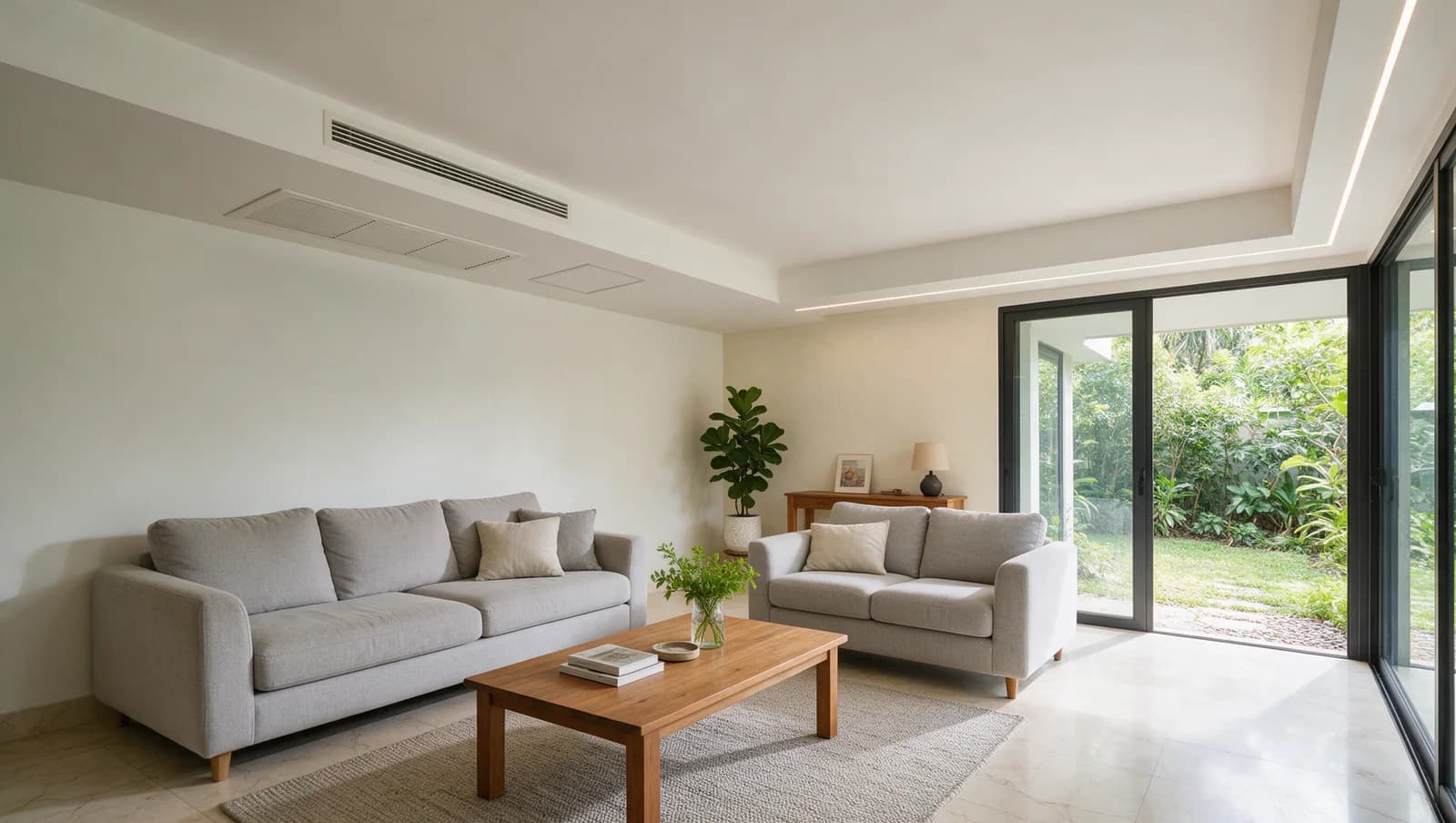
Ducted aircon hides the indoor unit above the ceiling, sends cooled air through ducts to grilles and draws room air back through a return grille. Ducted aircon installation makes sense when the ceiling has space for the unit, its ducts, that return path and an access door, without lowering the ceiling where headroom matters.
For a new or replacement landed-home aircon installation, weigh ducted against a ceiling cassette and a wall-mounted unit, room by room. A cassette also sits in the ceiling but takes air in and sends it out through its own panel, so it needs no ducts. A wall-mounted unit needs no ceiling work at all. Ask for the brochure and installation manual of the exact indoor and outdoor models quoted, because the ceiling depth and access each one needs are set out there.
Start with room conditions and simultaneous use
A living room open to the dining area is a different cooling space from a bedroom with its door closed. Record those connections, the hours each room is used and the people and equipment inside.
Ask the supplier to explain its room-load assessment and the conditions assumed. Daikin’s guidance says direct sunlight affects aircon selection, alongside the room and its use. A simple area rule can start a conversation but should not be the only basis for a large, open or unusually exposed space.
Write down which rooms are likely to run together. If bedrooms operate at night while living areas are off, the operating pattern differs from a household cooling several floors throughout the day. The outdoor-system choice must reflect the intended combinations, not just the sum printed on individual indoor-unit labels.
| Room information | Why it affects the proposal |
|---|---|
| Use and operating hours | Which zones need cooling together |
| Sun and glazing | Exposure considered in load assessment |
| Open connections | Whether adjoining areas form part of the cooled space |
| Ceiling and unit position | Air distribution and access |
| Noise-sensitive uses | Where equipment and airflow should be reviewed |
Compare the exact indoor and outdoor combination
A multi-split arrangement lets several indoor units share an outdoor unit. Ducted, wall-mounted and cassette describe how air is delivered indoors; they do not by themselves tell you which outdoor system or capacity is needed. A proposal therefore needs both the indoor format and the exact matched equipment schedule.
Aircon sets are sold by system number. A System 1 is one indoor unit on one outdoor unit, and the number counts the indoor units sharing that outdoor unit, up to System 5. So a System 3 or System 4 aircon tells you how many indoor units share one outdoor unit. It does not promise that every room gets its full rated cooling at the same time, and the same label can cover different outdoor units. Mitsubishi Electric’s Singapore Starmex R32 multi-split range lists System 4 at two total capacities, 10.7 kW and 11.6 kW, at its stated rating conditions. Ask each supplier for the outdoor model and its total capacity, not just the system number.
This maker’s combination and capacity tables illustrate why capacity must be checked against a specific combination. They are for the models named in that document. Ask for the corresponding selection data for the local models and the rooms expected to operate at once.
A shared outdoor unit also creates a shared dependency. It holds the compressor, which Daikin describes as the pump that circulates refrigerant, so every room on that outdoor unit relies on it. Separate systems may let one part of the house continue cooling while another is being repaired, but require their own siting, electrical provision and maintenance access. Compare that tradeoff against the household’s need for cooling; do not assume one arrangement is always cheaper to run.
Place indoor units where they can cool and be serviced
Ducted gives you a room with no indoor unit in sight, only grilles. Mitsubishi Electric’s ducted systems, for example, draw air from the home through a return air grille, pass it over the coil in an indoor unit hidden in the ceiling and send it through ducts to vents. Because ducts carry the air, the grilles can go where they suit the room, and one ducted unit can serve several rooms, where the same maker’s slimmer bulkhead units are designed for one.
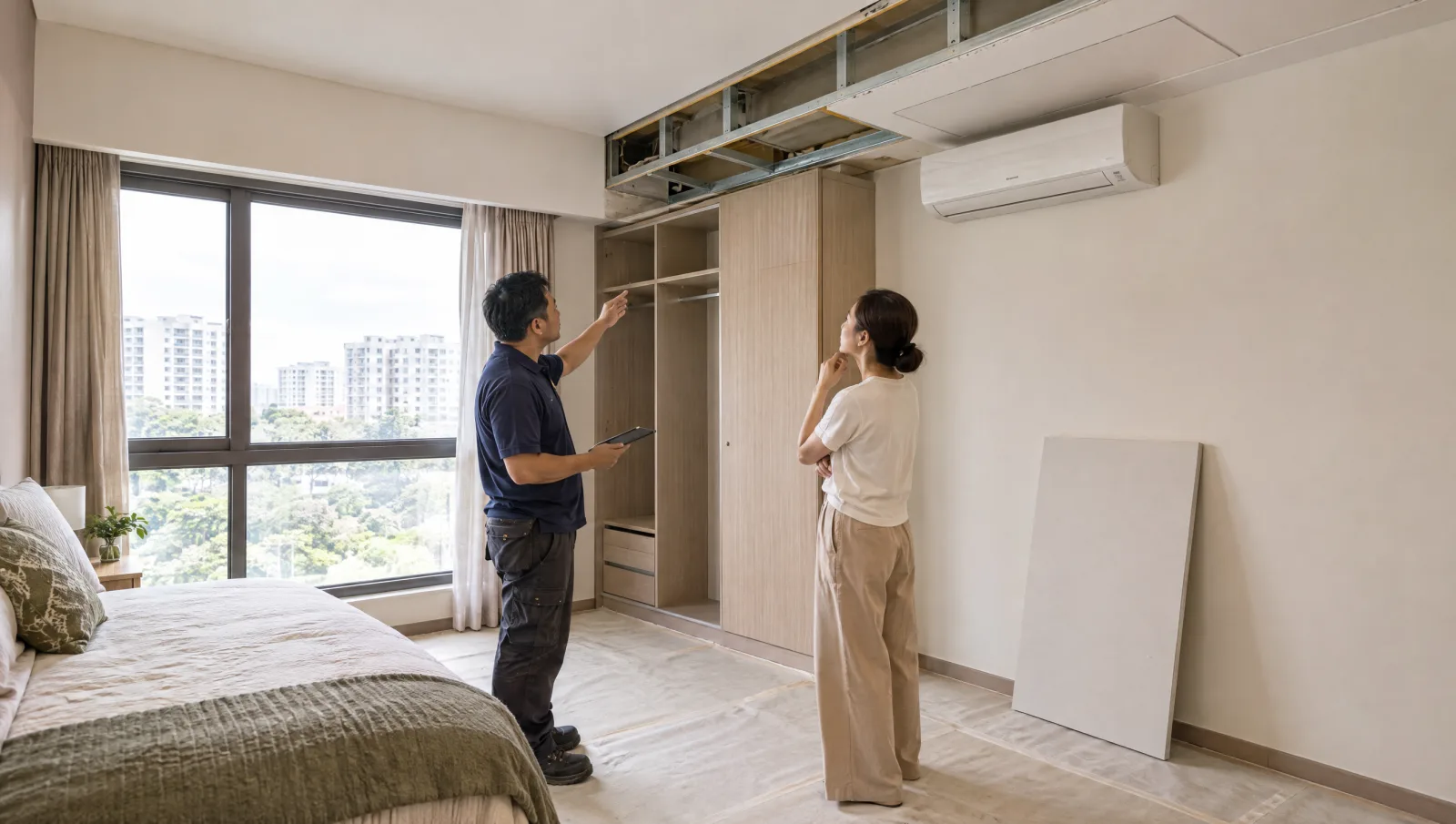
The tradeoff is ceiling space. A ducted unit needs height, a return path as well as supply grilles, and room to service it. In the maker’s multi-split guide, its SEZ-M compact bulkhead units are 200 mm high and its PEAD-M ceiling-concealed units 250 mm, with separate return-air and supply-air spigots. Those are that maker’s models, so ask for the height of the model actually quoted and the clearance the installer needs. Where that depth comes down as a bulkhead, it might be acceptable over a corridor but intrusive across a window or low stair landing.
Then place the return grille and the access doors. This manufacturer’s PEAD-M installation manual warns that intake noise increases dramatically if the intake sits directly beneath the unit, so the return belongs as far from the unit as possible. The same manual asks for the filter to sit where it can be serviced, and for access space to maintain and replace the motor, fan, drain pump, heat exchanger and electric box, with 450 mm by 450 mm access doors where there is 300 mm or more between the unit and the ceiling. If built-in joinery or a feature ceiling ends up under those doors, the next repair starts with taking it apart. Ask the designer to show the unit, supply and return paths, drain and access doors in one ceiling section, and use the model-and-scope quotation check to keep those provisions in the priced installation.
A ceiling cassette also sits in the ceiling, but its panel stays visible and it takes air in and sends it out through that panel, so it needs no ducts and no separate return route. In the maker’s SLZ-M cassette, the filter sits behind the intake grille, which is opened from below to pull the filter out, and the manual asks for authorised people to clean it.
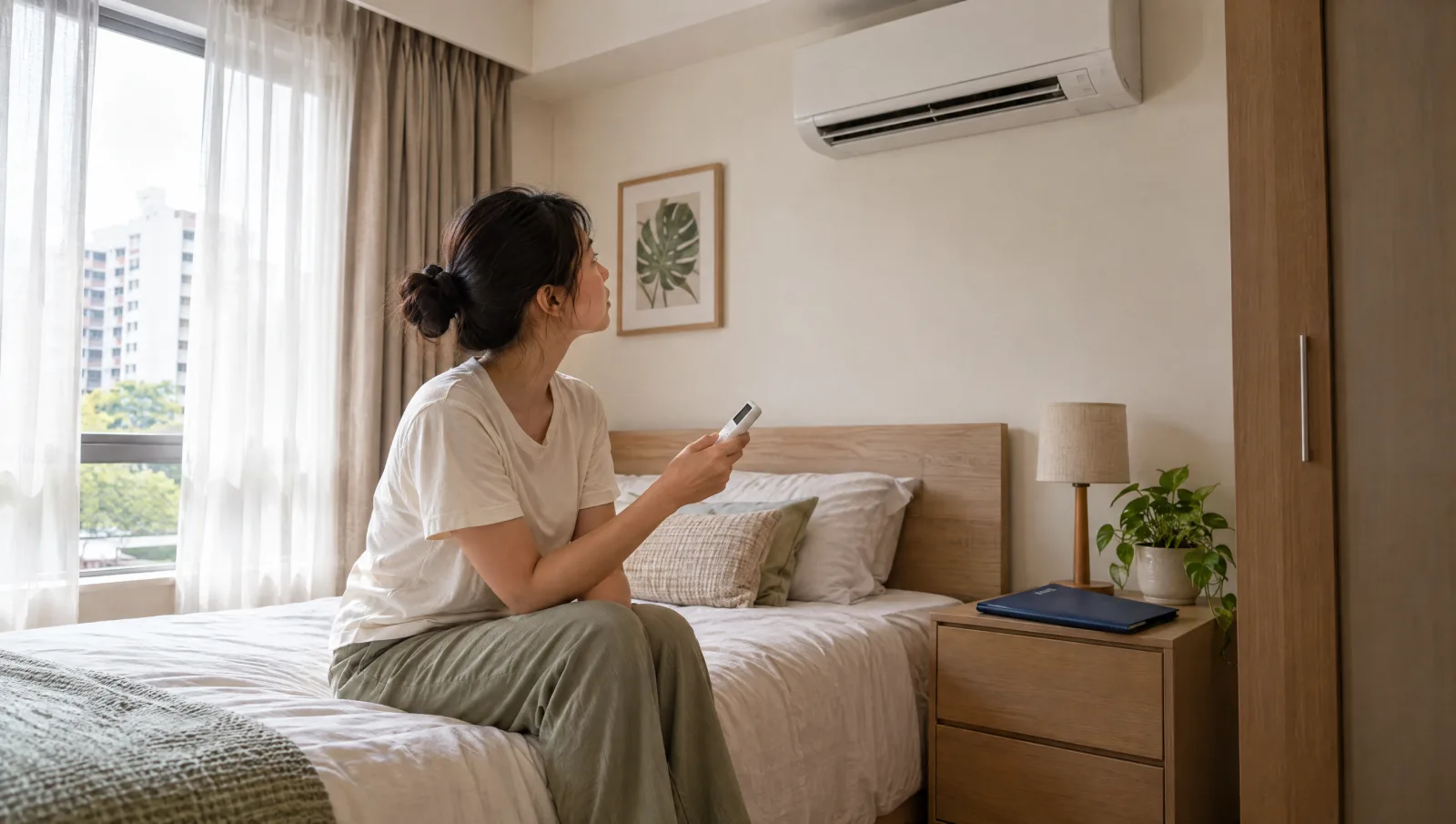
A wall-mounted unit needs no ceiling work at all. It stays visible on the wall, and the maker describes wall-mounted units as known for their easy installation and maintenance. For a cassette or a wall-mounted unit, test the air path against wardrobes, curtains and beds, and position it for the furnished room and the selected model’s clearances rather than a photograph of an empty interior.
Choose ducted when the ceilings are being redone anyway, a corridor or wardrobe zone can take the bulkhead, the return grille and access doors have sensible places to go, and the rooms it serves are used together. Rooms on one ducted unit cool together unless the system has zone control, which this manufacturer offers to turn off a section when it is not in use. If each bedroom should run on its own, that points to a slim unit per room or to zoning. Choose a cassette where a room has a false ceiling but no route for ducts and a return. Choose wall-mounted units when the ceiling is staying as it is, or when the simplest service access matters most.
Scroll across to compare all columns →
| What you are weighing | Ducted | Ceiling cassette | Wall-mounted |
|---|---|---|---|
| Where the unit sits | Above the ceiling, out of sight, with only grilles showing | In the ceiling, with its panel visible | On the wall, in full view |
| What it needs from the ceiling | Depth for the unit and ducts, a return air path and access doors | A ceiling void above the panel | Nothing |
| How rooms are controlled | Rooms on one unit cool together unless zone control is fitted | Each cassette serves the room or open area it sits in | Each unit serves the room it sits in |
| How the filter is reached | Through ceiling access, at a filter position planned for servicing | Behind the intake grille, opened from the room below | At the unit, from inside the room |
| Suits | Ceilings being redone and rooms used together | Rooms with a false ceiling but no duct route | Rooms where the ceiling stays as it is |
Resolve airflow, support and maintenance access
An outdoor unit needs the clearances and airflow arrangement required by its manufacturer. Do not enclose it behind landscaping or decorative screens without assessing the effect on airflow and access. Review discharge direction, nearby openings and neighbouring spaces with the installer.
BCA requires trained installers for units outside or projecting from buildings. Its separate requirement for a stainless steel bracket or purpose-designed concrete ledge or casing states an exception for units inside the property. Have the installer establish which requirements apply to the proposed position; the support exception should not be read as an exemption from all installation rules.
Close inspection of an outdoor unit’s bracket, ledge or casing is the trained installer’s job, done during servicing. BCA’s maintenance tips say to have a trained air-conditioning unit installer inspect the supports during routine servicing, and to inspect supports for corrosion or damage at least every six months. At home, do that six-monthly check by eye from inside the house or from the ground, looking for rust stains, cracks around a ledge or a unit that has started to tilt, and tell the installer what you saw. Don’t lean out of a window, climb a ladder or go onto a roof to look closer. BCA also says supports for units inside the property should still be checked and maintained regularly. A location that can only be reached by improvised climbing is a poor long-term service arrangement.
Decide whether existing pipes can be retained
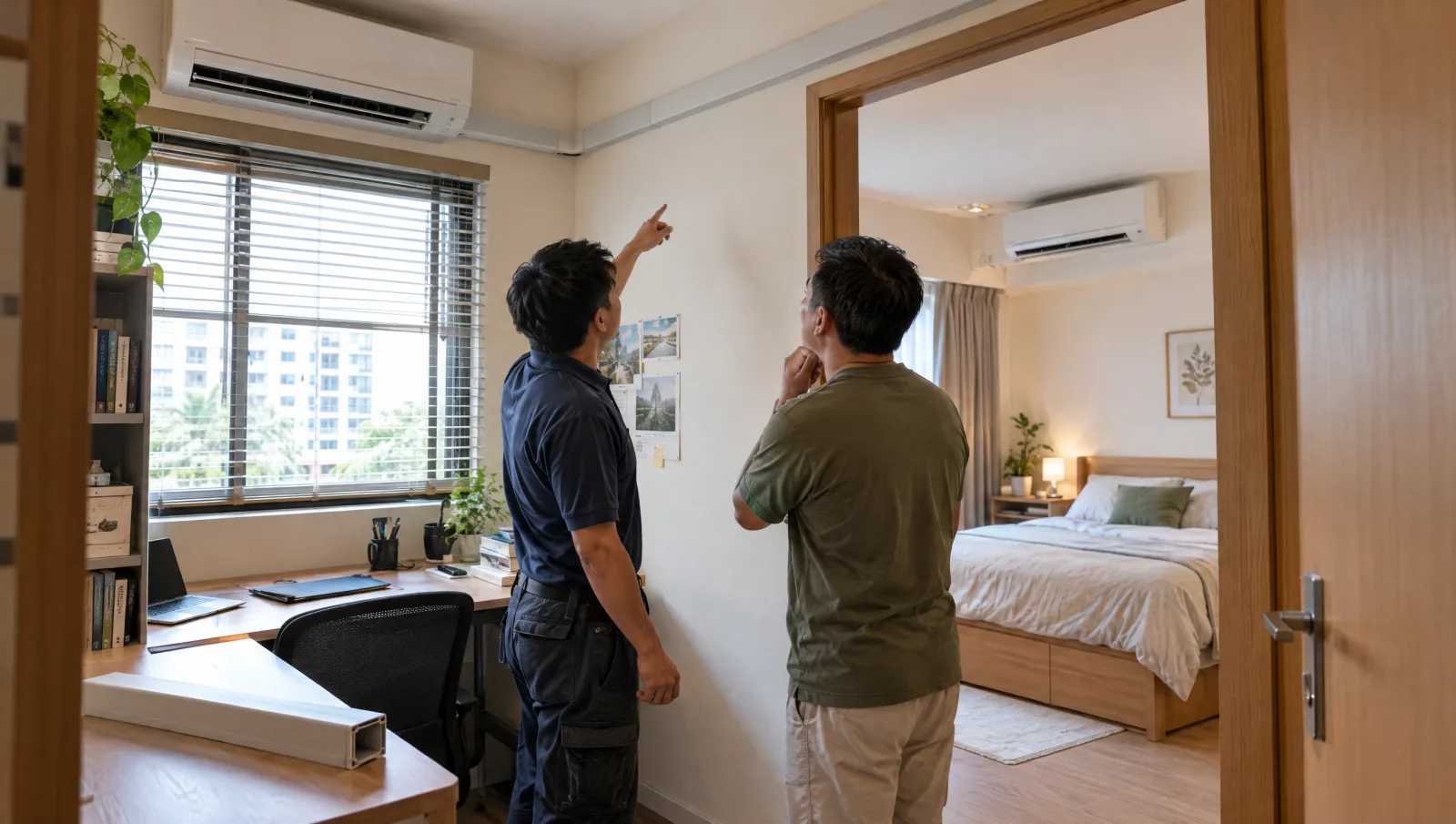
For a replacement, the visible trunking tells you where pipes run but not whether they suit the new system. The installer needs to compare existing sizes, condition, insulation and route with the selected model and refrigerant requirements. Keeping concealed pipes is a decision about their verified suitability, not simply avoiding hacking.
If retaining concealed pipework, obtain the proposed inspection and testing approach, the limits of what can be established and the warranty position. If replacement is necessary, price access, trunking, penetrations and reinstatement before deciding on the equipment package.
Coordinate insulation and joints through the full route. Daikin’s guidance explains why refrigerant pipework needs appropriate insulation, including the connections along its route. A new indoor unit connected to an unresolved concealed installation can leave the original problem in place.
Draw where each indoor unit’s water goes
Condensate drainage is a design task, especially where units sit far from a suitable outlet or ceilings are constrained. Ask the installer to mark the route, falls where relevant, access points and any pump on the coordinated drawings before ceilings close, because changing a condensate route after renovation closes it in means opening finished work again.
PUB’s discharge guidance distinguishes air-conditioning condensate from used water generated by washing. Establish the appropriate connection and nuisance controls for each activity. Do not assume a nearby external drain or garden discharge is acceptable without checking the route.
Agree how drainage will be demonstrated at commissioning and how it can be cleaned later. If a condensate pump is proposed, discuss its power, access, alarm or failure response and ongoing care with the installer. The pump is part of the installed system, not a detail to hide after the layout is approved.
Use the energy label alongside the operating plan
NEA’s tick rating helps compare the efficiency of regulated appliances. Check the label for the quoted model and relevant system configuration. It does not calculate the load of your room or guarantee a particular electricity bill.
Ask the supplier to state the assumptions behind any running-cost estimate, including operating hours and tariff. Compare systems on a consistent basis. Keep shading, room zoning, door use and sensible controls in the discussion alongside equipment efficiency.
To compare running costs, use the monthly running-cost formula in Daikin’s FAQ, which Mitsubishi Electric’s Singapore FAQ repeats. It multiplies the unit’s input power in kW by the hours used, the days used in the month and the electricity tariff. Ask each supplier for the input power of the exact models quoted, so you can run that calculation yourself with your own hours and tariff.
Compare a model schedule and a scope schedule
Require every indoor and outdoor model number, quantity and intended room. Add controllers, accessories and any condensate pumps. The schedule should match the drawings and the supplier’s capacity selection, so substitutions are visible before installation.
Then compare the installation scope: refrigerant pipes and insulation, condensate, electrical provision, supports, penetrations, access equipment, removal and disposal, making good, tests and handover. Ask how additional pipe length or unexpected access work is priced.
Separate equipment warranty from installation workmanship and service coverage. Daikin’s stated terms show how labour, transport and refrigerant can sit outside a compressor warranty, even when the compressor itself is covered. Read the terms for the actual offer instead of treating a long component warranty as whole-system cover.
| Schedule | What should be explicit |
|---|---|
| Equipment | Room, indoor model, outdoor model and approved combination |
| Routes | Pipework, insulation, condensate and electrical responsibility |
| Access | Supports, safe servicing and access equipment |
| Finish | Trunking, penetrations and reinstatement |
| Aftercare | Warranty exclusions, service scope and fault contact |
Commission before finishes conceal the evidence
Agree inspection points for pipework, insulation, drainage and access before concealment. The installer should perform the checks and commissioning required by the selected equipment’s instructions and applicable installation requirements. Ask for records of the work rather than assuming a cold-air demonstration proves every part of the system.
At handover, run the intended room combinations and have the installer explain controls, modes and normal indications. Check drainage, unusual noise and visible finish defects with the provider. Record unresolved items and who will close them out.
Collect model and serial details, manuals, installation and test records, warranty registration information and the service contact. Keep photographs of concealed routes linked to the room names; these help later diagnosis and renovation.
Make routine care accessible and diagnosis specific
Base the care plan on the selected equipment and how it is used. Daikin recommends quarterly servicing for units used every day. Keep that manufacturer advice separate from a blanket chemical-cleaning interval; the proposed deeper cleaning should follow the condition found.
If cooling remains poor after a service, note the affected room, the other units running, any error indication, and whether water is leaking or the unit sounds unusual. An aircon still not cold after servicing can have more than one cause. Mitsubishi Electric explains that adding refrigerant does not resolve a leak. A repeated fault needs its cause assessed rather than the same treatment booked indefinitely.
Leave work on refrigerant circuits, electrical components and inaccessible outdoor equipment to the appropriate technician. BCA’s support checks are part of safe upkeep; the household should not climb onto a roof or reach outside a window to inspect brackets.
Reconsider a package that leaves the main constraint unresolved
Pause if the supplier has not explained simultaneous capacity, cannot show a condensate route or proposes an outdoor location without safe service access. Resolve those constraints before upgrading to a more expensive product tier.
For an existing system, compare repair with replacement using a diagnosis and the condition of the full installation. Replacement may be justified, but buying new units alone will not repair unsuitable concealed routes, inaccessible drainage or poor siting.
Regulatory compliance
Check which requirements apply to your proposed scope. Agree the responsible qualified professionals, submissions and inspections before work begins.
BCA (Building and Construction Authority)
Establish the applicable installation and support-safety duties for the proposed outdoor-unit location.
Primary source: www1.bca.gov.sg/safety-and-standards/periodic-building-inspections/air-conditioning-safetyPUB (Public Utilities Board)
Confirm appropriate condensate and washing-water discharge arrangements.
Primary source: www.pub.gov.sg/-/media/PUB/PDF/Compliance/Used-Water/legislation/Specific-Requirements-for-Water-Discharge_Jun-2020.pdfNEA (National Environment Agency)
Use the relevant model energy label to compare regulated appliance efficiency.
Primary source: www.nea.gov.sg/our-services/climate-change-energy-efficiency/energy-efficiency/household-sector/tick-ratingGlossary
- Room load
- The cooling demand assessed for a room under stated conditions.
- Multi-split
- An arrangement in which one outdoor unit serves multiple indoor units.
- Combination table
- Manufacturer information describing supported indoor/outdoor combinations and relevant performance.
- Condensate
- Water produced as moisture is removed from indoor air during cooling.
- Commissioning
- Checks and setup needed to establish correct operation of the installed system.
- Ducted unit
- An indoor unit hidden above the ceiling that sends air through ducts to grilles and draws it back through a return grille.
- System number
- The count of indoor units sold with one outdoor unit, so a System 4 has four.
- Compressor
- The pump inside the outdoor unit that circulates refrigerant through the system.
Frequently asked questions
How long should an aircon last in Singapore?
Neither Daikin Singapore nor Mitsubishi Electric puts a number of years on an aircon’s life, and both say skipping regular servicing shortens it. A compressor warranty is not a lifespan either. Daikin’s 5-year and Mitsubishi Electric’s 60-month compressor warranties cover that one part. For an older system, judge it on its repair history, how well it still cools and whether parts and service support are available.
Which aircon brand is most reliable?
We don’t rank aircon brands, because there is no independent, like-for-like reliability data to rank them on. What decides how a system holds up is the model quoted for your rooms, whether service support and spare parts are available locally, what the warranty excludes and how well it is installed. A strong brand can’t make up for an undersized unit or a drain nobody can reach.
What is the three-minute rule for aircon?
It is a built-in protective delay. In Mitsubishi Electric’s MXZ outdoor units, the compressor will not restart for 3 minutes after it stops, to protect the air conditioner. Other models can behave differently, so check the manual for yours. Do not repeatedly switch the power to force a restart, and ask a technician about errors that keep coming back.
Can ducted aircon be added without renovating every room?
Yes, if the area you want to cool has a ceiling that can take the indoor unit, its ducts, a return path and an access door. The work can then stay in that area. A slim unit in a local bulkhead over a corridor or wardrobe zone is one way to do it, and Mitsubishi Electric’s SEZ-M bulkhead units are 200 mm high. The proposal should show which ceilings are opened and reinstated, and where the return, drain and access door go.
Does the energy label predict my electricity bill?
No. NEA’s label helps compare regulated appliance efficiency under its rating system. Actual consumption also depends on the equipment selected, room load, operating hours and how the household uses the rooms.
If you read nothing else
Talk through the options for your home
Tell us what you want to change, how your household uses the space and when you hope to start. Share photos or plans on WhatsApp if you have them.
Browse all air-conditioning articles →
Go deeper: air-conditioning articles
In-depth pieces that expand on the sections above: real costs, brand and system comparisons, the installation process, and the edge cases most homeowners hit.
Still deciding? Compare options & estimate cost
Side-by-side comparisons and an instant cost estimate for your Singapore home.