On this page
View In PDFA painting quotation you can compare names every room and surface, the repairs before painting, the paint by product and finish, the sealer and number of coats, how your floors and furniture are protected, who moves the furniture, and what happens if something outside the scope turns up. Line two quotes up against those seven things before you pick one.
If one quote leaves some of them out, you can't tell whether it's cheaper or just covers less. Our interior painting service starts with a free site assessment, and the painting buying guide covers planning the whole job.
Which rooms and surfaces does the price cover?
"Whole unit, all walls" doesn't tell you whether the ceilings, doors or wardrobe insides are in. Ask for a list room by room, saying which of these are painted:
- Walls, and which one is a feature wall in a second colour
- Ceilings, including any false ceiling
- Doors and door frames, on both sides
- Window frames, grilles and exposed pipes
- The insides of built-in wardrobes and cabinets
Anything left off the list isn't in the price, so a missing ceiling or door frame can turn up later as an extra.
In a condo, the Building and Construction Authority (BCA) counts even your unit's external walls as common property, so ask your management office before a quote includes one. Painting the outside of a landed house is a separate job, under our facade and exterior service.
What the repairs before painting should cover
"Patching" on its own doesn't tell you much. Ask the quote to name each repair and the walls it applies to, such as filling hairline cracks, scraping off peeling paint, cleaning off grease and treating mould.
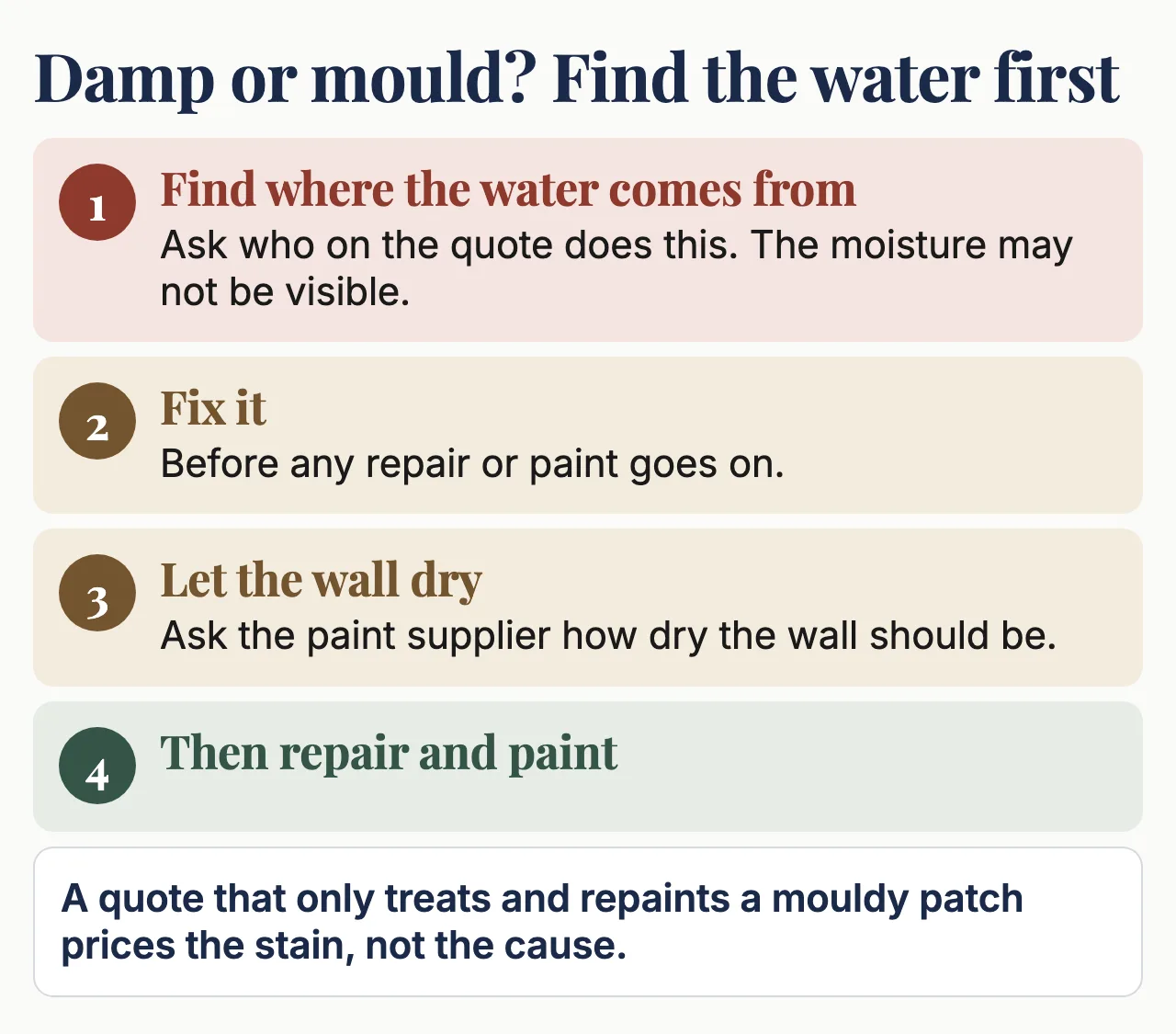
Find the water before painting over damp or mould
Mould points to water, not just a stain. In its handbook on painting conserved buildings, the Urban Redevelopment Authority (URA) says mould and other growth on plaster indicates an underlying and persistent moisture problem, and that many paint problems could be traced to moisture, such as seepage or water held in the wall, which may not be visible to the eye.
So a quote that only treats and repaints a mouldy patch prices the stain, not the cause. Ask who finds where the water comes from and fixes it first. Here's how to find the cause of a damp outside wall before repainting.
The same handbook says the wall should be sufficiently dry before repainting, and that the paint supplier's advice should be sought on how dry, and on the curing time for that type of paint.
Cracks, and work found once painting starts
A crack that keeps reopening after it's filled needs more than paint. When we take on a painting job and a crack keeps coming back, we arrange an engineer to look at it.
Some problems only show once old paint comes off or the furniture moves, so ask each quote what happens then. With us, anything found outside the quoted scope is shown to you and agreed before it's done.
Why the quote should name the paint
"Premium emulsion" can't be compared or checked. Ask for the product name, finish and colour code for each room, and keep the codes for touch-ups later.
A paint's data sheet sets its system: whether a sealer goes on first, how many finish coats follow, the time between coats and how dry the wall has to be. Ask for the data sheet of each paint the quote names, and check the quote's sealer and coats match it.
Is the sealer included?
Look for it as a line of its own. If the data sheet calls for a sealer and the quote doesn't list one, ask why, because that quote isn't pricing the same job. If the data sheet names the sealers that suit the paint, check the sealer on your quote is one of them.
Labels you can check on the tin
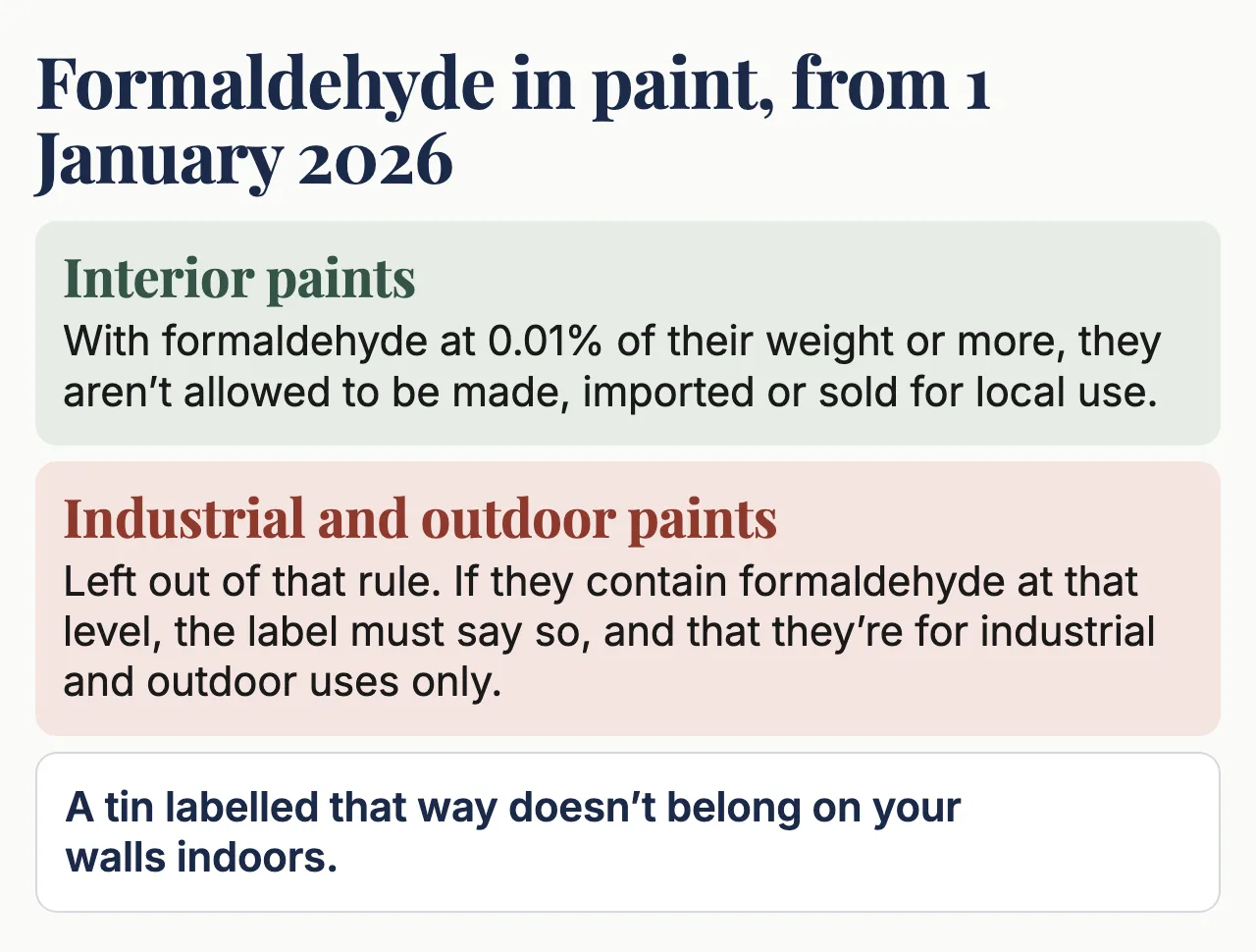
In its advisory updated in April 2026, the National Environment Agency (NEA) says that from 1 January 2026, interior paints with formaldehyde at 0.01% of their weight or more aren't allowed to be made, imported or sold for local use. Industrial and outdoor paints are left out, but if they contain formaldehyde at that level, their label must say so and that they're for industrial and outdoor uses only. A tin labelled that way doesn't belong on your walls indoors.
For a certified paint, ask for one under the Singapore Green Labelling Scheme, run by the Singapore Environment Council. Its paint standard requires no detectable formaldehyde or heavy metals such as lead, and low volatile organic compounds (VOCs) within limits that vary by type of coating and use.
Protection, furniture and cleaning up
Each room is out of use while it's painted and while the paint dries, so check the quote says:
- How the floors are covered, and what covers built-in carpentry, switches and frames
- Who moves the furniture, where it goes and who puts it back
- Who clears the debris and empty tins and cleans up at the end
- Which rooms are painted on which days
Ask what the paint's data sheet says about airing the room while the paint goes on and dries. The data sheet's drying and recoat times aren't a time for moving back in.
If new carpentry or other materials go in at the same time, NEA says moving back into freshly renovated rooms too early increases the risk of formaldehyde exposure, even with low-emission products, and that how long it takes for emissions to fall varies from case to case. NEA also suggests discussing ventilation with your contractor before work starts and allowing ventilation time in the schedule.
Building rules that change the quote
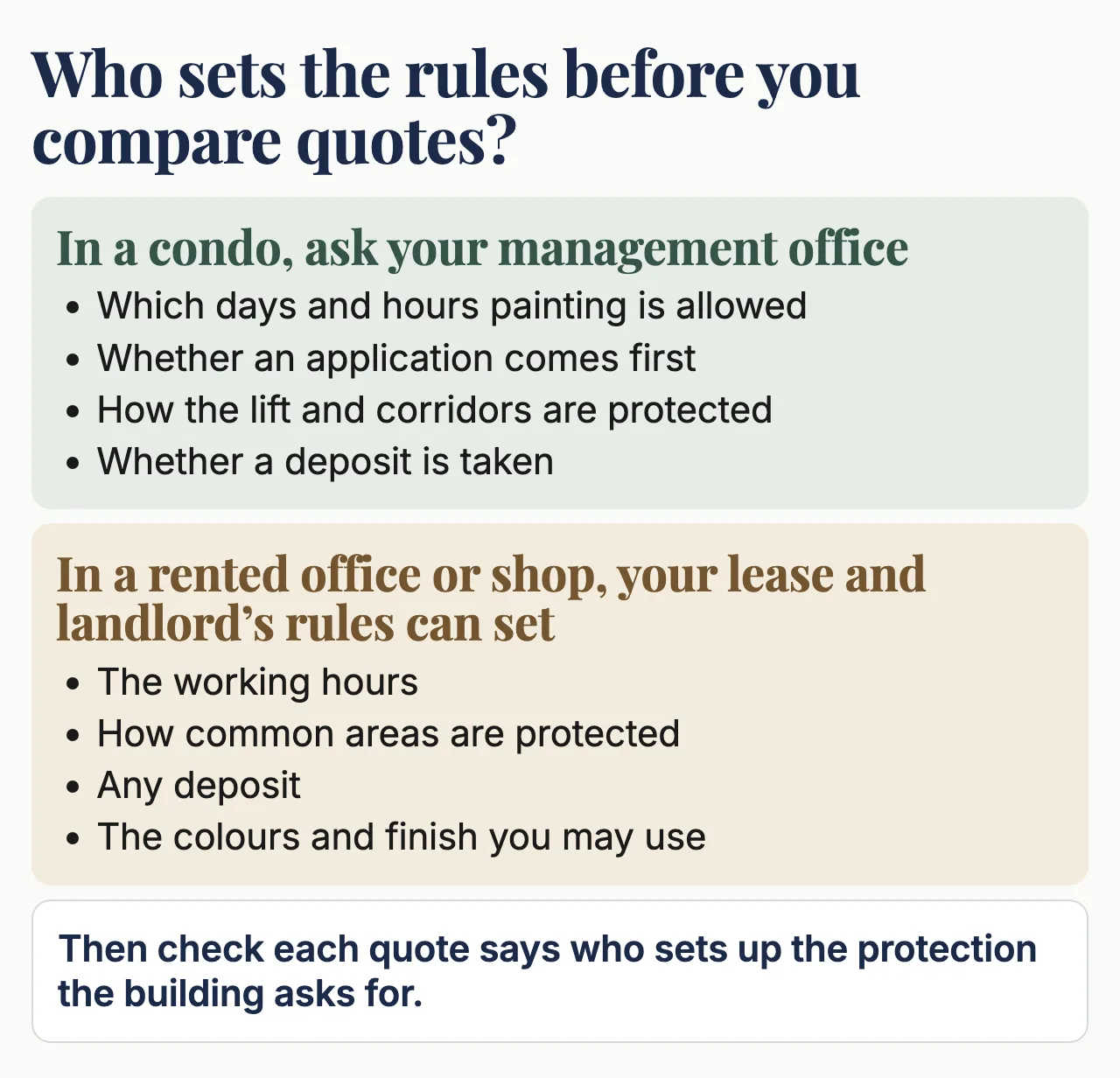
NEA notes that condo units are managed by their management corporation (MCST), and BCA advises checking with the developer or the MCST, and your Sale and Purchase Agreement, about renovation restrictions before any work. So in a condo, your estate sets the rules.
Ask your management office before you compare quotes
0 of 4 reviewed
Use this to track your review. Checks stay on this page while it is open.
Then check each quote says who sets up the protection your estate asks for. On deposits, BCA's by-laws guide says an MCST can't impose fines or forfeit deposits paid when a by-law is breached, though it may recover administrative fees for costs the breach caused.
Any approval your estate asks for is yours to apply for, and when we do the painting, we give you the details of the work its form asks about. Here's when a condo renovation needs MCST approval.
In a rented office or shop, your lease and your landlord's rules can set the working hours, how common areas are protected, any deposit, and the colours and finish you may use, so get the building's renovation rules first. Ask for the work to be split by area and day, so you know which rooms your staff can't use and when. For bigger works, here's which approvals a commercial renovation needs.
Payment terms and the warranty, in writing
Get both in writing before you accept. Ask each quote to set out:
- Payment. How much is paid up front, what each later payment is tied to, and whether the last one comes after you've walked the rooms
- Changes. That extra work is priced and agreed in writing before it's done
- Warranty. How long it lasts, what it covers, such as peeling paint, what it leaves out, such as damp from a leak nobody fixed, and how you claim
Our painting comes with our warranty and after-care.
Written terms also matter if a dispute can't be settled. The Singapore Courts' page on small claims, last updated 2 June 2026, says the Small Claims Tribunals can hear claims about a contract for services up to a total value of $20,000, or $30,000 with a Memorandum of Consent from both parties, filed within 2 years of the event that gives rise to the claim.
Check each quote line by line
| Line on the quote | What it should say | What to ask if it's missing |
|---|---|---|
| Rooms and surfaces | Each room, and which of its walls, ceiling, doors, frames and grilles are painted | Which surfaces in this room are in the price? |
| Repairs | Which walls get cracks filled, peeling paint scraped or mould treated | What do you do to this wall before painting? |
| Damp | Who finds and fixes where the water comes from before painting | How dry does this paint need the wall to be? |
| Paint | Product name, finish and colour code for each room | Can I see this paint's data sheet? |
| Sealer and coats | Whether a sealer goes on, and how many finish coats, matching the data sheet | Does this match the data sheet? |
| Protection and clean-up | How floors, carpentry, switches and frames are covered, and who cleans up | What do you cover, and is clean-up included? |
| Furniture | Who moves it, where it goes and who puts it back | Is moving the furniture in this price? |
| Building rules | The working hours and the lift and corridor protection your estate or landlord asks for | Is the lift and corridor protection in your price? |
| Extra work | Problems found are shown to you and priced in writing before they're done | What happens if you find more? |
| Payment and warranty | What's paid when, and the warranty's length, cover, exclusions and claims | Can I have these terms in writing? |
Why one quote costs more than another
Two quotes for the same home can both be fair and still differ, if they're pricing different work. The price moves with:
- How much there is to paint, from the floor area and number of rooms to a high ceiling or stairwell that needs taller access
- How many colours, and whether doors, frames, grilles and pipes are in
- The paint, and whether a sealer coat is part of its system
- The repairs, from cracks and peeling paint to mould and damp
- Whether furniture has to be moved or covered, and your building's rules on hours and protection
So before you compare totals, check both quotes list the same rooms, surfaces, repairs, paint and coats. The cheaper quote is only cheaper if it covers the same job.
Get a second quote you can line up against the first
If you'd like a quote to compare with the one you have, we'll do a free site assessment of your home, office or shop, look at every wall and ceiling you want painted, and send you a fixed-price quote within 3 to 5 working days of the visit, never from a photo. Have your estate's renovation guidelines or your lease ready, then hold both quotes against the table above.
Common questions
Should I paint before or after moving in?
Before, if you can. An empty home has no furniture to move or cover, and freshly painted rooms can air before you live in them. In a new condo, BCA says the Defects Liability Period is when you must report defects caused by substandard workmanship or defective materials, so report them to your developer before new paint covers them.
What decides when it's time to repaint?
URA's handbook on paints, written for conserved buildings, says how often to repaint depends on many factors, including the type of paint system, the quality of the last paint job and how exposed the surface is to things like weathering. If paint is peeling or mould keeps coming back, find the cause before you repaint.
Do I have to repaint before I hand back a rented home or office?
Your lease and your landlord decide. Read the lease's reinstatement or handover clause, and ask your landlord in writing which walls go back in which colour and finish before you get quotes, so each quote prices what the lease asks for.
Need help with your project?
Tell us what you need on WhatsApp and send a few photos. We'll arrange a free site assessment, then give you a fixed-price quote within 3 to 5 working days.