On this page
View In PDFYes, if the work changes how your building looks, adds floor area or touches its structure. Your management corporation (MCST) decides those, and your by-laws can add other work. Grilles that stop falls from an outdoor-facing window, balcony or door are the exception, though the estate can set their design. Structural hacking also needs an engineer and building control approval.
Settle this before you sign anything: the approvals shape your condo renovation scope and the order of work. The condo renovation buying guide covers the rest of the job.
When the law needs your MCST's approval
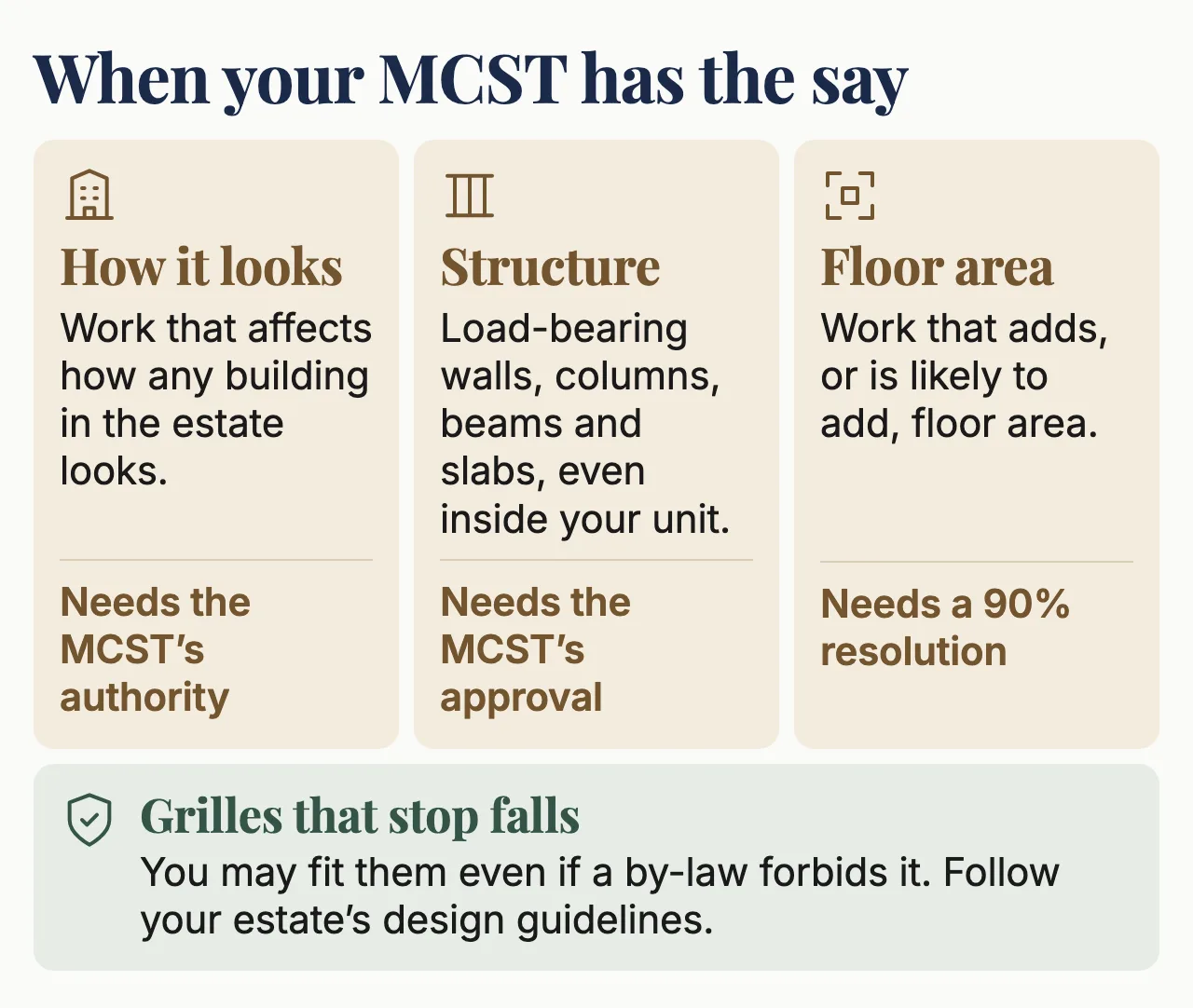
The Building (Strata Management) Act and guidance from the Building and Construction Authority (BCA) give your MCST the say in three cases.
- Appearance. Work that affects how any building in the estate looks needs the MCST's authority, which it gives only if the work won't detract from the building's look (or will be in keeping with it) and won't affect its structural integrity.
- Structure. The Act makes every structural element, such as load-bearing walls, columns, beams and slabs, common property, even inside your unit, and BCA's guide on works in a unit says work involving common property needs the MCST's approval.
- Floor area. Work that increases, or is likely to increase, the floor area needs a 90% resolution. The same guide explains that means owners holding at least 90% of the share value present at a general meeting vote in favour. Each unit's share value is set in the estate's schedule of strata units, and votes on these resolutions are counted by it.
For everything else, your estate decides. The same BCA guide says the MCST may make by-laws requiring its approval before you carry out work, and BCA advises checking renovation restrictions with the developer or MCST, and your Sale and Purchase Agreement, first.
Who writes your estate's rules, and how to get a copy
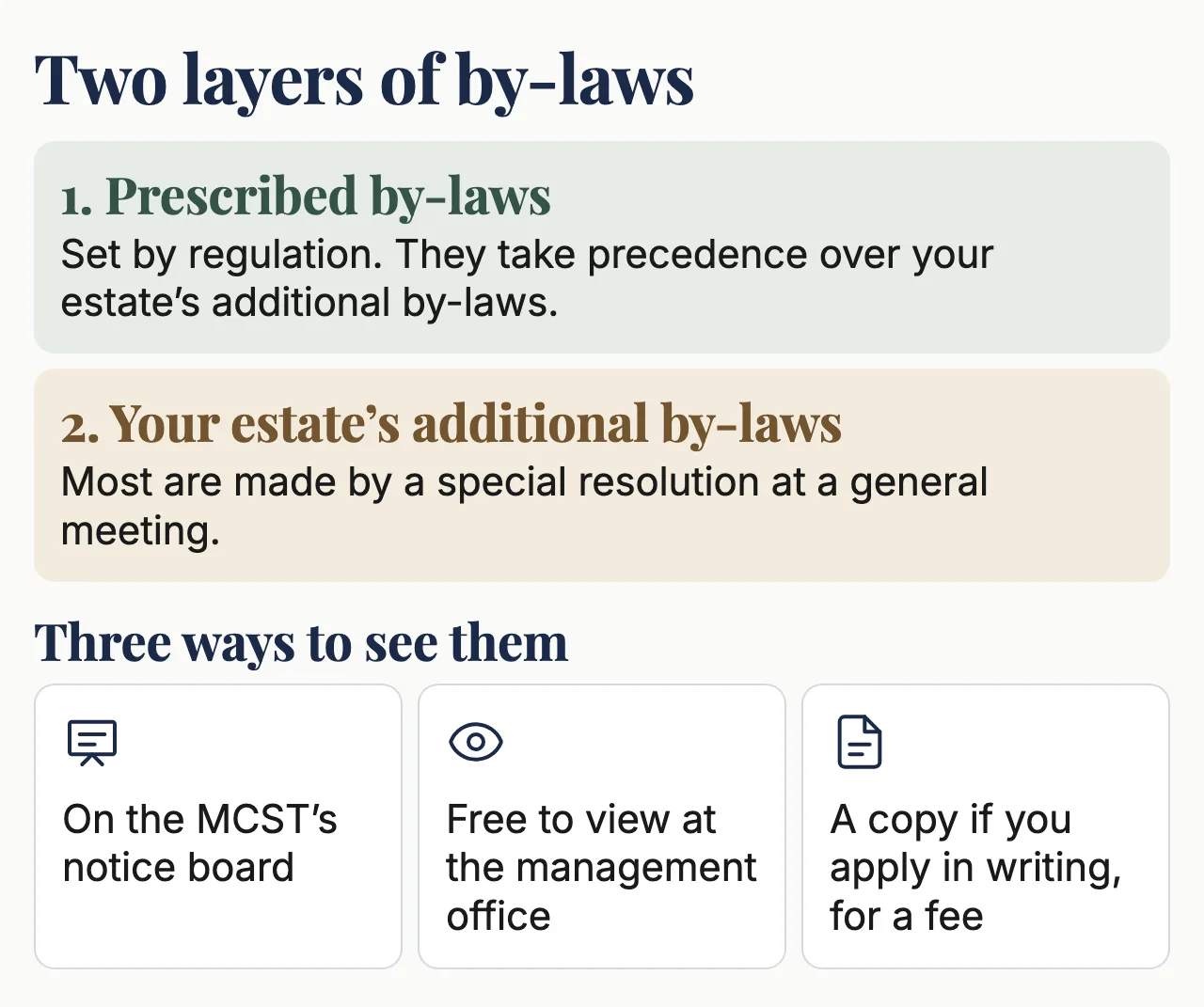
Two layers of by-laws apply, and BCA reminds you that you must follow them even if you missed the vote. BCA's by-laws guide says the prescribed by-laws, set by regulation, take precedence over your estate's additional by-laws. Most of those are made by a special resolution, which needs at least 21 days' written notice and support from owners holding 75% of the share value of the valid votes cast at a general meeting.
The MCST has to display the by-laws in force on its notice board, let you view them free at the management office, and give you a copy if you apply in writing, for a fee the Act caps by regulation. Ask for them with the estate's renovation guidelines and application form.
Which works need the MCST, an engineer, BCA or URA
| Work you're planning | Your MCST | Other approvals and trades |
|---|---|---|
| Internal works that add no floor area, such as partitions | As your by-laws require | No planning permission from the Urban Redevelopment Authority (URA), unless they create separate sub-units |
| Hacking a slab, beam, column or structural wall | Approval, as structure is common property | A Professional Engineer's assessment and the Commissioner of Building Control's approval |
| Changing windows | Approval, as an external feature | An approved window contractor or a builder registered with BCA, either with a trained window installer |
| Grilles and railings that stop falls from an outdoor-facing balcony, window or door | Can't stop them, but it can set their design | Install properly and repair any damage to common property |
| Open-sided cover over a balcony, private enclosed space or roof terrace | Consent; a 90% resolution may also apply, depending on its design and connection | No URA planning permission; meet BCA and fire safety requirements where they apply |
| Enclosing a balcony with walls or glass | Blinds follow its design guidelines | Not allowed under URA's rules; blinds are |
| A loft or furniture deck | As your by-laws require | No URA planning permission for one per unit, up to 5 square metres |
| Adding floor area, such as roofing a private enclosed space or a slab over a void | A 90% resolution | URA planning permission; BCA approval may also be needed |
The partition, cover, balcony, loft and floor-area rows come from URA's rules for strata-titled homes. For floor area, URA needs a letter from your MCST council's secretary or chairperson confirming the 90% resolution, sent with your planning application.
Can you hack walls in a condo?
Not before you know whether it's structural. BCA says structural elements such as slabs, beams, columns and walls can't be altered without proper assessment by a Professional Engineer, and the Commissioner of Building Control, who approves building plans, has to approve the work too.
So have an engineer check the wall against your unit's approved plans before anyone hacks it. BCA's guide notes your MCST may also require the engineer's endorsement on structural works.
Retiling works on the floor finish and underlayment, which the Act leaves out of the structural slab, though your by-laws still apply. The choice there is whether to overlay or hack the old floor, and in a bathroom, which waterproofing suits it.
Windows, grilles and the outside of your unit
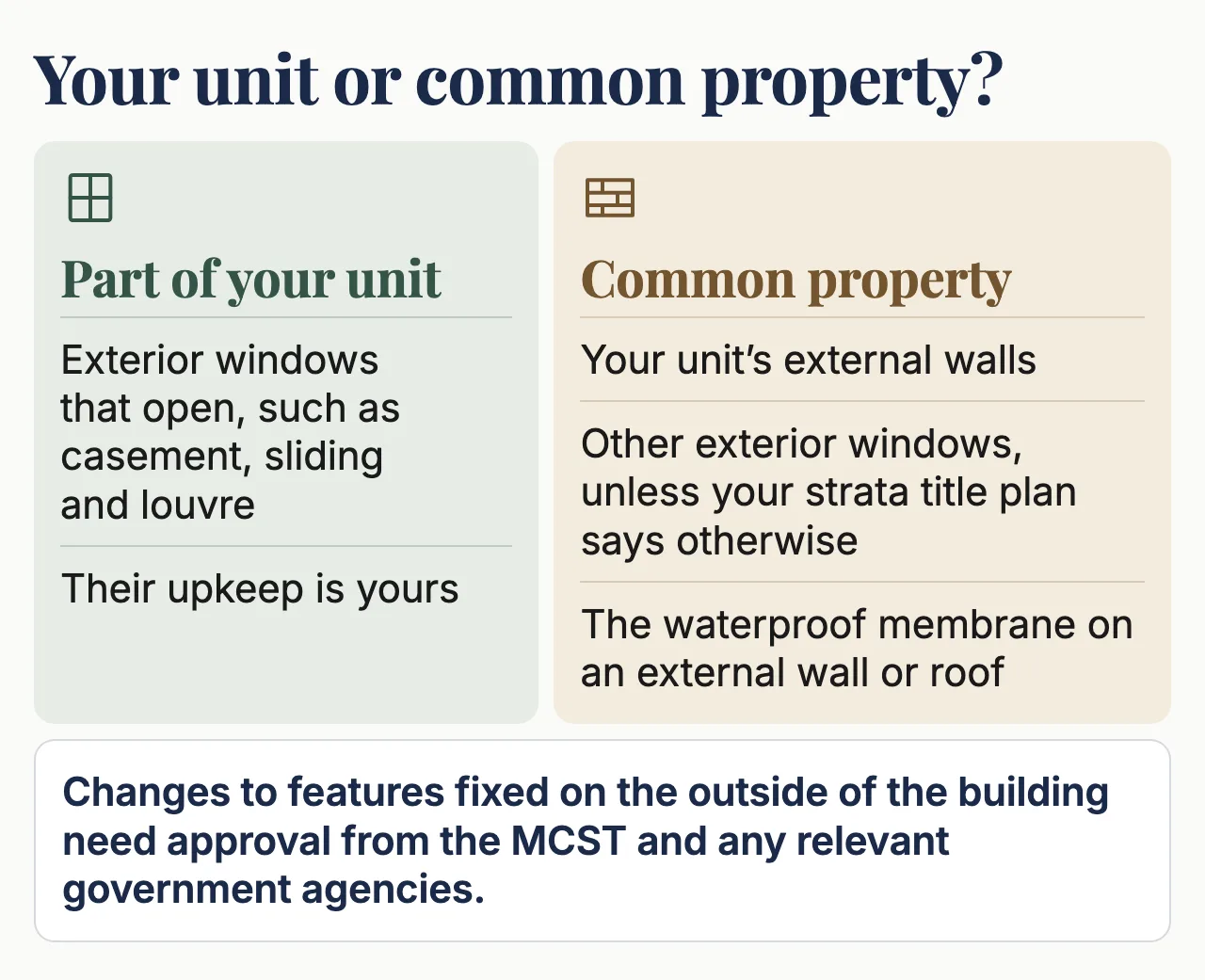
Common property is the part of the estate outside any one unit, and BCA's owner guide counts even your unit's external walls. It also says changes to features fixed on the outside of the building, such as windows and walls, need approval from the MCST and any relevant government agencies.
Under the Act, exterior windows that open, such as casement, sliding and louvre windows, are part of your unit, and BCA says their upkeep is yours. Other exterior windows are common property unless your strata title plan says otherwise.
BCA's window rules say you need an approved window contractor or a builder registered with BCA, either with a trained window installer, to replace windows. If a window doubles as a safety barrier against a drop of 1,000 mm or more, a Professional Engineer has to submit structural plans to BCA, unless BCA's standardised designs are used.
For grilles, BCA's guide on works in a unit says to check your MCST's approved designs first, and to ask the MCST in writing or at a general meeting for another.
The Act also makes the waterproof membrane on an external wall or roof common property, so take a leak from there to the MCST. Here's who arranges a condo roof repair.
Renovation hours, deposits and lift protection
Your estate sets these. The National Environment Agency (NEA) says it regulates noise from renovation and building works in landed properties, while residents affected by condo renovation noise take it to their MCST.
The deposit amount, what it covers and when it comes back are set by your estate's renovation rules, but BCA's by-laws guide says that when a by-law is breached, an MCST can't impose fines or forfeit deposits paid, though it may recover administrative fees for costs the breach caused.
Ask your management office before you book a start date
0 of 4 reviewed
Use this to track your review. Checks stay on this page while it is open.
The MCST application is yours to make
BCA's guide on works in a unit puts the duty to get the MCST's authorisation on you as the unit owner, and your estate's renovation guidelines set what the application has to include. On a job with us, we give you the scope and details of the work the form asks about, and arrange the engineer or Qualified Person (the registered architect or engineer who submits plans to BCA) where the work needs them.
What happens if you renovate without approval
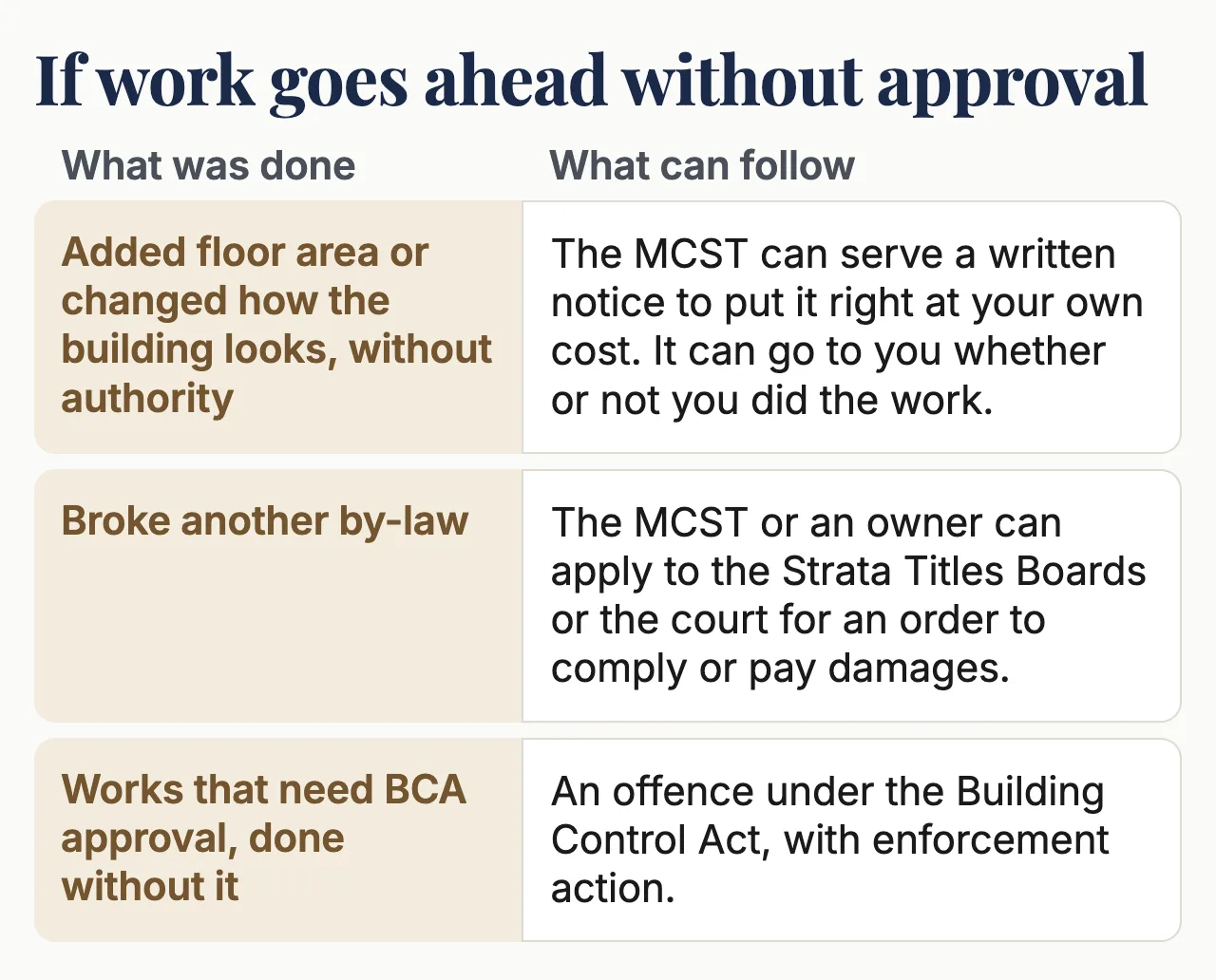
If work that adds floor area or changes the building's appearance goes ahead without authority, section 37(4A) of the Act lets the MCST serve a written notice requiring you to put it right at your own cost, within a reasonable time it sets. The notice can go to you whether or not you did the work.
For other by-law breaches, BCA's by-laws guide says the MCST or an owner can apply to the Strata Titles Boards or the court for an order to make someone comply or pay damages.
For works that need BCA approval, BCA says that if you're found with unauthorised additions or alterations, you've committed an offence under the Building Control Act and face enforcement action. Buying a resale unit? BCA suggests having an architect or engineer compare it as built with its approved plans, because a lawyer's legal search only shows works already brought to BCA's attention.
How condo rules differ from HDB's
In an HDB flat, HDB itself issues the renovation permit, as NEA notes. In a condo, the MCST approves under the Act and your by-laws, and an engineer, BCA or URA come in for the parts that need them.
Map the approvals before you get a quote
Send us your estate's renovation guidelines and your planned works, so the approvals are mapped before pricing. We'll do a free site assessment of your unit and give you a fixed-price quote within 3 to 5 working days of the visit, never from photos.
Common questions
What should I check before renovating a brand-new condo?
Report defects during the Defects Liability Period first. BCA explains that the developer must resolve defects from substandard workmanship or defective materials under the Sale and Purchase agreement, and that upkeep is yours once the period has passed. Before any major additions or alterations, BCA advises checking with the developer and the project architect or Professional Engineer.
Where can I get my condo unit's approved floor plans?
BCA says you can fill in its Plan Purchase Application Form to view and buy your unit's approved plans. They help an engineer tell which walls are structural.
Can the MCST refuse my renovation?
It can. If you think a refusal is unreasonable, the Act lets the Strata Titles Boards order the MCST to consent to an alteration to common property or an improvement affecting the building's appearance. BCA's dispute guide says the Boards' decisions are final, apart from an appeal to the High Court on a question of law.
Need help with your project?
Tell us what you need on WhatsApp and send a few photos. We'll arrange a free site assessment, then give you a fixed-price quote within 3 to 5 working days.