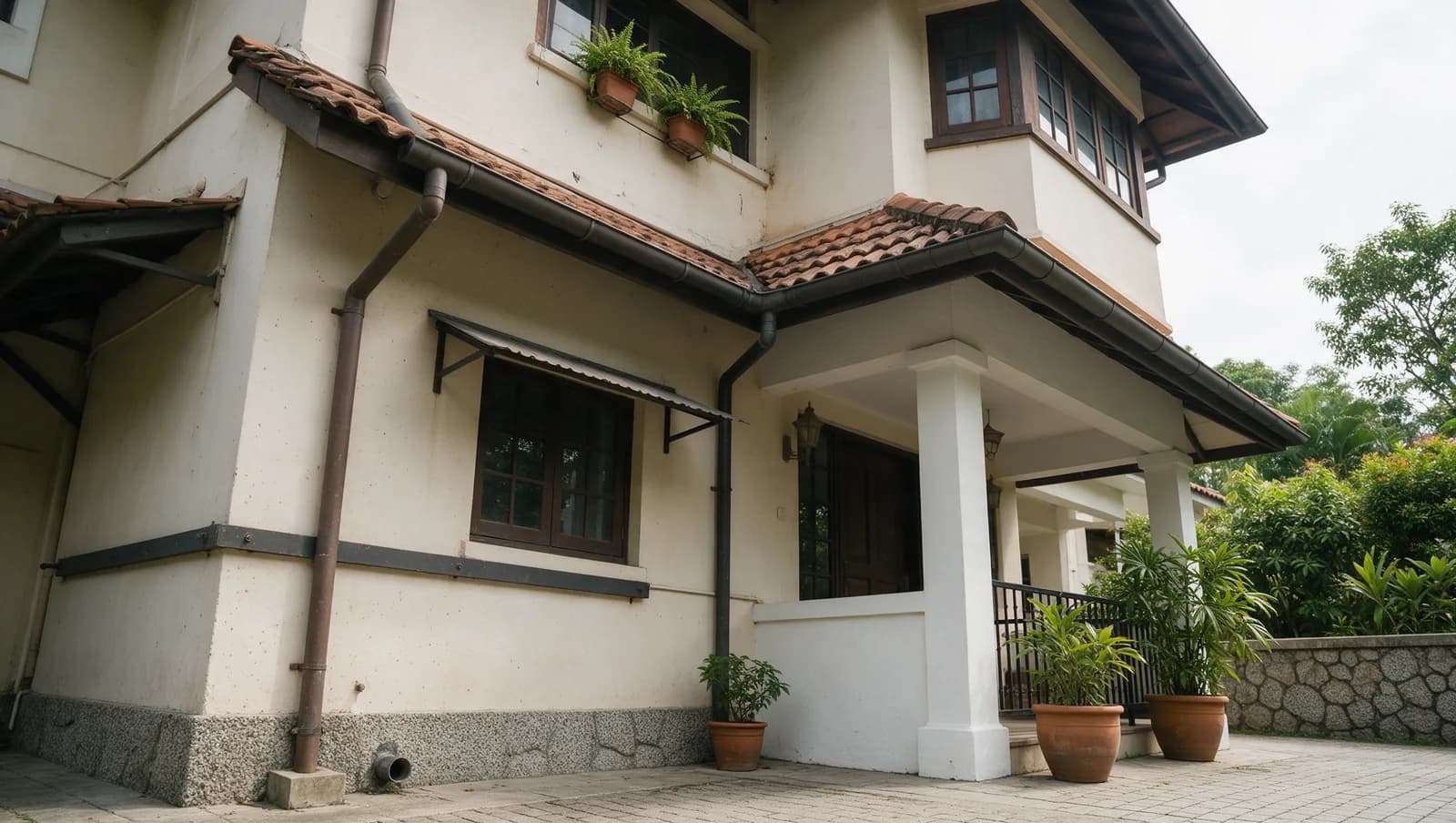
If your house is used only as a home, BCA's Periodic Facade Inspection doesn't apply. That seven-yearly check for buildings over 20 years old excludes detached, semi-detached, terraced and linked houses used solely as residences. You still need a professional check when you see bulging or cracked plaster, spalling concrete, cracked or loose tiles, or white salt stains.
A facade is the outside face of a building and everything fixed to it. BCA's facade inspection scope, for instance, covers the exterior of the building and any exterior feature attached to it, from windows, grilles, plaster, tiles and cladding to gutters, awnings, screens and external balustrades. For facade and exterior works on a landed house, the first decision is whether the job is a repair, cleaning, repainting or a new look, because each one answers a different problem.
Your part is look-and-note from safe places, meaning the ground, inside the house, windows and balconies. Close checks at height, including tapping the wall, belong with the contractor's or inspector's team working from proper access.
Separate repair from redesign
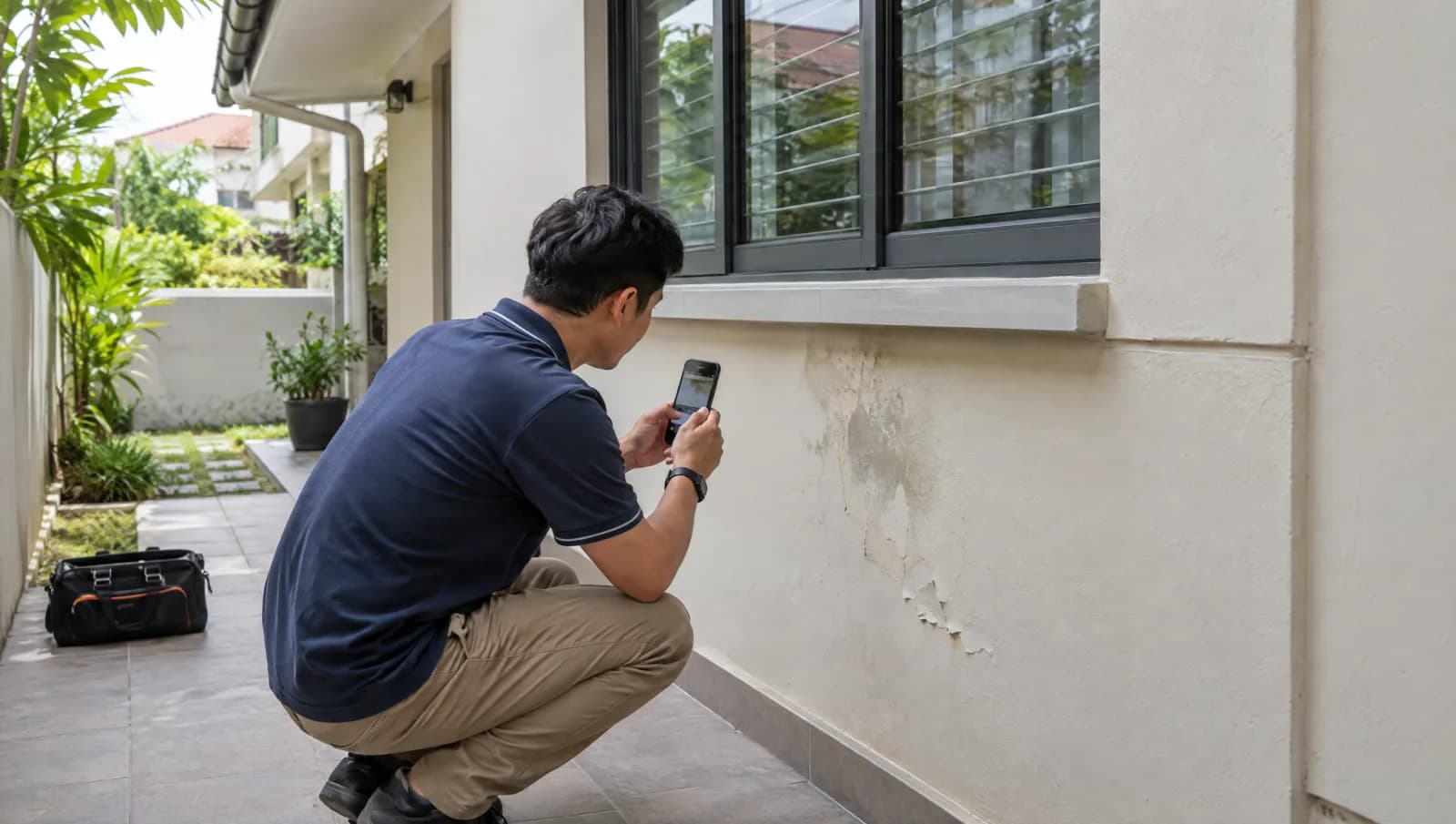
From the ground you can spot the defects BCA lists as common, such as bulging or cracked plaster, spalling concrete, cracked or loose tiles and white salt stains (efflorescence) on plaster or brick. What you can't see is plaster or tiles that have come away from the wall behind a surface that still looks sound. BCA's statutory method, which a house used only as a home doesn't have to follow, shows what a thorough check adds. It is led by a registered professional engineer (civil or structural) or a registered architect, who inspects at least 10% of each face of the building at close range to find what a visual survey can miss, tapping the surface with a tapping rod or rubber mallet to find hollow or debonded plaster and tiles. Each type of facade is then rated safe, in need of repair or unsafe.
Before you agree to a facade inspection for a landed house, ask whether it will include close-range tapping, on which sides of the house, and whether the report will rate each area. The answers tell you whether the check can find hidden hollowness or only what is already visible. Cleaning removes surface dirt and repainting renews the finish, but neither tells you why a wall is damp or why plaster has come loose.
If plaster, tiles or a fixed feature look loose, bulging or ready to fall, keep people away from the area below and get it assessed promptly rather than waiting for a repaint. BCA's facade page says building owners must keep their building facades safe and well-maintained, and the landed exclusion takes a house out of the inspection regime without saying anything about whether its walls are sound.
Establish the wall and its interfaces
Start with what you already have, such as drawings, records of past repairs and notes or photos taken from safe places. For a leak, note when and where the damp appears inside and after what kind of rain, without assuming the stain sits right behind the point where water gets in. Ask whoever checks the wall to say which points they saw, which they suspect and which they confirmed.
Water needs a way in. BCA's 2004 guide on waterproofing external walls says rain usually gets into external walls through joints and cracks, and it cites a 2003 BCA survey of about 10,000 private residential units in which almost 90% of the wall seepage came through cracks in plastered brick walls. So a repair scope for a damp wall should name which cracks will be repaired, and which joints, such as the gaps between the wall and window or door frames, will be sealed, before any paint goes on. If damp keeps returning after painting, find where the water gets in before paying for another coat.
An external wall separates the inside of the house from the weather; an internal wall divides rooms inside it. BCA's guide names cast in-situ reinforced concrete, precast concrete and masonry brick as the three common types of external wall. The type matters for leaks, because the guide notes that large precast panels and cast in-situ concrete generally keep water out better than brick walls, which have extensive joints between layers of bricks. Plaster (render) and paint hide the wall underneath, so a photo of the finish can't show its type; the drawings or the person checking the wall can confirm it.
Choose the appropriate depth of work
Choose the depth of work after the check, not before. Repainting renews the finish on plaster that is still sound. Renewing the render (replastering) replaces the plaster layer the paint sits on. Cladding adds a new layer fixed to the wall, with its own supports, edges, openings and upkeep.
Let the findings point to the option. Sound plaster with faded or stained paint points to cleaning and repainting. Hollow or bulging plaster in patches points to repairing those areas first and then painting. Where tapping finds hollow or cracked render across much of a wall, we recommend pricing render renewal for that wall, because patching most of it leaves little of the old layer worth keeping. If you want a different look rather than a repair, cladding or timber or aluminium facade screens can give it, once the fixings have been checked.
Cladding and screens hang their weight on fixings into the wall, so ask who designs and checks those fixings before you choose a material. When cladding is part of work that needs structural plans, BCA's submission list includes a certification letter on how the cladding's load is transferred.
| Option | What to compare in each quote |
|---|---|
| Targeted repair | Which areas will be repaired, the cause each repair deals with, and how the patches will look once painted. |
| Repaint | Preparation, the paint system and number of coats, the maker's surface and weather conditions, and an even finish. |
| Render renewal | How much will be stripped, where the new render stops, how it meets windows and edges, and why the old layer failed. |
| Cladding | Fixings and support, the complete assembly, joints at edges and openings, upkeep and how a panel can be replaced. |
Check the property and the actual proposal
BCA's facade inspection guidelines exclude detached, semi-detached, terraced or linked houses used solely as residences. If part of the house is used for something else, such as an office, two other conditions decide whether it falls under the regime. It applies only to buildings over 20 years old, which are inspected every seven years, and the guidelines also exclude buildings whose highest point is 13 metres or lower from the ground. If the use has changed or BCA has sent you a notice, check with BCA, and keep maintaining the exterior either way.
Conserved buildings follow a separate process. URA lists facade painting among its Category 3 examples and requires Conservation Permission for those works before they start, while bigger changes can fall under another category. Settle which route applies to your house before treating a colour or material as ready to go.
Make each elevation buildable
Reaching the upper walls, eaves, parapets and high details is work at height under Singapore's workplace safety rules, so the contractor plans and provides the access for the front, sides and rear, whether that is scaffolding or a lift platform. Tell the team about daily entry, parking, drains, plants and neighbouring boundaries so the plan works around them.
A scaffold for a side or rear wall may need to stand on a neighbour's land, so ask early who arranges that permission and how plants, drains and paving will be protected and put back. Better access also lets the team tap areas nobody could reach before, which can turn up more hollow plaster. Agree up front how any extra repair will be shown to you and priced before it goes ahead.
Ask for the quote to list each side of the house separately, with how it will be reached, what will be protected and any permission still to be arranged. A side missing from that list may be missing from the price too.
Approve the system and a representative sample
A paint's technical data sheet sets the conditions for applying it. Dulux's Weathershield sheet asks for a sound, clean, dry surface, and Dulux says not to apply it in wet weather or on walls with a moisture reading above 17%, which should be left to dry further. A wall still damp from a leak would fail that product's moisture limit, and painting over it won't show where the water came from.
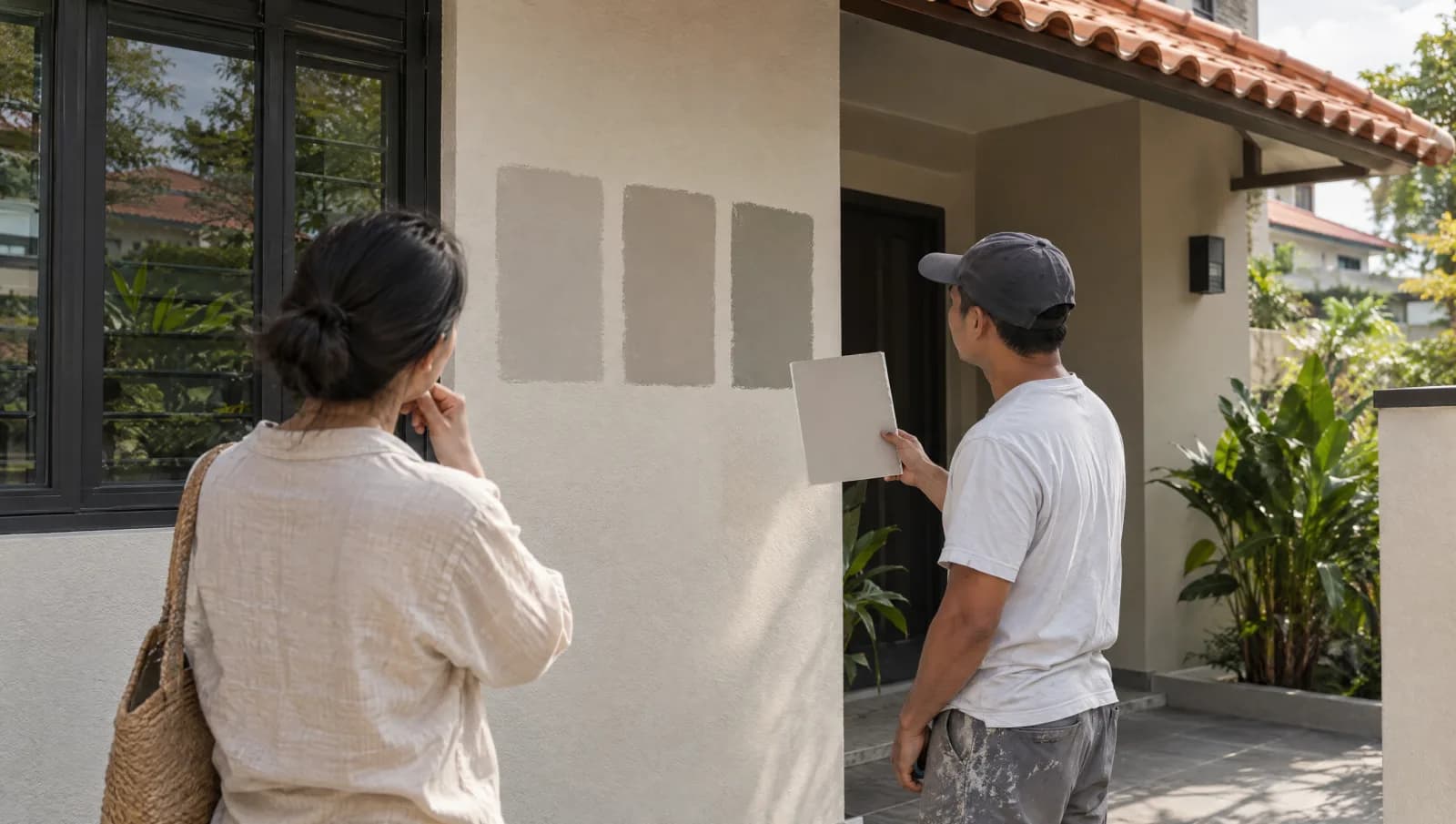
Ask for a sample panel on a part of the wall you can see from the ground, next to the roof, windows, gates and other materials that will stay. Look at it in sun and in shade, note its colour, sheen, texture and location, and think about glare if a reflective finish is proposed. The accepted sample and specification become the reference for the rest of the job, and our guide to testing exterior paint colours before the painters begin covers this step in more detail.
Compare a complete package
Give every firm quoting for the facade works the same check findings, drawings and finish brief, so each price covers the same house. Ask each quote to spell out the preparation, the repairs by location, the paint system and number of coats, access for each side, protection and putting things back. A lower total may simply leave out the repairs or a hard-to-reach side.
Some repairs can't be measured until the scaffold is up and the walls can be tapped. For those, ask the quote to say what is still unknown and how extra work will be measured and priced, so it isn't settled on the spot. A one-line “repair all cracks” doesn't tell you whether it covers hairline cracks in the paint, cracks that move with the building, or structural work that needs an engineer.
For a landed exterior, paying a contractor is worth it for anything you can't reach from the ground. Upper walls, eaves and parapets mean working from a scaffold or platform, which is work at height under workplace safety rules and a contractor's job with proper access, not a homeowner's job on a ladder. The fee buys that access, the preparation and repairs, and the primer and finish coats the paint maker specifies.
| Scope boundary | Question to resolve |
|---|---|
| Window and roof junctions | Who seals the joints where the wall meets each window and the roof edge, and how will they be shown to be watertight? |
| Services | Who removes, protects and refits lights, pipes, aircon brackets and other items on the wall? |
| Unseen defects | How will extra repairs found from the scaffold be shown to you and priced before work goes ahead? |
| Completion | Which photos, records and checks will you receive before the scaffold comes down? |
Inspect while access is still available
Checking the finished upper walls is the contractor's job, done from its scaffold or access platform before that equipment comes down. Ask its team to show you dated close-up photos of each repaired area, one side of the house at a time, and to match the work against the accepted sample and the agreed repairs. Your own check is look-and-note from the ground, windows and balconies; don't climb the scaffold or a ladder. Collect the photos, any inspection or test records, the paint product details and the maintenance instructions.
Keep that record with the house, marked by location. When windows are replaced, the roof is repaired or a pipe is run through a wall later, whoever does the work can see where the wall was repaired and sealed. A warranty is only useful alongside a clear record of what was installed and what you are expected to maintain.
Regulatory compliance
Check which requirements apply to your proposed scope. Agree the responsible qualified professionals, submissions and inspections before work begins.
BCA
Periodic Facade Inspection applicability (houses used solely as residences are excluded), and structural plan requirements where cladding or fixings form part of the work.
Primary source: www1.bca.gov.sg/safety-and-standards/periodic-building-inspections/periodic-facade-inspectionURA
Conservation Permission where the property and proposed work fall within conservation controls.
Primary source: www.ura.gov.sg/guidelines/conservation/additions-alterationsGlossary
- Substrate
- The surface or underlying material that a finish is applied or attached to.
- Render
- The plaster layer applied over an external wall, under the paint. Renewing it means replastering.
- Facade interface
- A connection between the wall and an opening, roof edge, pipe or adjoining material, such as the joint around a window frame.
- Close-range inspection
- In BCA's statutory facade inspection, a hands-on check of at least 10% of each face of the building, tapping the surface to find hollow or loose plaster and tiles that can't be seen from a distance.
- Spalling
- Concrete flaking or breaking away from its surface. BCA lists it among common facade defects.
- Efflorescence
- White salt deposits on plaster or brick walls. BCA lists it among common facade defects.
Frequently asked questions
Does a landed house need BCA's facade inspection every seven years?
No, if it is a detached, semi-detached, terraced or linked house used solely as a home, because BCA's guidelines exclude those houses. The inspections also apply only to buildings over 20 years old, and buildings whose highest point is 13 metres or lower from the ground are excluded too. If part of the house is used for something else or you have received a notice, check with BCA. Either way, keep maintaining the exterior.
Can waterproof paint fix an exterior-wall leak?
Not on its own when water is getting in through a crack or a joint. BCA's guide on external walls says rain usually gets in through joints and cracks, and its good practice is for gaps around window and door openings to be fully grouted with waterproofing mortar before finishing work starts. A coating laid over an open crack or joint leaves the way in where it was, so find and repair the entry point first, then paint.
When should I not paint my house?
Don't paint in wet weather, on walls that are still damp, or over cracks, bulging plaster or leaks that haven't been repaired. For one product, Dulux's Weathershield sheet says not to apply it during wet weather or where the wall's moisture reading is above 17%, leaving those walls to dry further. Dulux also asks for loose or powdery paint to be removed and mould and algae to be treated first.
Which company is best for exterior painting?
No single company is best for every house. The right firm is the one whose written quote shows it has looked at your walls. Four signs help. The quote names the paint system and number of coats from the maker's sheet, and Dulux's Weathershield sheet, for example, specifies one primer coat and two finish coats. It prices crack and plaster repairs separately from the painting. It says the walls' moisture will be checked before painting starts. And it explains how the team will safely reach each side of the house and the high details.
What are the different types of exterior walls?
BCA's guide on external walls names cast in-situ reinforced concrete, precast concrete and masonry brick as the three common types. The guide also lists curtain walls, cladding walls and concrete block walls among the systems in use. Plaster (render) and paint sit on top of the wall, so the finish alone won't tell you which type you have; check the drawings or ask whoever inspects the wall before choosing repairs.
If you read nothing else
Talk through the options for your home
Tell us what you want to change, how your household uses the space and when you hope to start. Share photos or plans on WhatsApp if you have them.
Browse all facade & exterior articles →
Go deeper: facade & exterior articles
In-depth pieces that expand on the sections above: real costs, brand and system comparisons, the installation process, and the edge cases most homeowners hit.
Still deciding? Compare options & estimate cost
Side-by-side comparisons and an instant cost estimate for your Singapore home.