On this page
View In PDFA flat concrete roof relies on one continuous waterproof layer, so its weak points are where water sits or the layer is joined, at low spots, blocked outlets, joints and edges. A pitched roof sheds rain down overlapping tiles or sheets, so water gets past cracked tiles, ridges, valleys, flashings or a worn underlay. Each needs a different repair.
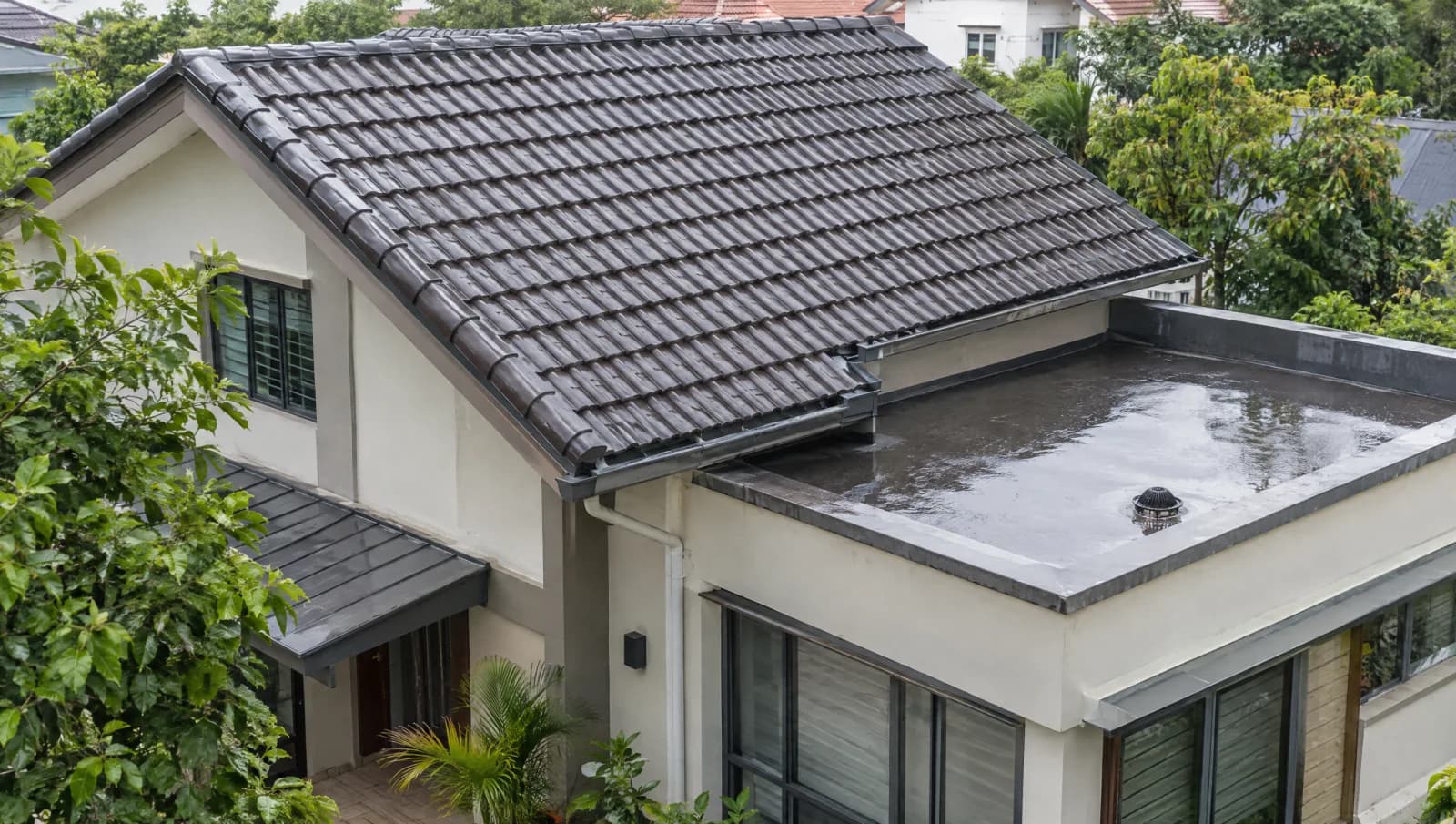
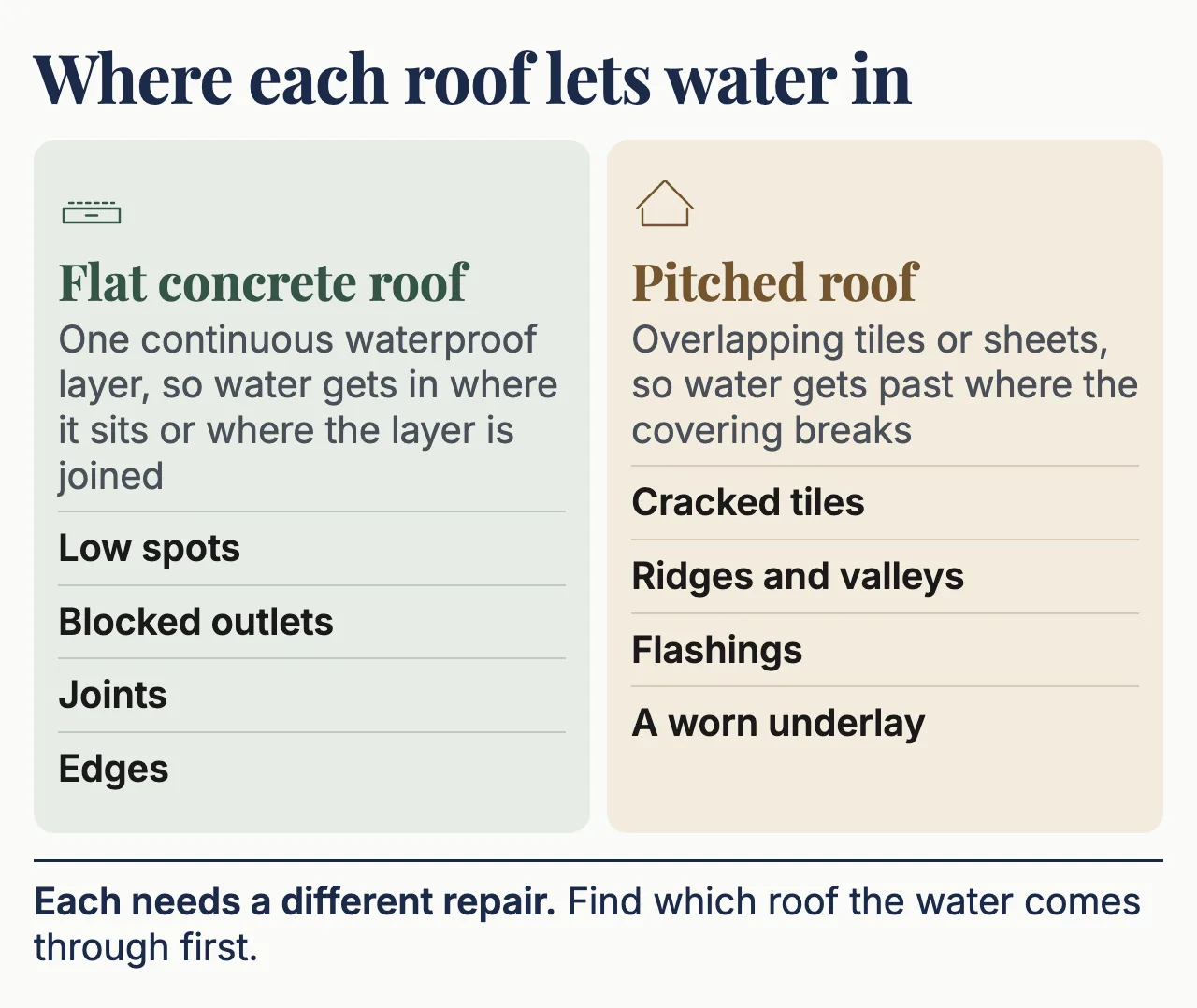
A landed house can have both, for example a pitched roof over the main house and flat concrete roofs over a porch, a rear extension or the top of an attic. Before anyone prices roof waterproofing for your house, the first job is to find which roof the water is coming through and what that roof is built from. A coating that suits a flat slab won't fix a slipped tile, and new tiles won't fix a flat roof that holds water.
Why Roof Type Drives the Strategy
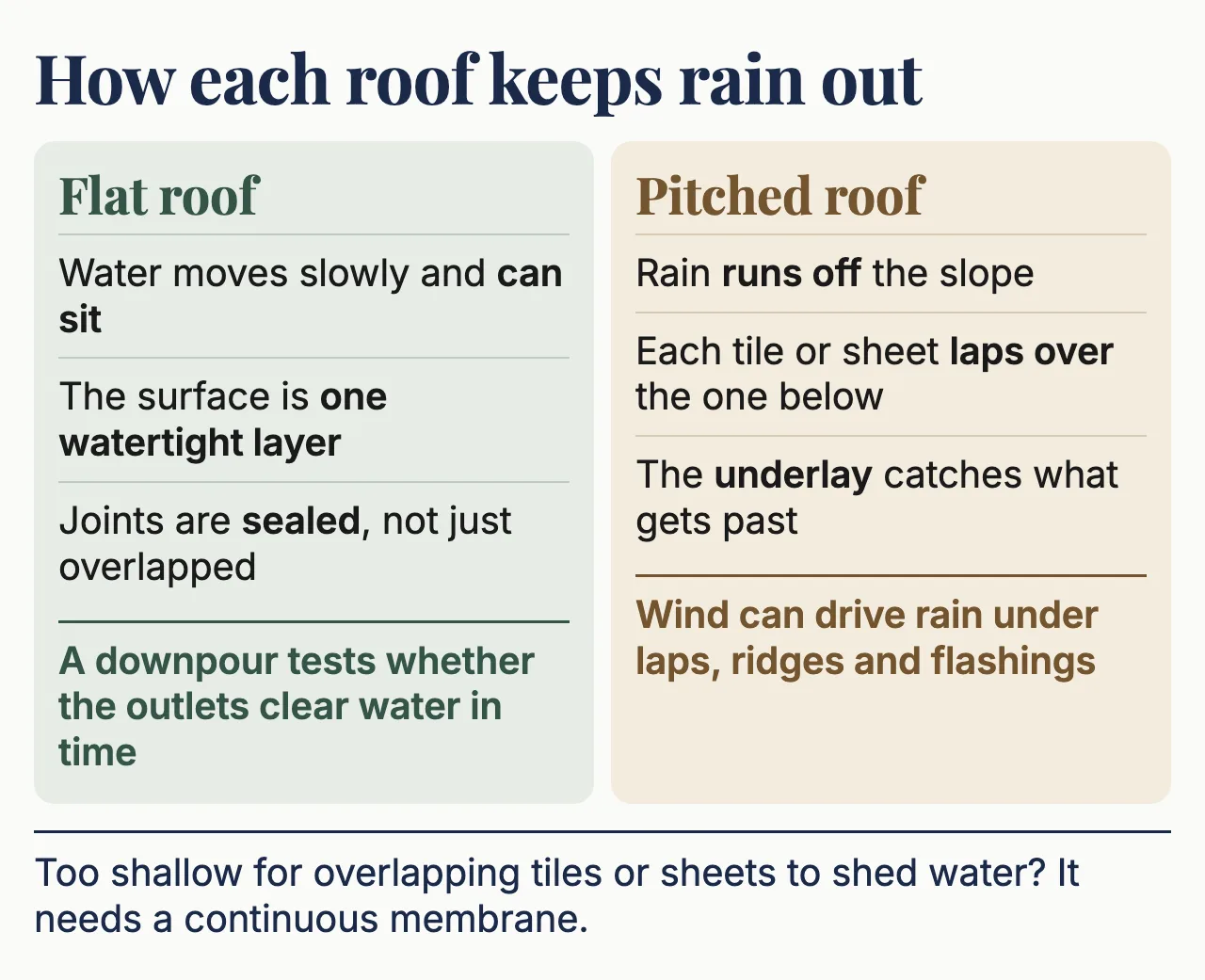
The difference comes down to how long water stays on the surface. On a pitched roof, rain runs downhill over overlapping pieces, each tile or sheet lapping over the one below, and the slope carries the water off. What gets past the tiles meets a second line, an underlay beneath the tiles that acts as a secondary waterproofing layer. On a flat roof, water moves slowly and can sit, so the surface itself has to be one watertight layer with its joints sealed rather than simply overlapped. That is why one torch-on membrane's data sheet has the sheets laid from the low point of the roof upward, starting in the valleys, so that no lap faces the flow of water.
Where a roof stops counting as pitched depends on what covers it. Tile makers set a minimum pitch for each tile, and for one maker's range concrete tiles need at least 15 degrees and clay tiles 25 degrees, depending on the design, while below 15 degrees neither is appropriate and a flat roofing system is the correct choice. The same maker, writing for Malaysian construction, puts the line between a low-pitched roof and a flat roof at around 2 to 5 degrees, depending on the material and drainage. In practice, a flat roof is any roof too shallow for overlapping pieces to shed water, so it needs a continuous membrane instead.
Singapore's weather tests each design in its own way. It rains on an average of 171 days a year, much of it heavy and with thunder, and Sumatra squalls in the Southwest Monsoon bring gusts of 40 to 80 km/h. On a flat roof, a downpour tests whether the outlets can clear water before it builds up. On a pitched roof, wind can drive rain up under tile laps, ridges and flashings, and tiles laid below their minimum pitch let water back up at the laps in wind-driven rain.
So an assessment starts by identifying how your roof is built. The approved building plans for the house, which owners can buy through BCA, can show how the roof was designed, though not what has changed since or what condition it's in now.
Flat roofs on Singapore houses
Singapore planning rules call a flat concrete roof an RC flat roof, short for reinforced concrete. URA's roof rules for terrace, semi-detached and detached houses allow a pitched roof within the permitted building envelope, but a flat roof less than 3 metres below the top of that envelope has to be an RC flat roof, kept non-accessible except for maintenance. Roof terraces may go on the attic floor, at least 3 metres below the top of the envelope. An RC flat roof is a reinforced concrete slab laid to a slight fall, with a waterproof membrane on top and sometimes a screed or tiles over that as protection. The slab carries the load, and the membrane is what keeps the rain out.
Flat doesn't mean level. The roof is laid to a slight fall so water runs to scuppers, outlets or gutters. BCA's Green Mark maintainability guide for residential buildings gives a fall no gentler than 1:150 for concrete flat roofs, about 7mm over each metre, as an indicative figure, and the data sheet for one exposed roof coating recommends a 1% slope, with 0.5% as the minimum where the layout and drains allow. Neither is a legal minimum for an existing house, and a fall that small is hard to judge by eye. What the roof does after rain tells you more.
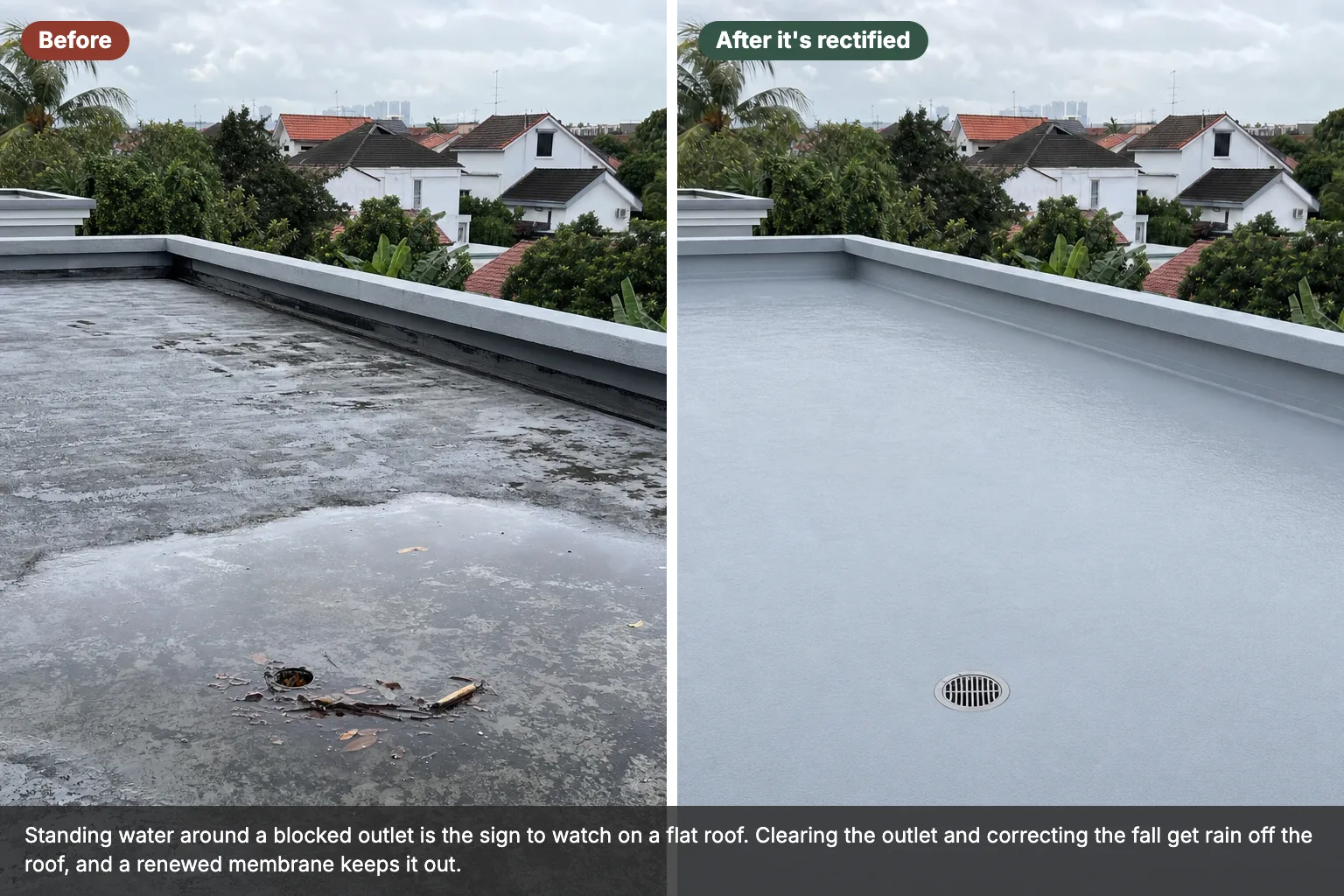
Standing water is the sign to watch for. BCA's CONQUAS standard for new private housing passes a flat roof only when ponding is under 3mm with no sign of chokage, and requires a water-tightness test on flat roofs, declared by the project's Qualified Person. An existing house isn't assessed that way, but the benchmark is useful. Water still lying on the roof long after the rain has stopped points to a dip, a blocked outlet or a fall running the wrong way. If a window or doorway overlooks the roof, look from there after rain rather than walking out onto it.
A membrane that tolerates ponding doesn't make ponding acceptable. One polyurethane roof system is resistant to ponding water but not suitable for permanent immersion, and the exposed coating above is made for roofs with short ponding only. If water keeps collecting, the fall or the outlet needs correcting as part of the job. Why water pools on a roof and what fixes it goes through falls, outlets and overflows in detail.
Where the water goes next matters as much. NEA's environmental health code asks designers to avoid features where water can stagnate and breed mosquitoes, and to give any part of a building where water may stagnate permanent, safe access for maintenance. An outlet or scupper nobody can reach is hard to keep clear. Any new outlet also has to run to rainwater drainage, because PUB's sewerage code bars connecting any area that receives rain to the sewers.
Damp under a flat roof on a dry day
If the ceiling under a flat roof looks as if it's sweating, the roof may not be leaking at all. Humid air leaves water on anything cold enough, the way a glass of iced water beads on the outside, and Singapore's relative humidity runs above 90% before sunrise and averages around 82% over the year. A cold air-conditioning pipe, duct or drain line in the ceiling space can drip onto the ceiling board and leave a stain that looks like a roof leak. US EPA moisture guidance treats condensation on pipes as a sign of high humidity and recommends insulating cold pipes. Timing is the clue you can collect safely. Note whether the damp appears after rain, on dry days or when the air-conditioning has been running, and pass that on to whoever inspects.
Flat Roof Waterproofing Systems
A flat roof waterproofing membrane comes in two families. BCA's maintainability guide lists both for concrete roofs, a preformed bitumen or polymer sheet membrane designed with proper overlaps and terminations, or a water-based or solvent-based liquid-applied membrane. Either can work. The choice turns on how the roof is used, what sits on top of it and how many details it has.
Torch-on bitumen sheets are one sheet option. One mineral-surfaced torch-on membrane sold in Singapore is torched onto a primed deck with head laps of 12cm and side laps of 10cm, and can be left exposed to the sun without a protective screed or tiles. On a sheet roof, the laps and the edges where the sheet turns up walls and into outlets are the places to check. How torch-on and liquid waterproofing compare covers the trade-offs between the two in more depth.
Liquid membranes are brushed, rolled or sprayed on and cure into a seamless layer, which helps on roofs crowded with pipes, brackets and upstands. The exposed coating above is made for roofs with many details and complex geometry, but it is an exposed system that must not be covered with tiles or concrete. The polyurethane system is listed for flat and sloping fully exposed roofs.
| If the roof will be | Look for | Watch for |
|---|---|---|
| Left exposed, with access only for maintenance | An exposed, UV-resistant system detailed around every outlet, pipe and upstand | Some exposed coatings must not be tiled over, so a later terrace can mean a new system |
| Tiled, screeded or planted as a terrace or garden | A system its maker lists for that covered use, with a protective layer over it | An exposed coating isn't automatically suitable under tiles |
| Holding water after rain | Falls or outlets corrected first, then a system rated for any ponding that remains | Resisting ponding isn't the same as permanent immersion |
| Crowded with pipes, brackets and upstands | A system that can be reinforced and sealed at each detail | Every penetration is another joint to seal |
There isn't a single best flat roof system. We recommend deciding how the roof will be used first, then asking each contractor to name the system and show you its data sheet, so you can check that it's listed for your roof's surface, exposure and any standing water. For a roof you plan to tile or turn into a terrace later, whether to leave waterproofing exposed or cover it with screed is worth settling before the work starts.
What waterproofing a concrete roof slab involves
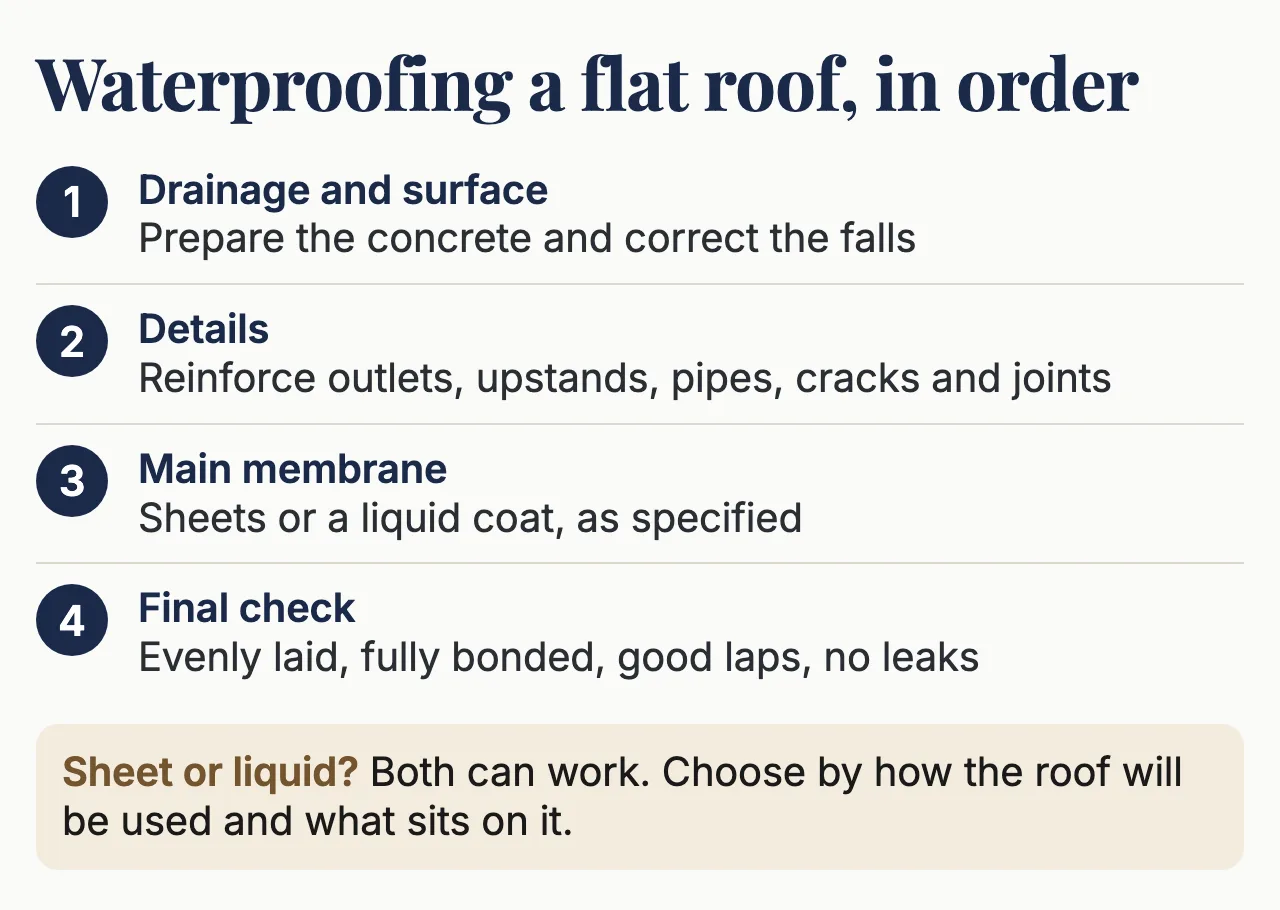
Waterproofing a concrete roof slab starts with preparing the concrete and correcting the falls, then sealing the details, and only then laying the main membrane. The data sheet for the exposed coating sets out what preparation means for that product, which is cement laitance removed mechanically by blast cleaning or scarifying, loose and weak concrete cut away, blowholes and voids opened up and filled, and a dry surface with no rising moisture. Outlets, upstands, pipes, cracks and joints are then reinforced, and the main field goes on in the specified number of coats or sheets.
Whatever the system, waterproofing a flat roof follows that order, from drainage and surface preparation to the details, the main membrane and a final check. For the finished result, CONQUAS describes good exposed waterproofing as evenly laid and fully bonded to the base, with good laps at joints, proper details where it turns up a wall, and no leaks or damage. That's a fair standard to hold any contractor to, along with a clear answer on whether the finished roof will be water-tested and how that will be done safely for your structure.
Flat roof construction on a new extension follows the same order at a larger scale. The slab is formed to falls or screeded to them, outlets and scuppers are built in, and the waterproofing and any protective finish go on last. A new or altered slab is structural work, and BCA advises owners to engage a Qualified Person to establish which approvals it needs. None of this is homeowner work, since it happens at height near open roof edges.
Repair, overlay or strip and renew
A flat roof repair can be local, an overlay, or a full strip and renewal. A local repair suits a defect at one point, such as a lifted lap or a failed seal at an outlet, when the rest of the membrane is sound. An overlay puts a new system over the old one and depends on the old layer being sound. The same data sheet requires existing coatings to be firmly adhered with oxidised layers removed, and bituminous felt to be firmly fixed with no badly degraded areas. Where the old layer is loose or degraded, it has to come off first.
Replacing a flat concrete roof means renewing the layers on top of the slab, which are the membrane, any screed laid to falls and any tiles or protection over it. The slab isn't part of that job unless it's damaged or being altered, and then it becomes structural work, which our guide to roof waterproofing approvals explains. The roof waterproofing buying guide sets out how to choose between repair, overlay and removal from what the inspection finds.
Where pitched roofs leak
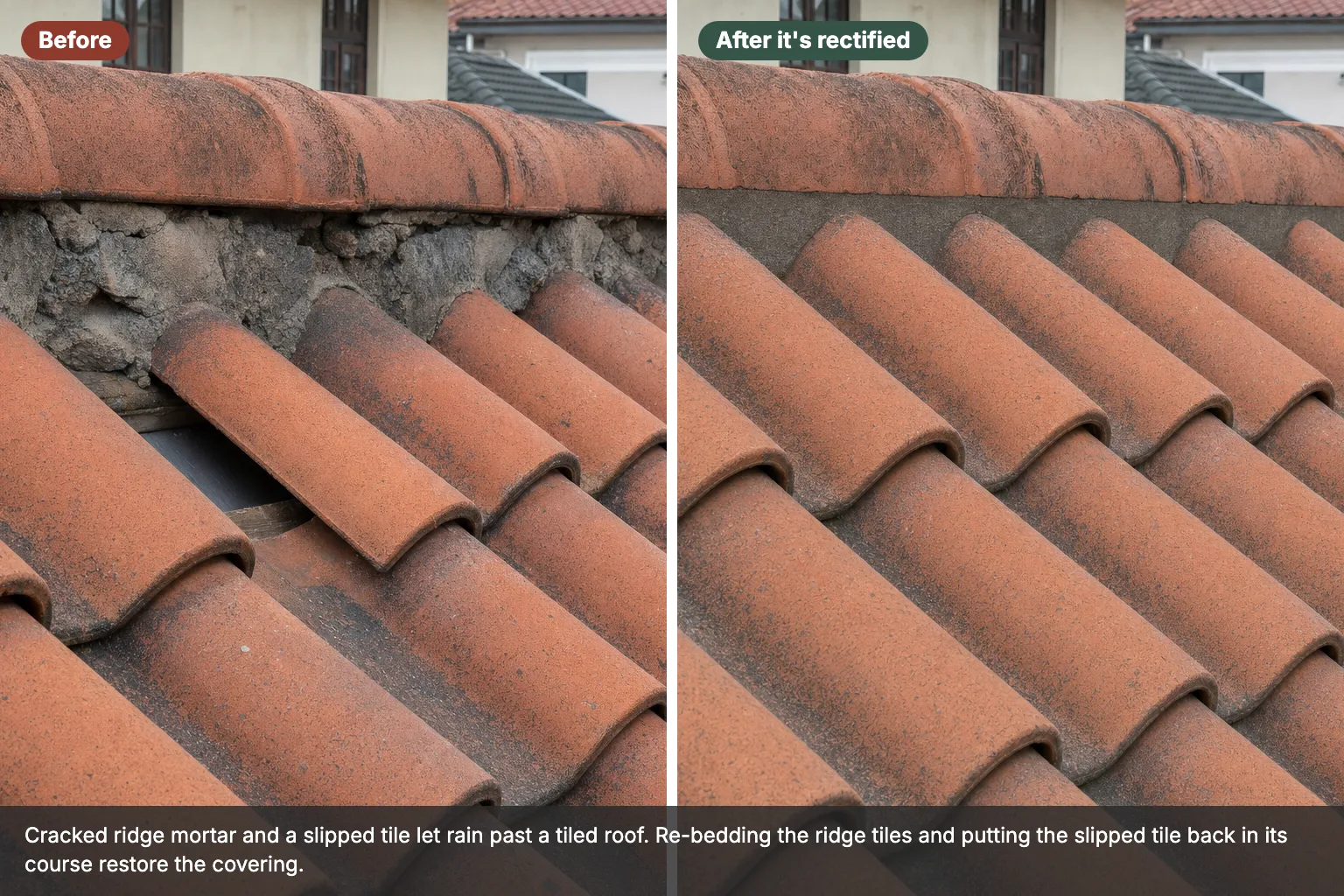
A pitched roof on a landed house may be clay or concrete tiles with an underlay beneath them, tiles laid over a sloping concrete slab, or metal sheets. Find out which before anyone quotes, because the layer under the covering decides what a repair involves. Don't assume every tiled roof sits over a waterproofed concrete slab.
For tiled roofs, a tile maker's guide to leak causes names seven places water gets in.
- Cracked or slipped tiles, which leave a direct gap in the covering.
- Cracked ridge and hip mortar, which can also leave ridge tiles loose in strong wind.
- Blocked or damaged valleys, where two slopes meet and the most water flows.
- Poorly flashed pipes, vents and wall abutments.
- Poorly detailed eaves and verges, where wind or capillary action can draw rain back under the tiles.
- A worn underlay, which can fail unseen while the tiles above look intact.
- Tiles laid below their minimum pitch.
Several of these are hard to see from below. A stain near an outside wall can point to an abutment flashing, one under a valley to the valley itself, and a patch mid-slope to a tile or the underlay. These are leads for the inspector, not a diagnosis.
Gutters at the eaves carry what a pitched roof sheds. When one blocks, water backs up at the edge of the roof and can stand long enough to breed mosquitoes, which is why NEA's code has said since 2005 that no roof gutters should go on new developments, and asks for existing ones to be removed or sealed when A&A or reconstruction work involves the roof structure, though NEA can grant waivers case by case. If a repair grows into that kind of rebuild, the Qualified Person is advised to consider another way to carry rain off the roof.
For what a sound pitched roof looks like, BCA's CONQUAS standard checks for no leaking, no rust or stains, tiles in alignment, openings sealed against pests and proper dressing around anything that passes through the roof.
Pitched Roof Waterproofing Systems
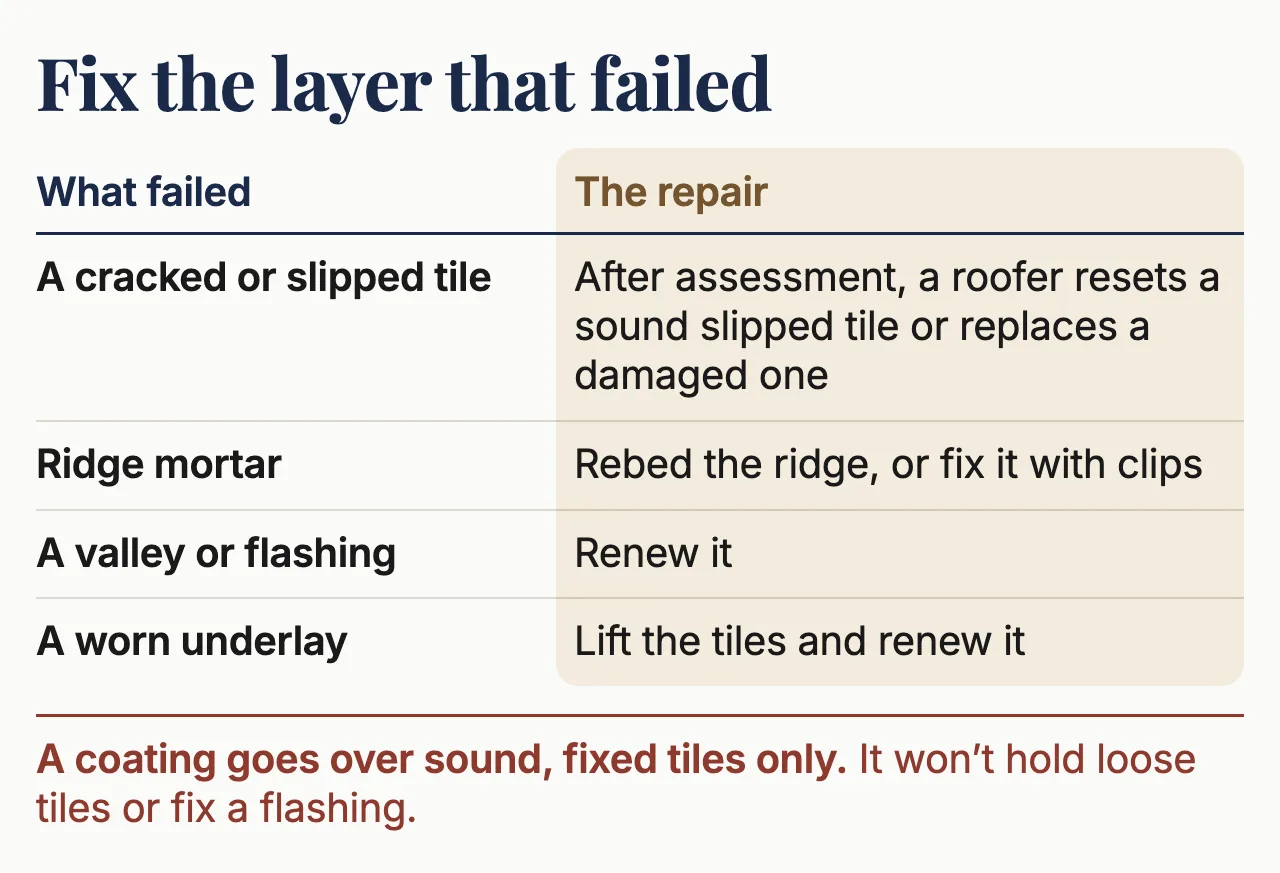
Pitched roof waterproofing means restoring whichever layer has failed. That can be replacing cracked tiles, rebedding ridge tiles or fixing them with mechanical clips, renewing a valley or flashing, or lifting tiles to renew the underlay beneath. The tile maker above uses ridge clips that hold ridge tiles independently of the mortar, and preformed valley and flashing pieces in place of site-made ones. A tile repair doesn't restore a failed underlay or flashing beneath it, so the quote should say which layer is being fixed.
Can a coating waterproof roof tiles?
Some liquid roof coatings list tiles as a surface they can go on. The exposed coating's data sheet requires every tile to be sound and securely fastened, broken or missing ones replaced, and fully glazed tiles abraded before priming, and the polyurethane system lists unglazed ceramic tiles among its substrates. So a coating is an option over sound, fixed tiles, not a way to hold loose ones in place. It also works only on the surface it covers. Water coming through a wall flashing or a valley needs that detail repaired, whatever goes on the tiles, so find the leak route first.
An exposed sloping concrete roof, with no tiles, is waterproofed more like a flat roof. Liquid systems such as the polyurethane one above are listed for sloping exposed roofs as well as flat ones. The slope helps water run off, but joints, upstands and penetrations still need detailing, and a compatible protective finish may be required.
Metal sheet roofs are laid to the sheet maker's minimum pitch, which BCA's maintainability guide ties to the manufacturer's specification or a pitch table for each profile. The guide to aluminium roof leaks covers when resealing fixings, joints and flashings is enough and when sheets need replacing.
Cost Differences
Flat and pitched roofs cost different amounts to waterproof for different reasons, and shape alone doesn't set the price. The work each roof needs does, and these are the lines that move a quote up or down.
| What moves the price | Flat concrete roof | Pitched roof |
|---|---|---|
| Getting to the work | Easier to stand on, but an unprotected edge still makes it work at height | Slope, height and fragile tiles can mean scaffolding or edge protection before any repair starts |
| What comes off first | Whether the old membrane can stay, or must be stripped because it is loose or degraded | Whether tiles must be lifted and relaid to reach the underlay, battens or flashings |
| Drainage | Screeding to correct the falls, or adding or enlarging outlets, if water ponds | Clearing or rebuilding valleys, and what happens to any gutters |
| Details | How many outlets, pipes, brackets and upstands need sealing | Ridges, hips, valleys and wall flashings to rebed or renew |
| What sits on top | Lifting and relaying tiles, screed or planters on a terrace | Finding replacement tiles that match the existing profile |
| Checking the result | Whether a water test is included and how it will be done | Who checks the roof space and ceilings after the next heavy rain |
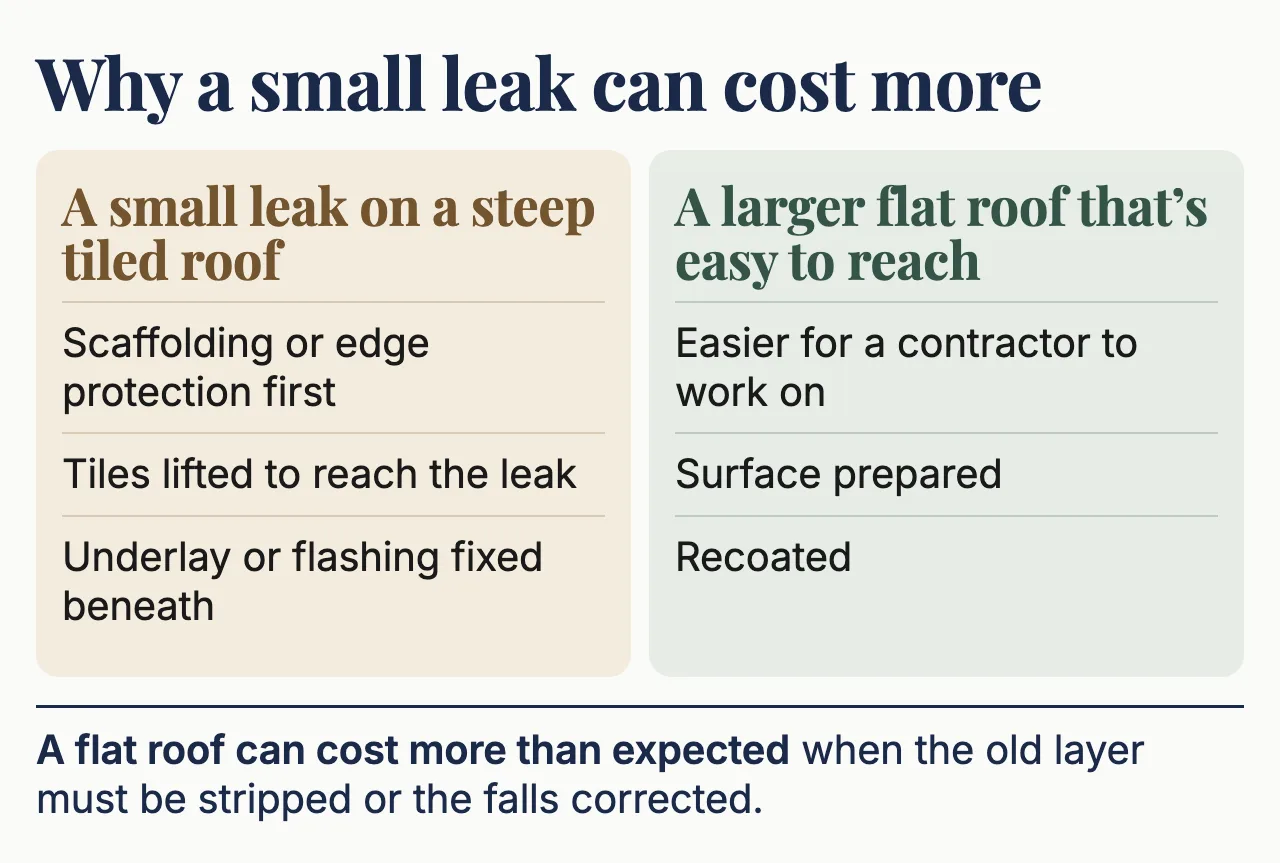
Read each quote against those lines. A small leak on a steep tiled roof can cost more to fix than recoating a larger flat roof that is easy to reach, because of the access and the tiles that must come off to reach the leak. A flat roof can cost more than expected when the old layer has to be stripped or the falls corrected. Ask each contractor to name the system, give you its data sheet, and separate access, diagnosis, the waterproofing itself, drainage work and making good, so you're comparing the same scope rather than two different jobs. The quote should also state the product's specified application rate, reinforcement and protective finish, so you can check these against the manufacturer's instructions.
To plan the assessment, send us photos taken from safe places, such as the stained ceiling, the roof seen from a window and the eaves from the ground, and tell us whether the damp appears in heavy rain, in wind from one direction or on dry days. Say whether the roof is flat, pitched or both, when it was last waterproofed, and whether you have the approved plans. Photos can't show a hidden leak path or set a final price, but they help decide what the inspection needs to look at.
Common questions
Does a pitched roof need waterproofing?
Yes, but on a tiled roof the waterproofing is spread across several parts rather than one layer. Overlapping tiles shed the rain, and an underlay, flashings, ridges and valleys deal with what gets past or around them, so waterproofing work means restoring whichever of those has failed. An exposed sloping concrete roof without tiles is different, and can take a liquid membrane listed for sloping roofs.
Can you walk on a flat roof?
Not unless it's a roof terrace built for it. URA's roof rules for terrace, semi-detached and detached houses keep a flat roof less than 3 metres below the top of the permitted building envelope non-accessible except for maintenance, and its open edges make going up there work at height, so look from a window and leave roof access to a contractor equipped for it. A roof terrace on the attic floor is built to be used, and roof terrace waterproofing needs a system specified for that finished floor, because an exposed coating chosen for maintenance access may not be one that can be tiled over.
Are flat roofs a bad idea in Singapore?
No, but a flat roof depends on its drainage in a way a pitched roof doesn't. Water moves slowly across it, so a blocked outlet or a dip in the surface leaves water sitting on the membrane. Having a contractor keep the outlets clear and deal with ponding early does more for a flat roof than a thicker coating. In return you get a roof surface a contractor can work on for maintenance or solar panels.
Can a flat roof take solar panels?
It can, if the structure, the roof and its waterproofing are assessed first. Every bracket, cable entry or ballast block sits on or passes through the membrane, and the waterproofing under the panels is harder to reach once they're in place, so any repair is best done beforehand. The roof waterproofing buying guide covers coordinating solar work with the roof.
Roof Waterproofing across Singapore
Need help with your project?
Tell us what you need on WhatsApp and send a few photos. We'll arrange a free site assessment, then give you a fixed-price quote within 3 to 5 working days.