On this page
View In PDFReport defects first, then renovate. Under the standard agreement for buying a new condo unit from a developer, the developer must make good defects that show up within 12 months, and gets one month to fix each one after your notice. So inspect and report before anything is painted, tiled or built over.
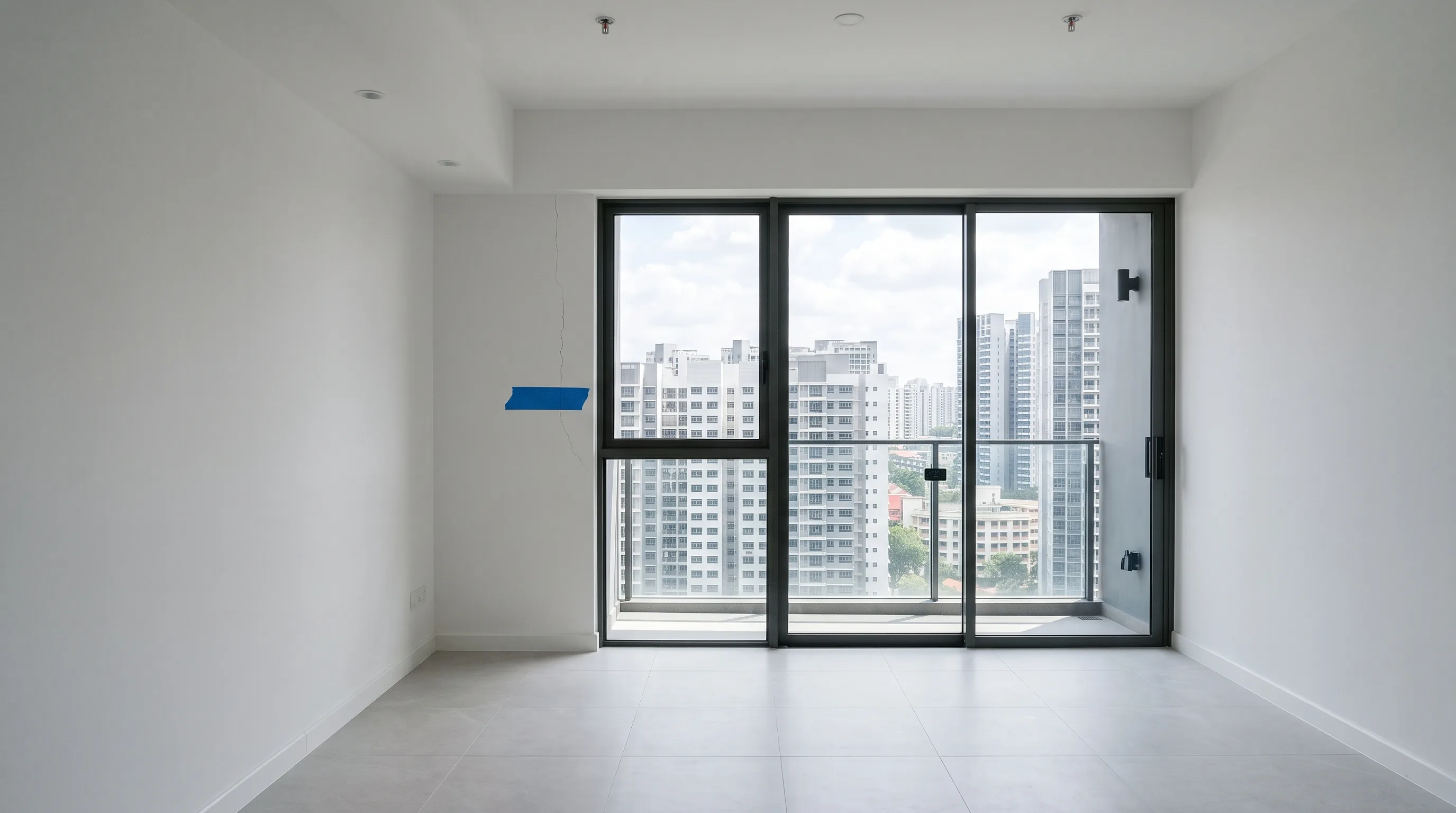
This page goes deeper on the defects step in our condo renovation guide: when your 12 months start, how reporting works, what the agreement lets you change in the first year and who decides for the estate early on. For the works themselves, see our condo renovation service.
When your 12 months start
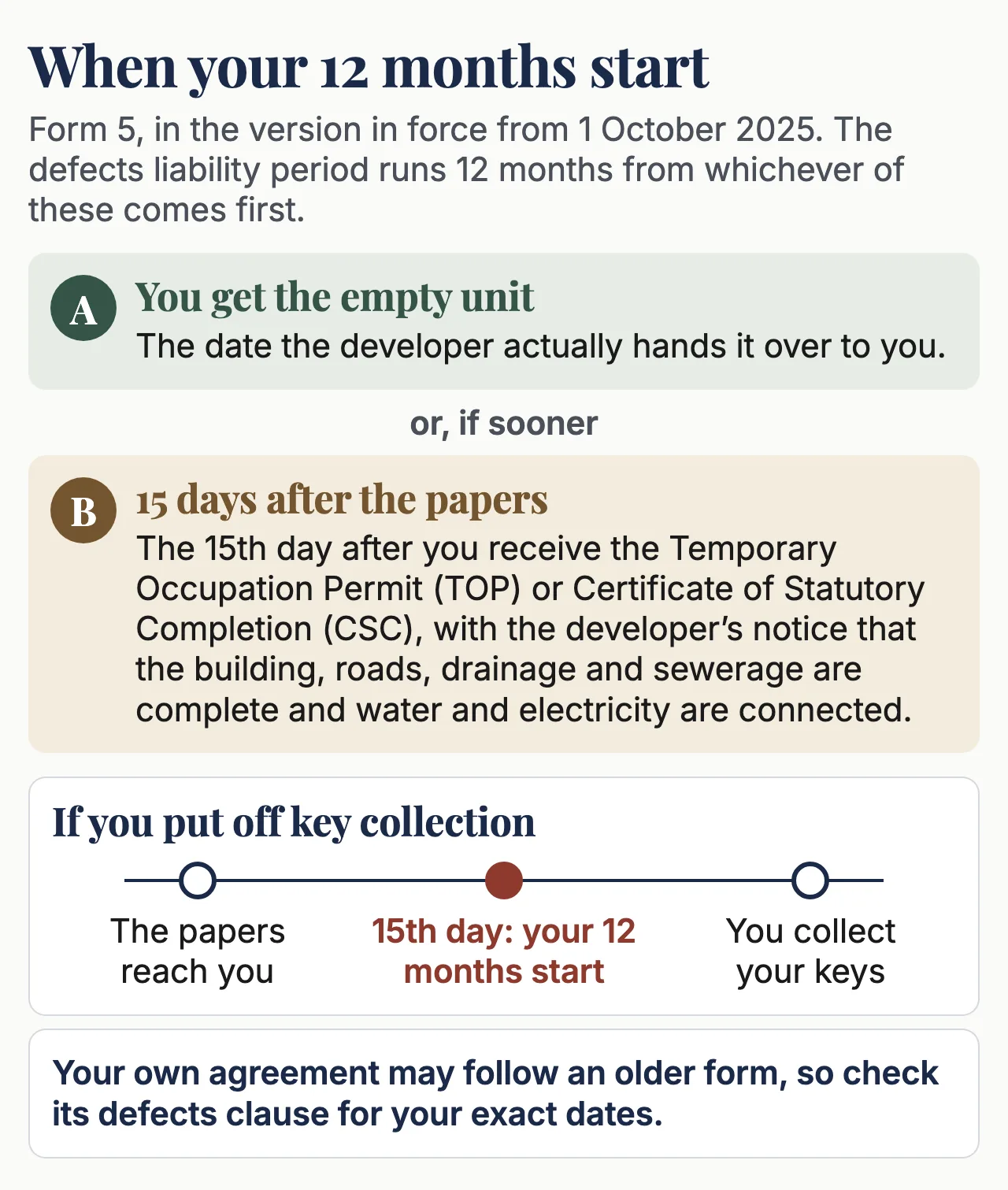
After you collect the key, URA says you can inspect your unit and report defects in your unit and housing project to the developer for rectification within the 1 year defects liability period.
The exact dates come from Form 5 of the Housing Developers Rules, the sale and purchase agreement the law sets for a unit in a strata development, such as a condo, bought from a developer. In the version in force from 1 October 2025, clause 17 runs the 12 months from whichever of these comes first:
- the date the developer actually hands the empty unit over to you (the agreement calls this delivering vacant possession), or
- the 15th day after you receive the Temporary Occupation Permit (TOP) or the Certificate of Statutory Completion (CSC) for the unit, together with the developer's notice that the building, roads, drainage and sewerage are complete and water and electricity are connected.
So the clock can start before you collect your keys. If those papers reach you and you put off key collection, the second date comes first.
Your own signed agreement may follow an older version of the form, or carry amendments approved under the Rules, so check its defects clause for your exact dates.
What counts as a defect
The form defines a defect as a fault in the unit, the housing project, the common property or the limited common property (shared areas the agreement sets aside for some units only) that's due to defective workmanship or materials, or to it not being built to the specifications in the agreement. So it covers the shared parts of the estate as well as your own rooms.
BCA says any defect reported during the defects liability period stays the developer's responsibility if it's still unsolved after the period ends. Once the period has passed, upkeep is yours, and you may need your own contractor and bear the cost of repairs.
What happens after you report a defect
Put every defect in writing to the developer. Clause 17 of the standard form then sets out three steps.
| Step | What the standard form says |
|---|---|
| You give the developer notice of a defect | The developer must make it good within one month of receiving your notice |
| The month passes and it isn't fixed | You may notify the developer in writing of a building or renovation contractor's quoted cost for the repair, and that you'll have your own contractor do it if the developer doesn't within 14 days of that notice. A copy of the quotation goes with the notice |
| The 14 days pass and it still isn't fixed | You have the right to have the repair done and recover its cost from the developer, and may deduct it from the sum the Singapore Academy of Law holds as stakeholder for the developer |
We recommend keeping a dated copy of every notice, photo and reply. If it ever comes to the third step, that's your record of what you reported and when.
What to check before any finish goes on
We recommend a slow walk through every room before you sign off any renovation drawings, photographing each problem with the date. Look and note only: leave opening panels, ceilings and electrical points to the developer's workmen.
Look for these and photograph each one
0 of 7 reviewed
Use this to track your review. Checks stay on this page while it is open.
Do this before your contractor starts, because new paint, tiles and carpentry hide exactly what you're looking for. If tiles look cracked or sound hollow, our tile inspection brief explains what each sign can and can't tell you.
Why renovating over an unreported defect causes trouble
The developer's duty covers faults from defective workmanship or materials, or from not building to the specifications. Once your contractor has hacked, drilled, tiled or painted the same spot, it's hard to tell whose work caused a crack or a leak, and fixing what's underneath can mean taking your new finish off again.
That's why we recommend this order:
- Inspect and photograph.
- Report each defect to the developer in writing.
- Let the developer fix it, then check the repair.
- Only then let your contractor cover or change that area.
You don't have to hold up the whole renovation. Work in rooms with nothing outstanding can go ahead once your estate's approvals are in place, while the rooms with reported defects wait for the developer.
What you can change before the completion certificate
Until the CSC is issued for your unit, the standard form adds two limits:
- Clause 10.2. You can't carry out alterations or additions that leave the unit not built to the plans and specifications approved by the Commissioner of Building Control, unless the developer agrees in writing first.
- Clauses 15.3 and 15.4. If the CSC is refused, withheld or delayed because of works you did without the developer's written consent, the developer may give you notice to put things right within 30 days. If you don't, the developer can enter the unit, make the changes the Commissioner of Building Control requires and recover the cost from you.
For works generally, BCA says that in a new property you may go ahead with minor additions and alterations if they're insignificant building works under the Building Control Regulations, and advises checking with the developer and the project architect or Professional Engineer before any major works. BCA adds that going ahead without the approvals your works need can delay your CSC.
Removing or opening up a wall is where this matters most. Our wall hacking approval guide explains which walls need an engineer and a permit, and where one is needed, we arrange the engineer.
What the agreement restricts until the MCST takes over
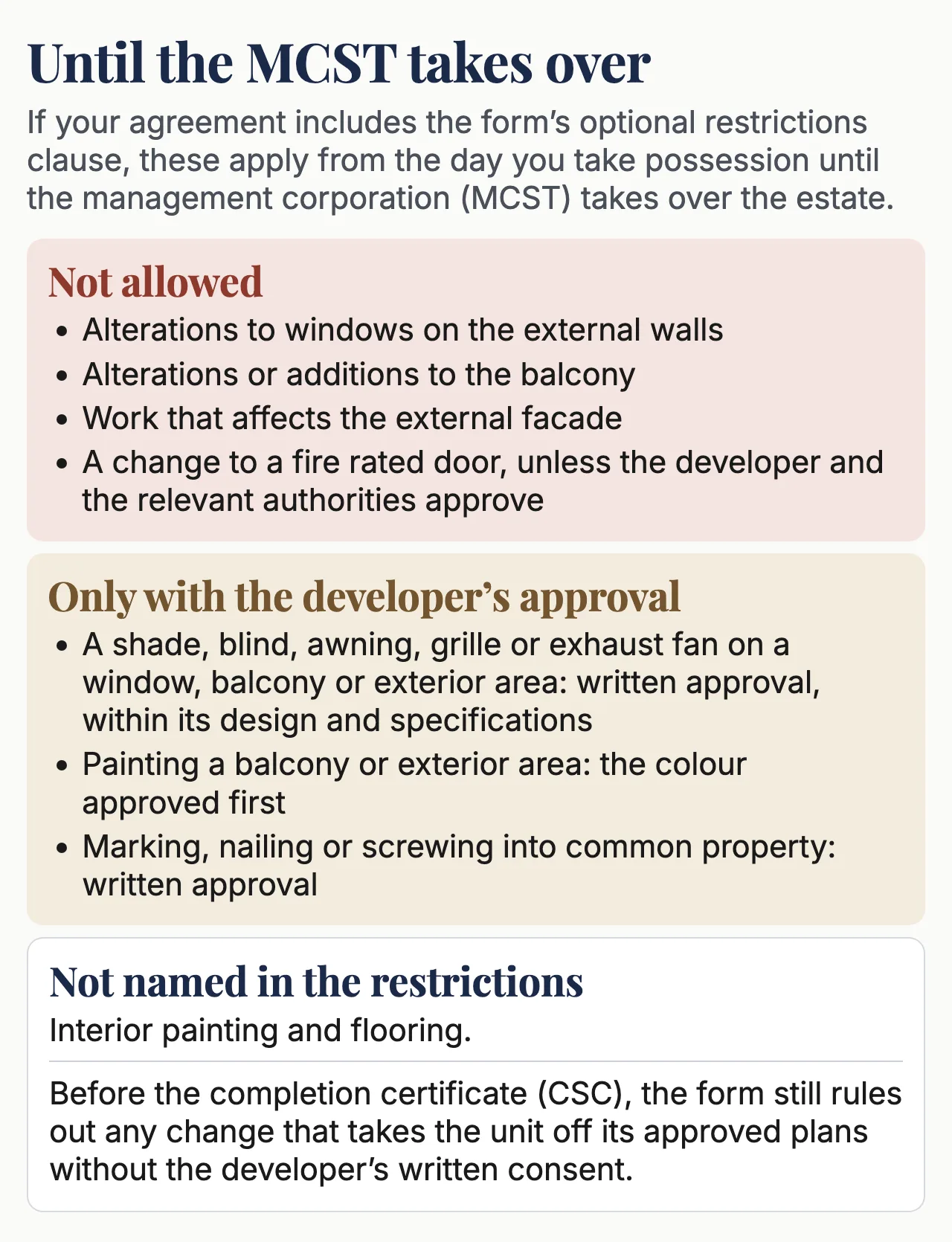
The standard form offers developers an optional clause on restrictions before the management corporation (MCST) is formed. If your agreement includes it, you follow the restrictions in the form's Third Schedule from the date you take possession until the MCST takes over managing and maintaining the estate from the developer. Among them, these touch renovation:
- No alterations to windows on the external walls, no alterations or additions to the balcony and no work that affects the external facade, and no change to a fire rated door in the unit unless the developer and the relevant authorities approve.
- No shade, blind, awning, grille, exhaust fan or similar fixed to a window, balcony or exterior area without the developer's written approval, or outside its design and specifications.
- No painting a balcony or exterior area until the developer has approved the colour.
- No marking, painting, nailing or screwing into any structure that's common property without the developer's written approval.
- No repair, alteration or renovation that weakens or damages the household shelter.
- No structure on a roof terrace, where the unit has one.
- Let the developer in at reasonable times, on reasonable notice, to maintain or repair pipes, wires, cables and ducts serving other units or the common property, and don't build any structure, fixture or feature that gets in the way of that.
Your agreement may carry other optional clauses too. One in the form says balconies, private enclosed spaces, open terraces and roof gardens can't be roofed over or enclosed without the prior written approval of the relevant authority and of the developer or, once formed, the MCST.
Interior painting and flooring aren't named in the Third Schedule, though before the CSC, clause 10.2 still rules out any change that takes the unit off its approved plans without the developer's written consent. BCA also advises checking with the developer or the MCST, and your agreement, about renovation restrictions before you start any work.
Who decides for the estate until owners elect a council
Early on, decisions sit with the developer. Section 23 of the Building (Strata Management) Act 2004 has the developer exercise the powers and perform the duties of the MCST's council from the time the MCST is constituted until a council is elected at the first annual general meeting.
The developer must hold that first meeting no later than the earlier of two dates: one month after the end of the MCST's initial period (its first 12 months, or until the first meeting if that's sooner), or 8 weeks after owners of at least 10% of the lots ask for it in writing.
So ask the estate's management office for its renovation guidelines and application form before you book a contractor. Once the owners' council is elected, our guide to MCST approval rules explains what the MCST can and can't decide about your works.
Book your renovation around the defect list
Once your defects are reported, book a free site assessment. We visit and measure up, then give you a fixed-price quote within 3 to 5 working days of the visit, never from a photo. Bring your defect list along, so we both know which repairs the developer still owes you.
Common questions
Can I paint my condo before handover or during the defects liability period?
Plan it for after handover. Until then, the standard agreement has the developer completing the unit so it's fit for occupation and clearing out surplus material and rubbish before it delivers vacant possession. Interior painting isn't on the agreement's list of restricted works, but report wall and ceiling defects first, since fresh paint hides cracks and stains. If your agreement carries the form's restrictions clause, then until the MCST takes over, a balcony or exterior area can only be painted in a colour the developer has approved. Our painting quote checklist covers what the quote should include.
Will renovating void my new condo's defects warranty?
Not the developer's defect duty. Nothing in the standard agreement ends it because you renovate, and it covers any fault due to defective workmanship or materials, or to the unit not being built to the specifications. What renovation changes is the evidence, because once your works cover or alter the spot, it's harder to show a crack or leak came before them. Warranties are a separate thing. If your agreement has the form's optional warranties note, makers' and suppliers' warranties on equipment and appliances the developer installed pass to you at handover, and the developer stays fully responsible for its defect duties. Where the project has prefabricated bathroom units, the form requires a note that later penetrations aren't recommended because they will compromise the waterproofing warranty, so check before anyone drills into those bathrooms.
I bought my unit from its first owner. Do I still get the defects period?
Yes, for whatever is left of it. Under clause 21 of the standard agreement, if the first buyer completed the purchase and transferred the unit to you before the defects liability period expired, the developer performs its defect duties as if you were the buyer, and you can use the same rights. That includes a defect the first buyer reported that wasn't fixed by the transfer date.
Need help with your project?
Tell us what you need on WhatsApp and send a few photos. We'll arrange a free site assessment, then give you a fixed-price quote within 3 to 5 working days.