On this page
View In PDFYou need three-phase power when your home or shop has to draw more than a single-phase supply can carry, and SP Group's handbook caps single-phase at 23 kVA (100A at 230V). An upgrade application must go to SP Group through your licensed electrical worker (LEW), with your letter of consent. If your landlord or building management holds the supply, it goes through them.
If you'd like one firm to arrange the electrical work that comes with bigger loads, that's what our electrical works service is for. Planning the rest of the job, from rewiring to a new DB box, is in our electrical works buying guide.
What single-phase and three-phase supply mean
Both are low-voltage supplies from the grid. SP Group's handbook lists 230V single-phase and 400V three-phase on a four-wire system, and counts both as low tension, the lowest of its four supply categories.
What matters for your home or shop is how much each one can carry.
| Single-phase | Three-phase | |
|---|---|---|
| Voltage | 230V | 400V, four-wire |
| Most it can supply under SP Group's connection schemes | 23 kVA, 100A | Up to 5,000 kVA per substation |
| Supply sizes on SP Group's application form | 30A, 60A or 100A | 30A, 60A or 100A, or a stated kVA above 69 kVA |
So a bigger single-phase supply can come before three-phase. SP Group's Form CS/1 offers single-phase at 30A, 60A or 100A, and 100A is the single-phase top. Past 23 kVA, the next step is three-phase.
For a large shop or workshop there's one more line. A direct low-voltage connection from SP Group's network is available for a load of up to 280 kVA (400A), if there's enough network capacity nearby. Above that, or where capacity runs short, SP Group's handbook says you have to provide a substation.
What 45 kVA means for your installation
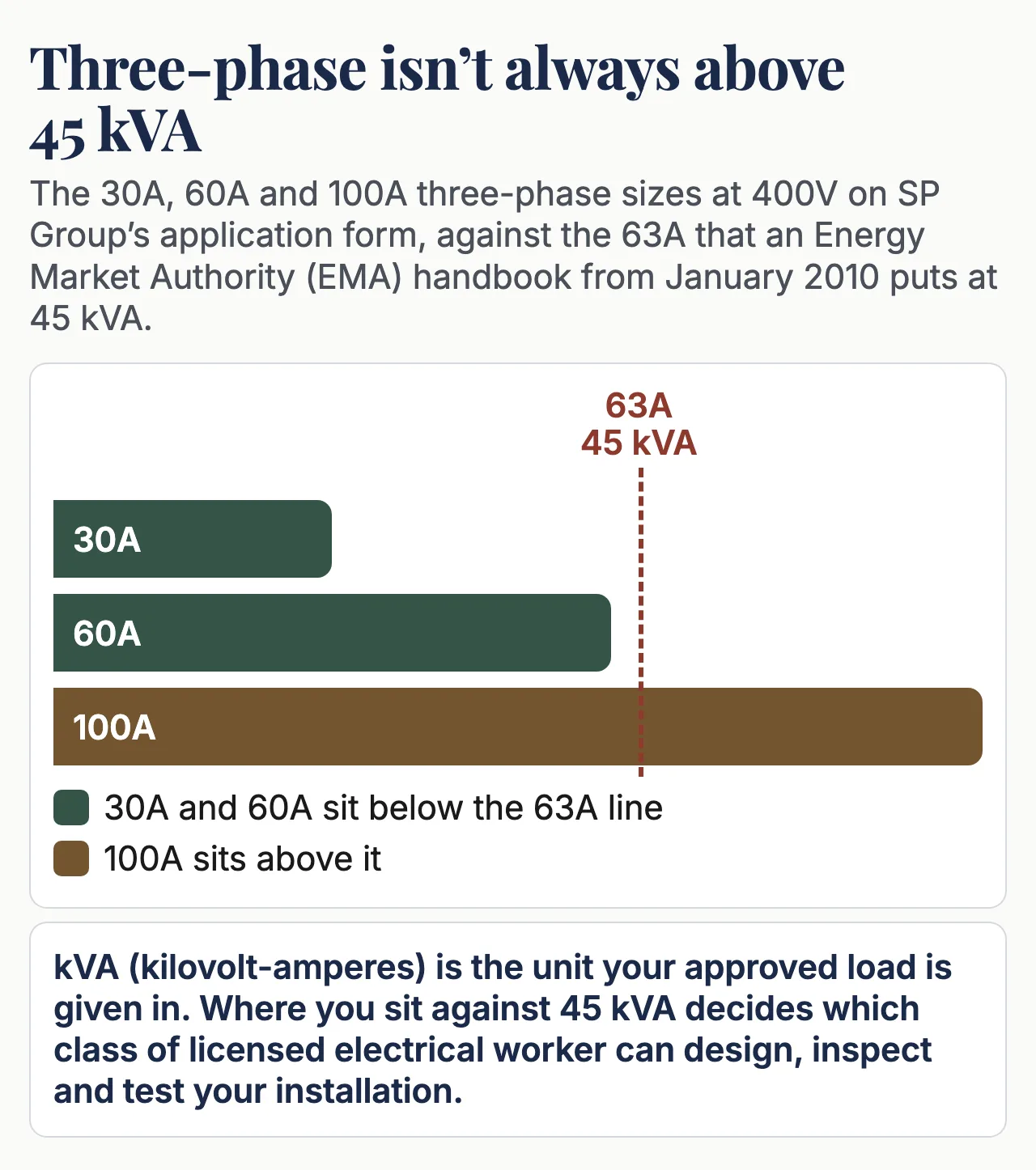
Your approved load is the total electrical load that an electrical installation is designed to handle, in the words of an Energy Market Authority (EMA) handbook from January 2010. The same handbook puts 45 kVA at 63A three-phase at 400 volts.
That's worth knowing, because three-phase doesn't automatically put you above 45 kVA. On SP Group's form, a 30A or 60A three-phase supply is below the 63A in EMA's handbook, and a 100A three-phase supply is above it.
Where you sit against 45 kVA decides which class of LEW can design, inspect and test your installation. For a shop, it also decides whether you need a licence to run it.
Why 45 kVA decides which licensed electrical worker you need
Under regulation 5 of the Electricity (Electrical Workers) Regulations, a licensed electrician may design, install, inspect and test an installation of up to 1,000 volts and 45 kVA. Above 45 kVA, an electrician may still install, repair, maintain and operate it, but only under an electrical technician's supervision, and up to 500 kVA.
A licensed electrical technician may design and submit plans up to 150 kVA, and install, inspect and test up to 500 kVA, in both cases up to 1,000 volts. A licensed electrical engineer may take full charge of any installation. Each licence is subject to any conditions EMA attaches.
So if an upgrade takes your approved load past 45 kVA, ask which class of LEW will design it, and inspect and test it. Our article on whether you need a licensed electrician for wiring covers checking that the licence is current.
When a home or shop outgrows its supply
Your supply has to cover everything you run. When you plan to add load, the question is whether your new total still fits your approved load, and whether it still fits a single-phase supply. If your premises take their supply straight from SP Group, its application form has the LEW fill in your total load requirement, including what you already have.
So make a list for your LEW of what you plan to add, for example:
- More aircon units, or bigger ones
- An induction hob, oven or other big kitchen appliances
- An EV charger in your porch or car park
- Ovens, chillers, compressors or other equipment in a shop or workshop
Give the maker's power rating for each item where you have it. Your LEW can then work out whether your current supply covers it, and if not, what size and type of supply you'd need.
A new DB box isn't the same as a bigger supply
Replacing your distribution board (DB box) and upgrading your supply are different jobs. SP Group's application form, which is for premises that take their supply straight from SP Group, has a separate box for 'Replacement of switchboard with no upgrading' among its types of connection.
Whether you need one, the other or both is for the LEW to say after looking at your installation. Our buying guide covers what a DB box replacement involves.
Who applies for the upgrade
You do, through your LEW. SP Group's handbook says customers applying for their installations to be connected must submit their applications through their LEWs, and each application must come with a letter of consent. If your landlord or MCST holds the supply, the upgrade goes through them instead.
In that letter, the owner of the premises confirms they've given the LEW consent to submit applications on their behalf, and the LEW acknowledges it. SP Services, the SP Group company that receives the applications, may still deal with you directly at its discretion.
Here's how an upgrade runs in the handbook when your premises take their supply straight from SP Group:
- You appoint an LEW and sign the letter of consent.
- The LEW fills in the installation details on Form CS/1, including your existing approved load and the total load you need, and submits it through SP Group's online portal. You sign the applicant's part.
- SP Services generally responds within 10 business days, with a quotation or an agreement setting out the service connection charge.
- SP PowerGrid, which operates and maintains the network, starts work only once the agreement has been signed and received with the service connection charges.
- When your installation is ready, the LEW arranges the inspection and turn-on, covered below.
SP Group's handbook limits each premises to a single intake connection point, identified by its house or block number. So when you upgrade, all your existing service connections have to be amalgamated into one intake.
If your project is still at the planning stage, the handbook advises engaging SP PowerGrid early, so it can assess what the network needs. The lead time depends on network conditions, including any reinforcement needed.
Who tests and turns on the new supply
Your LEW arranges it. SP Group's handbook says arrangements with SP Services for energising the service connection and turning on your installation are taken care of by the LEW.
For a home connected directly to SP Group's network, the LEW books the inspection and turn-on once the installation is complete and SP PowerGrid says the service connection is ready. For a load below 45 kVA, that goes in on Form CS/5 with a Certificate of Compliance. Above 45 kVA, SP Group asks for a different set of documents, including an as-built single line drawing.
On the day, the LEW must be present for SP Services' inspection, and you or someone representing you must be at the premises for the turn-on, for electrical safety reasons. SP Services issues a PASS inspection report on site once your installation is turned on.
Shops and businesses above 45 kVA need an installation licence
For a shop, office or other non-domestic premises with a load above 45 kVA, SP Group's handbook says you apply for a licence from EMA to use or operate the electrical installation, through an appropriate class of LEW.
Before booking the meter installation and energisation, the LEW must inspect and test the installation, and must issue a Certificate of Readiness to SP PowerGrid at site before the supply is energised. For non-domestic premises of up to 45 kVA, the handbook's turn-on steps are the same booking, inspection and PASS report as for a home.
For homes, EMA's January 2010 handbook says all electrical and supply installations used exclusively for domestic purposes are exempted from the installation licensing requirement.
If your landlord or MCST holds the supply
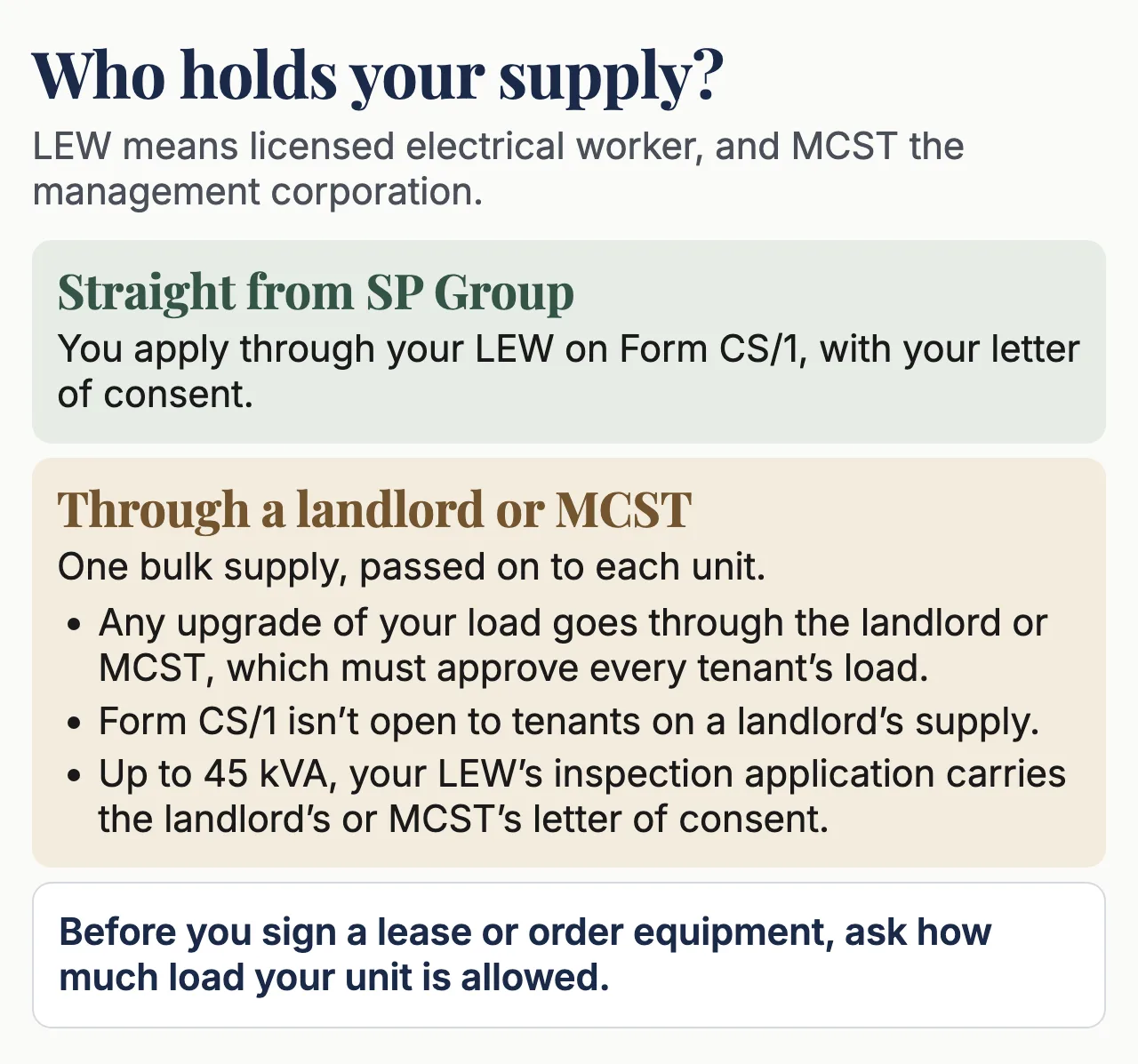
In some buildings, the landlord or management corporation (MCST) takes one bulk supply from SP Group and passes it on to each unit. SP Group's handbook calls these multi-metered premises, and names HDB, JTC and other private multi-metered buildings among them.
If your shop or unit is in one, the handbook says any upgrading of your load must go through the landlord or MCST, which must approve the load of every tenant in the building. SP Group's Form CS/1 isn't open to tenants on a landlord's supply at all.
For a load of up to 45 kVA, your inspection application still goes in through your LEW, with a letter of consent from the landlord, management corporation or HDB. On the landlord's or management corporation's version of that letter, an LEW confirms they've checked the building's loading and that your load can be catered for without exceeding the building's total approved load, and the landlord's authorised person gives consent.
If the building's own approved load can't cover what its tenants need, the landlord must apply to SP Group to upgrade the building's connection. So before you sign a lease or order equipment, ask the landlord or management office how much load your unit is allowed.
Our article on commercial renovation approvals covers the other permissions a shop fit-out can need. In a condo, our article on MCST approval for renovations covers what the estate can ask for before works start.
HDB flats have their own rules for electrical works, which this article doesn't cover.
What to have ready before you ask about an upgrade
Before an LEW looks at your supply
0 of 5 reviewed
Use this to track your review. Checks stay on this page while it is open.
If you're adding aircon, a new kitchen or shop equipment and want the electrical side arranged with it, we start with a free site assessment, where we look at your DB box and go through what you plan to add. You get a fixed-price quote within 3 to 5 working days of that visit, never from a photo. Our specialist does the electrical work, and we supervise through to handover.
Common questions
Will three-phase power increase my electricity bill?
Single-phase and three-phase are both low tension supplies in SP Group's handbook, and its tariffs are charged for low tension, high tension and extra-high tension electricity consumption. So both sit in the same low tension category, and your bill follows the electricity you use. The upgrade itself carries a service connection charge, which SP Group sets out in its quotation or agreement.
Do I need three-phase power for an EV charger?
You do if the charger takes your total load past what a single-phase supply can carry, which is 23 kVA in SP Group's handbook. If it only takes you past your current supply, a bigger single-phase supply may be enough. An EV charger adds to your load like any other appliance, so give your LEW the charger's model and power rating along with everything else you plan to add, and they can tell you what supply it needs. Separately, regulations under the Electric Vehicles Charging Act 2022, as first published in December 2023, name a licensed electrical worker as the prescribed person for installing a fixed EV charger, and require that person to install it in accordance with the technical reference TR25:2022.
How do I know if I already have three-phase power?
Ask your LEW to check, and don't open the DB box or meter cover yourself. If your premises take their supply straight from SP Group, its application form has the LEW record your existing approved load, and it describes supplies by size and type, such as 60A at 230V single-phase or 100A at 400V three-phase.
Need help with your project?
Tell us what you need on WhatsApp and send a few photos. We'll arrange a free site assessment, then give you a fixed-price quote within 3 to 5 working days.