On this page
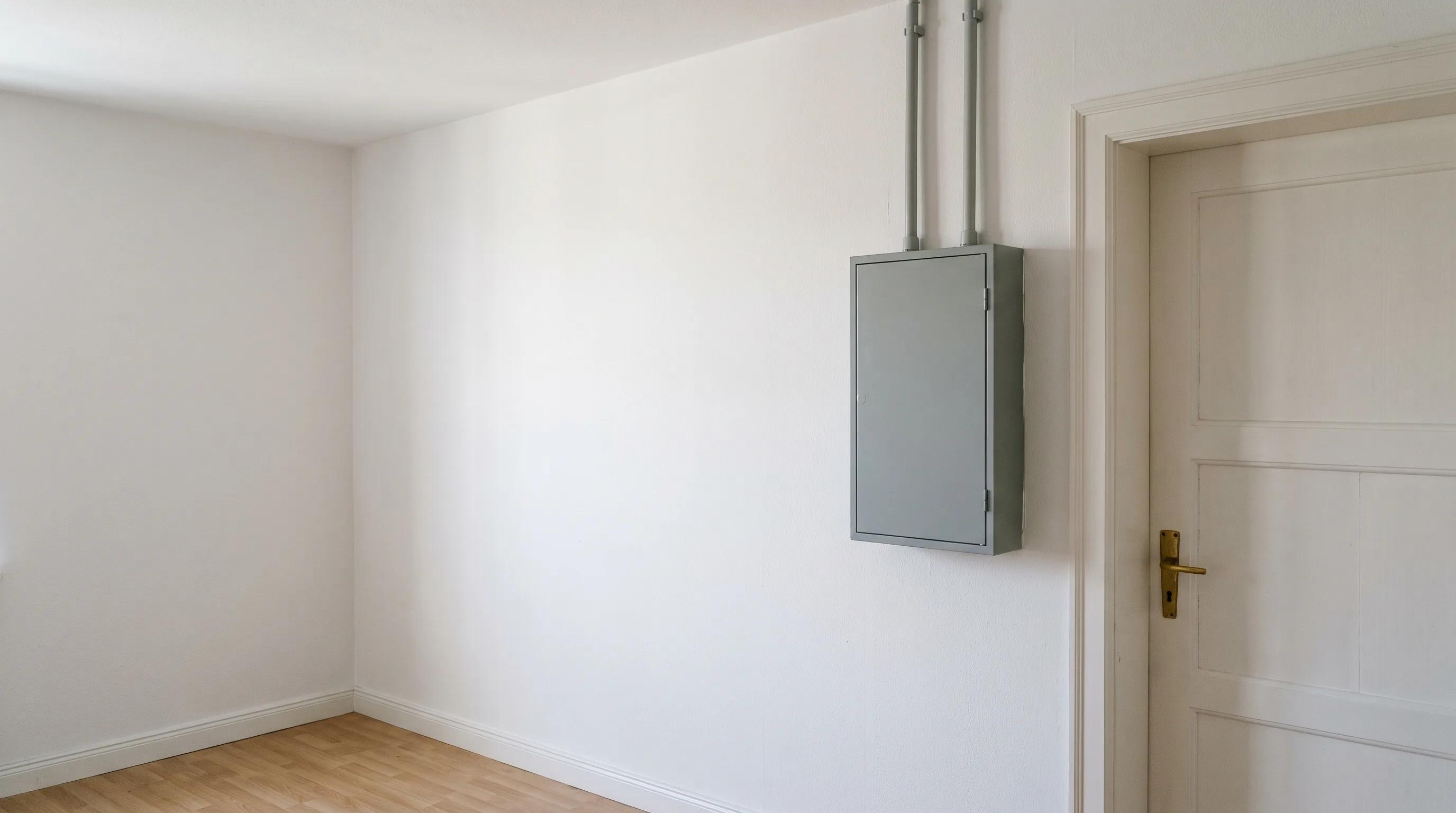
View In PDFYes, for wiring. The Electricity Act makes it an offence to do electrical work unless you're a licensed electrical worker (LEW) or supervised by one. Its exceptions, subject to any other written law, include replacing a lamp connected in your own electrical installation, or any fuse in your own electrical installation similar to that of a household.
If you'd rather one firm arranged the electrical work and the patching around it, that's what our electrical works service is for. Planning the job itself, from new points to comparing quotes, is in our electrical works buying guide.
What the law says about who may do electrical work
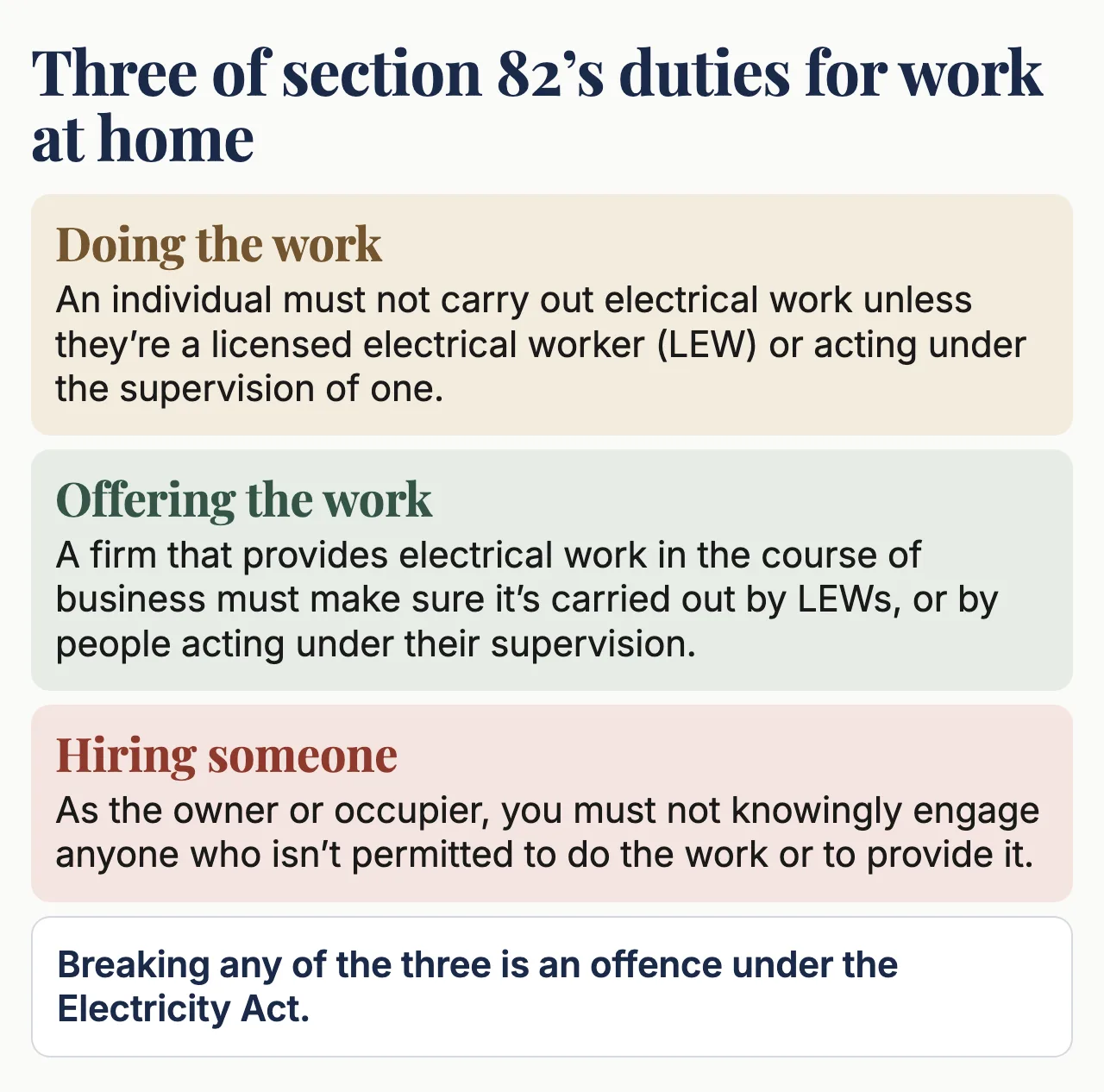
Section 82 of the Electricity Act draws the legal line. Three of its parts apply when you have electrical work done at home:
- Doing the work. An individual must not carry out electrical work unless they're an LEW or acting under the supervision of one.
- Offering the work. A firm that provides electrical work in the course of business must make sure it's carried out by LEWs, or by people acting under their supervision.
- Hiring someone. As the owner or occupier, you must not knowingly engage anyone who isn't permitted to do the work or to provide it.
Breaking any of the three is an offence. And the Act's idea of electrical work is wide: it includes installing or repairing an installation, altering its structure, replacing or adding any part, and maintenance work on it. It leaves out oiling, greasing, cleaning or painting an installation, along with manufacturing one.
Supervised work is allowed, with an LEW in charge
The supervision route means the person at your distribution board (DB box) may not be the licensed one. Under regulation 10 of the Electricity (Electrical Workers) Regulations, an LEW may supervise anyone doing work the LEW is personally licensed to do, and must make sure that person doesn't break the Regulations.
So when a firm sends a team, ask which LEW is supervising the job, not only who turns up. The same rule covers you: apart from the Act's exceptions below, section 82(1) requires you to be an LEW or to act under one's supervision if you do electrical work yourself.
What you can do yourself, and what needs an LEW
Among the Act's exceptions, and subject to any other written law, it is not unlawful to replace a lamp connected in your own electrical installation, or to replace any fuse in your own electrical installation similar to that of a household.
| Job at home | Who may do it | Whose words |
|---|---|---|
| Replacing a lamp connected in your own installation | You, subject to any other written law | Electricity Act, section 82(8) |
| Replacing any fuse in your own electrical installation similar to that of a household | You, subject to any other written law | Electricity Act, section 82(8) |
| Adding, extending or replacing sockets, switches or lighting points | An LEW, or someone under an LEW's supervision | Electricity Act, sections 2 and 82(1) |
| Installing, repairing or changing wiring | An LEW, or someone under an LEW's supervision | Electricity Act, sections 2 and 82(1) |
| Repairing or replacing circuit breakers or the consumer control unit | An LEW, or someone under an LEW's supervision | Electricity Act, sections 2 and 82(1) |
What a licensed electrical worker is
In EMA's words, an LEW is a person who is technically competent in carrying out electrical work and is licensed by EMA. There are three classes: licensed electrician, licensed electrical technician and licensed electrical engineer. So a licensed electrician is one class of LEW.
Routes to the electrician's licence include a relevant National Institute of Technical Education certificate with at least 2 years' relevant practical experience in Singapore, or at least 10 years' relevant practical experience here. EMA then assesses the candidate's technical competency through a written test, practical test and interview.
Regulation 5 sets what each class may do, subject to any conditions EMA attaches to the licence. Among its terms:
- Licensed electrician. Design, install, repair, maintain, operate, inspect and test an installation of up to 1,000 volts with an approved load of up to 45 kVA (kilovolt-amperes). For an installation of up to 1,000 volts above 45 kVA and up to 500 kVA, an electrician may install, repair, maintain and operate it only under an electrical technician's supervision.
- Licensed electrical technician. Install, repair, maintain, operate, inspect and test installations of up to 1,000 volts and 500 kVA, and design and submit plans for ones of up to 150 kVA.
- Licensed electrical engineer. Design, install, repair, maintain, operate, inspect, test and take full charge and responsibility for any electrical installation.
The 1,000-volt limit on an electrician's own work up to 45 kVA, and on a technician's design work, doesn't apply to one kind of lighting circuit, which the Regulations call an electric discharge lighting circuit. The approved load is the total electrical load that an electrical installation is designed to handle, and EMA's example is that 45kVA is equivalent to 63A (amperes) three-phase at 400 volts. Ask the LEW what your home's approved load is, so you know the class in charge covers it.
Check that the licence is current
Under the Regulations, while a licence is suspended or after it's cancelled, its holder is deemed not to be a licensed electrical worker. If the person doing the work is working under supervision, ask for the supervising LEW's name too.
What happens before supply to a new installation is turned on
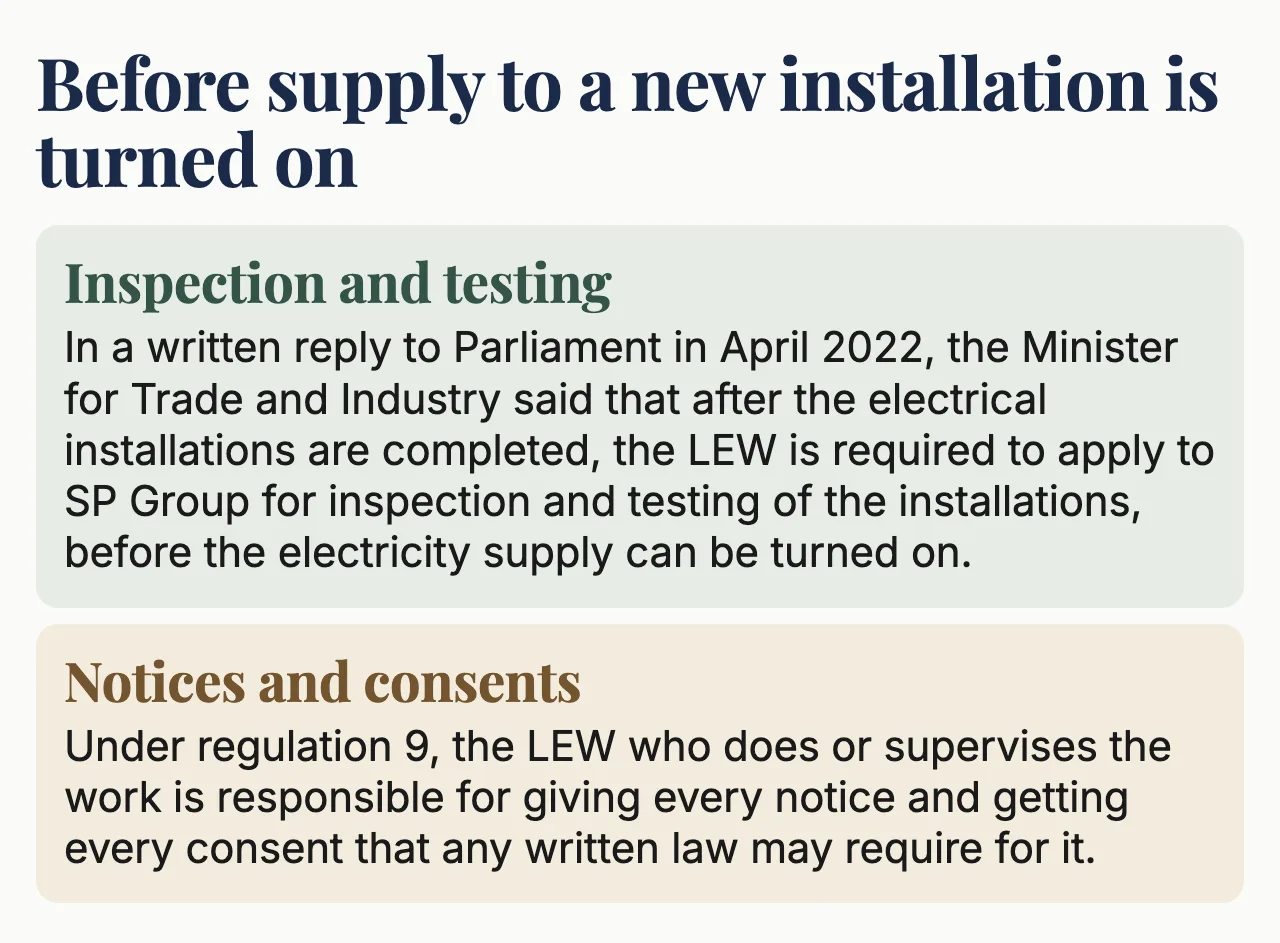
After the electrical installations are completed, the LEW is required to apply to SP Group for inspection and testing of the installations, the Minister for Trade and Industry said in a written reply to Parliament in April 2022. This is to make sure they're installed correctly and safe before the electricity supply can be turned on.
The notices and consents the law requires for the work sit with the LEW. Regulation 9 makes the LEW who does or supervises the work responsible for giving every notice and getting every consent that any written law may require for it, from EMA or any other authority.
Condos and landed homes
Section 82 doesn't distinguish a condo unit from a landed house: the same licensing rules apply to both. What a condo can add is a second set of rules from the estate.
In a condo, your estate's management corporation (MCST) may make by-laws requiring its approval before works in a unit, a strata guide from the Building and Construction Authority (BCA) notes. BCA also says you should check with the developer or the MCST and the Sale and Purchase Agreement about renovation restrictions before carrying out any work.
So ask the management office whether electrical work needs an application, and when work can run. Any approval the estate requires is yours to apply for, and we give you the details of the work its form asks about. Our article on MCST approval for condo renovations covers the rest.
Housing and Development Board (HDB) flats have their own rules for electrical works, which this article doesn't cover.
The penalty for unlicensed work
Breaking section 82 is an offence, and that includes knowingly hiring someone who isn't permitted to do the work. Section 82 sets no penalty of its own, so the Act's general penalty, in the version in force from 1 September 2025, applies: on conviction, a fine of up to $10,000, imprisonment of up to 12 months, or both, and up to $250 more for every day or part of a day a continuing offence goes on after conviction.
What to ask before you hire
Ask before the work starts
0 of 4 reviewed
Use this to track your review. Checks stay on this page while it is open.
If you're buying your own switches or light fittings, agree who's responsible for fittings you supply before work starts.
If you'd like the electrical work arranged for you, we start with a free site assessment, where we look at your DB box and the points you have and go through what you want changed. You get a fixed-price quote within 3 to 5 working days of that visit, never from a photo. Our specialist does the electrical work, and we arrange and supervise it through to handover. Tell us what you're planning through our electrical works service.
Need help with your project?
Tell us what you need on WhatsApp and send a few photos. We'll arrange a free site assessment, then give you a fixed-price quote within 3 to 5 working days.