On this page
View In PDFIf the window opens, it's yours to repair or replace. Under Singapore's strata law, casement, sliding and louvre windows in your unit's exterior wall are part of your unit, not common property. Fixed windows in that wall are common property unless your strata title plan says otherwise, so your MCST (the estate's management corporation) must keep them in repair.
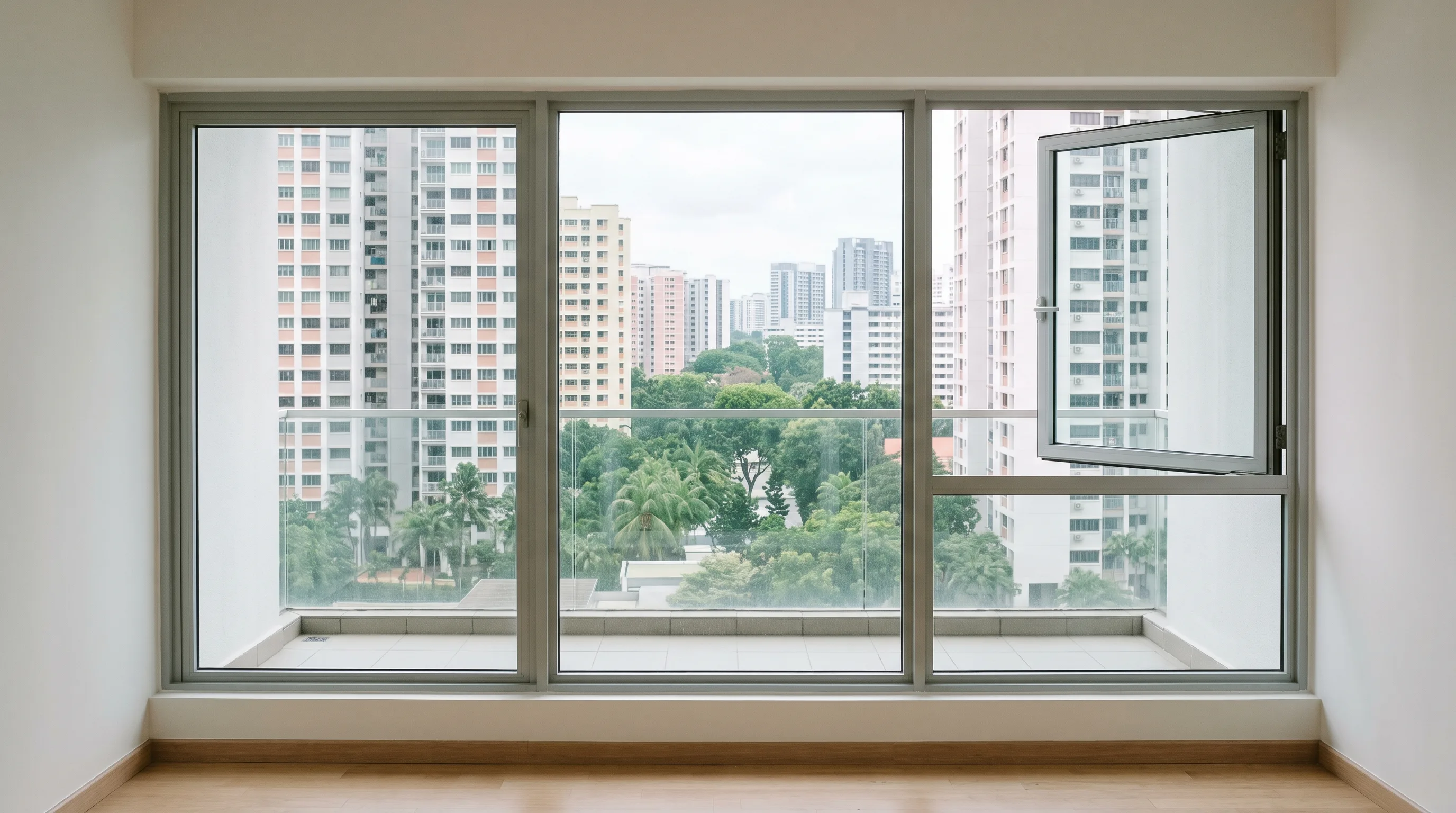
The Building and Construction Authority (BCA), on its condo owner page, puts the upkeep of external openable windows on you as the unit owner, and tells you to check with your MCST which features come under your charge. Below is how to tell which side of that line your window falls on, what a facade inspection changes, and how a leak is split. For the windows themselves, our window replacement service and our windows buying guide cover the options.
Openable windows are yours, fixed ones are the estate's
Section 2(9) of the Building (Strata Management) Act 2004 sorts every window in a unit's exterior wall into one of two groups.
| Window in your unit's exterior wall | Whose it is under the Act | Who repairs or replaces it |
|---|---|---|
| Casement, sliding or louvre window, or any window with a moving part | Part of your unit, not common property | You, at your cost |
| A window with no moving part, such as a fixed glass panel | Common property, unless your strata title plan describes it otherwise | The MCST, from the funds every owner pays into |
The Act's idea of a window is wider than you might think. It includes glass panels, glass bricks, louvres, glazed sashes and glazed doors, and anything else that lets daylight straight in from outside. So, going by those definitions, a glazed door in your exterior wall that slides or swings falls in the first group.
The quick test: does any part of it move? If it does, the window is part of your unit. If nothing moves, it's common property, and the only thing that can change that is your strata title plan. That's the plan registered for your estate that shows what falls inside and outside each unit.
BCA's strata living guide puts it the same way in general terms: everything inside your unit is generally yours and under your responsibility, while areas outside it are usually common property the MCST maintains.
What the MCST must repair, and who funds it
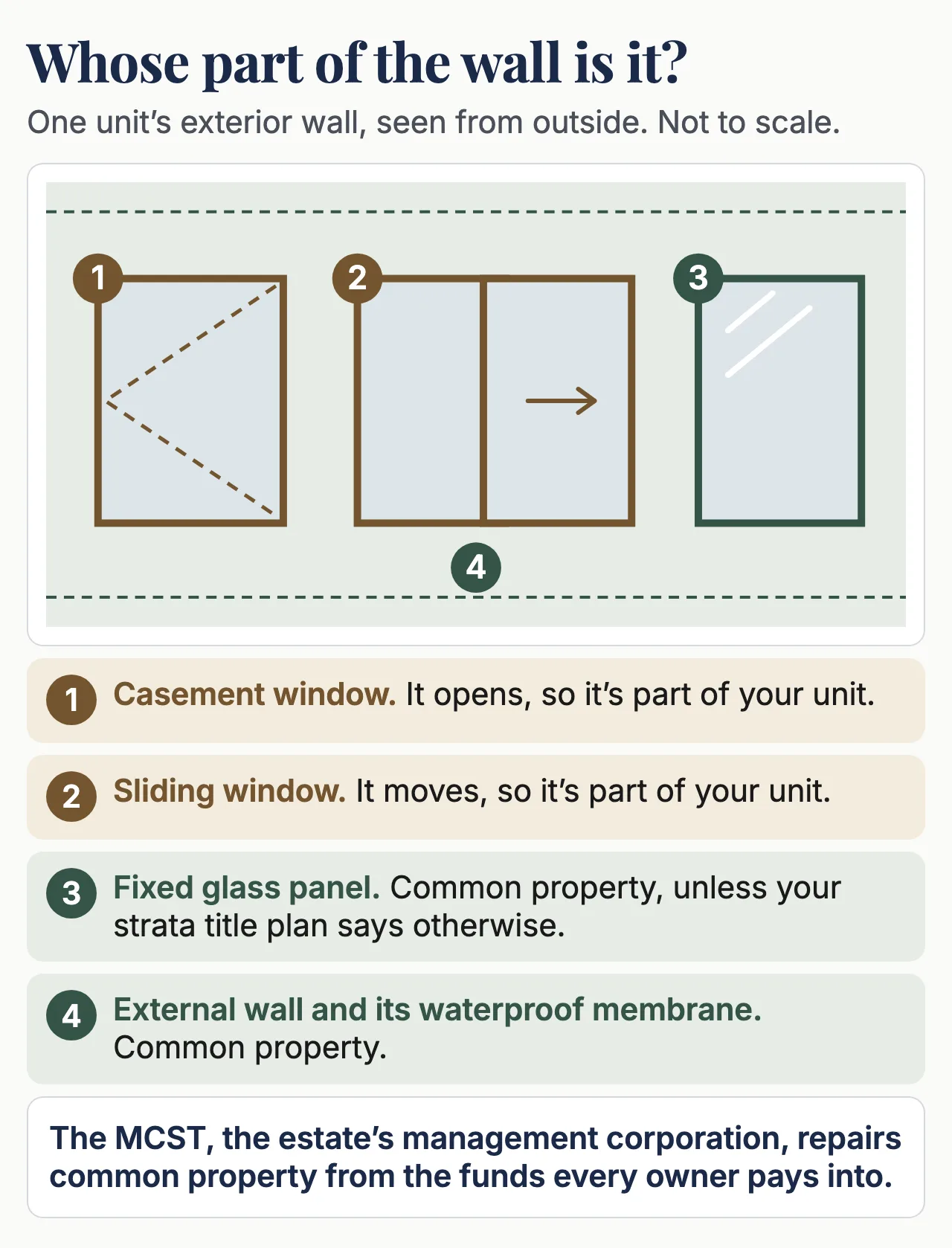
Section 29 of the strata Act makes it the MCST's duty to properly maintain and keep in good and serviceable repair the common property, including renewing or replacing it where reasonably necessary. The same duty names each door, window and other permanent cover over an opening in a wall where a side of it is part of the common property.
Fixed windows in your exterior wall sit on that list, and so does the wall around them. The external wall is common property, not part of your unit. BCA's condo owner page gives the external walls of your unit as an example of common property.
"The MCST pays" still means you pay a share. Under BCA's strata living guide, you pay contributions in proportion to your unit's share value into the management and sinking funds that maintain the common property. If those funds fall short of a major or unforeseen job, the owners can vote a special levy.
Keeping your openable windows safe is on you
Owning the window comes with a duty. BCA's condo owner page says lack of or poor maintenance that leads to property damage or injury may make you liable for compensation. In a high-rise, a window that falls is a danger to anyone below.
BCA's windows safety page sums up your part as check, clean, change. Its 2023 release on fallen windows advises checking and maintaining your windows once every six months:
- Casement windows: check that fasteners aren't rusty or loose, and oil the joints and moving parts.
- Sliding windows: check that the safety stoppers and angle strips are in place, and keep the tracks clean so the panels slide smoothly.
- Any window: look and note from inside only. Don't lean out or climb onto a ledge to inspect the outside of the frame.
Replacing worn parts is a job for the trade. BCA says retrofitting must be done by an approved window contractor or builder with trained window installers, who should replace all aluminium rivets at the window stays with type 304 stainless steel rivets.
If a window needs replacing, BCA says you'll need an approved window contractor and a trained window installer, or a registered general builder. Our article on who can replace windows in Singapore explains each of those roles and the form that's filed after the work.
Paying for it doesn't mean you can change how it looks
Your openable windows sit in a wall that belongs to the estate, and they shape how the whole block looks. BCA's condo owner page says alterations to features fixed on the external building, such as windows and walls, aren't allowed without approval from the MCST and any relevant government agencies.
The strata Act backs that up. You need the MCST's authority for any improvement to your unit that affects the appearance of a building in the estate. If you go ahead without it, the MCST can give you written notice to put it right at your own cost.
Your estate may set out what it'll accept in by-laws. BCA's guide to works in units says those guidelines may cover the design, colour, material, size and dimensions of the work, and BCA's condo page says you must follow by-laws once they're made, even if you missed the vote. So before you choose a new frame colour or glass, ask the MCST for its design guidelines and approval form. Our guide to MCST approval rules covers how that process works.
Window grilles and safety devices
Safety equipment is the exception. The strata Act lets you install window grilles, screens or a device that limits how far a window opens, even if a by-law says otherwise. You must repair any damage the installation causes to common property, and keep its look in keeping with the building. BCA's guide adds that you still follow the estate's design guidelines for safety equipment, if it has any.
Where a window has a safety barrier built into it, such as a railing across a full-height window, BCA says replacing or reinstating that barrier needs a Professional Engineer to design and submit structural plans, unless one of BCA's standardised designs is used. Where an engineer is needed, we arrange the engineer.
When the facade inspection flags your windows
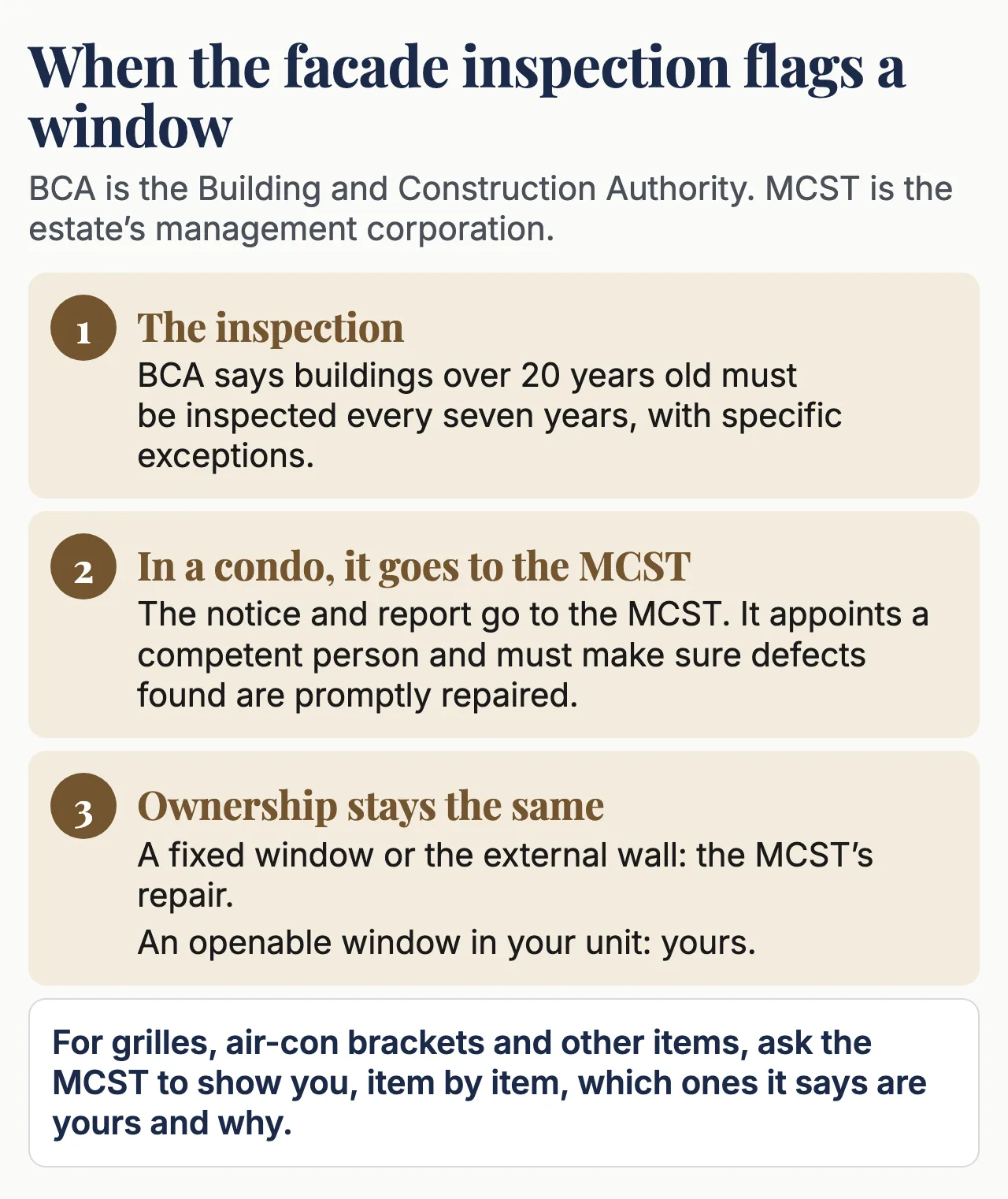
Once your condo is over 20 years old, the periodic facade inspection comes into play. BCA's facade inspection page says buildings over 20 years old must be inspected every seven years, with specific exceptions. The building owner must appoint a competent person to carry it out, and must make sure any defects the inspection finds are promptly repaired.
In a condo, that building owner is the MCST. For this part of the Building Control Act, the owner of a building in a strata title plan is the management corporation having control of its common property. So the inspection notice and report go to the MCST, not to you.
The report doesn't change who owns what. If it flags a fixed window or the external wall, that's common property and the MCST's repair to arrange. If it flags an openable window in your unit, that window is part of your unit, so its repair or replacement falls to you.
If a public authority serves a notice on you directly to carry out work on your unit and you don't, the strata Act lets the MCST do the work and recover the cost from you as a debt. It can also recover it from whoever buys the unit after the work is done.
For anything else the report lists against your unit, such as grilles or air-con brackets, the same question applies: is it part of your unit, or common property? Ask the MCST to show you, item by item, which ones it says are yours and why, before you book any work.
Is a leak at the window yours or the MCST's?
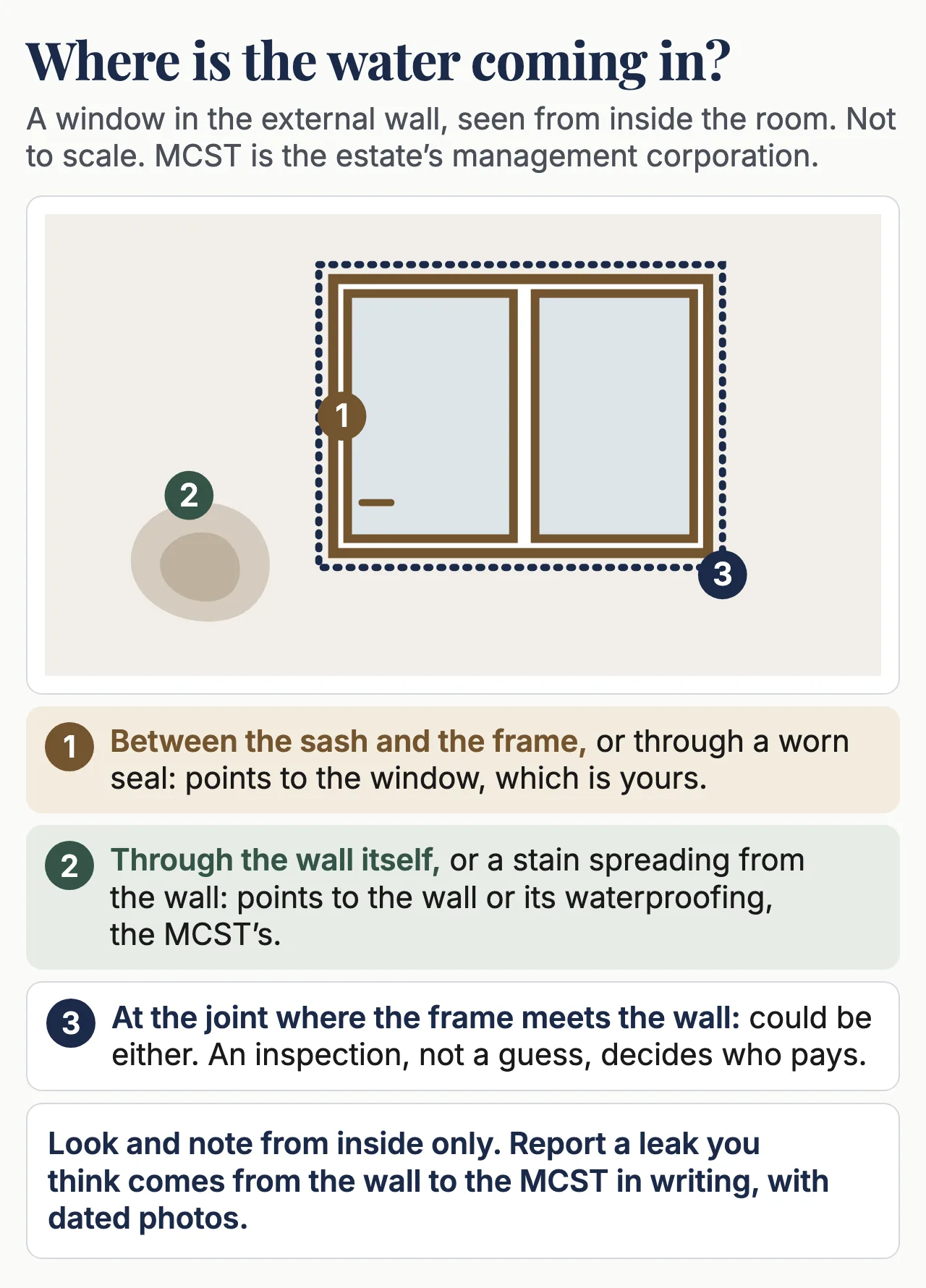
Find the cause before anyone pays, because the law splits the parts. The openable window is part of your unit. The external wall is common property, and the strata Act makes the waterproof membrane attached to an external wall common property too, even where it sits within your unit.
- Water coming in between the sash and the frame, or through a worn seal on an openable window, points to the window, which is yours.
- Water coming through the wall itself, or staining that spreads from the wall rather than the window, points to the wall or its waterproofing, which are the MCST's.
- Water at the joint where the frame meets the wall could be either. That's where a proper inspection, rather than a guess, decides who pays.
Report a leak you think comes from the wall to the MCST in writing, with dated photos. If your condo is new, check the defects liability period first. That's the period in which you report defects from poor workmanship or faulty materials to the developer, and BCA says a defect reported during that period stays the developer's responsibility even if it's still unsolved when the period ends. Once the period has passed, you're responsible for your unit's upkeep. Our article on checking an exterior wall leak explains what to record while you wait.
What to check before anyone pays
Before you pay for a window repair or agree to a bill
0 of 6 reviewed
Use this to track your review. Checks stay on this page while it is open.
BCA's strata living guide says the strata title plan shows what falls inside and outside your unit, and that's the document to check. If you and the MCST still disagree, BCA's condo owner page points to mediation at the Community Mediation Centre or the Singapore Mediation Centre, or an application to the Strata Titles Boards.
If the windows are yours to replace
Once you know the openable windows are yours, book a free site assessment. We visit and measure every window, then give you a fixed-price quote within 3 to 5 working days of the visit, never from a photo. Have your estate's window guidelines and approval form ready for the visit. Our specialist then carries out the replacement, and we supervise and hand it over.
Common questions
My sliding windows are original to the building. Does the MCST pay to replace them?
No, not because of their age. Under the strata Act, a sliding window in your unit's exterior wall is part of your unit, however old it is, and BCA puts the upkeep of external openable windows on you. The exception is a new condo still in its defects liability period, where a defect from poor workmanship or materials, reported in time, is the developer's to fix.
Can a fixed window ever be part of my unit?
Only if your strata title plan describes it that way. The strata Act makes fixed windows in an exterior wall common property unless the plan says otherwise, so the plan is the document to check.
I've just bought a resale condo and a window leaks. Who pays?
It turns on the cause. A leak through an openable window, such as a worn seal, is yours as the new owner to fix. A leak through the external wall or its waterproofing is the MCST's to fix, because both are common property. Also ask the MCST whether it did any work on your unit under a public authority's notice the last owner ignored, because the strata Act lets it recover that cost from a later owner.
Can my MCST stop me putting up window grilles?
No. The strata Act lets you install window grilles and similar safety equipment despite any by-law against it. You still repair any damage to common property, keep the look in keeping with the building, and follow the estate's design guidelines for grilles if it has them.
Need help with your project?
Tell us what you need on WhatsApp and send a few photos. We'll arrange a free site assessment, then give you a fixed-price quote within 3 to 5 working days.