On this page
View In PDFLower-emission carpentry starts with the boards, adhesives and finishes used to make the cabinets, not only the decorative surface you choose. Ask for the actual products and supporting test information before ordering. That helps you understand what a material claim covers and compare proposals for the rooms where your family will live.

For a whole-house carpentry and built-in fit-out, confirm the boards, adhesives and finishes before the cabinets are made, and discuss ventilation before the household moves back in. A report for one board does not describe every part of a cabinet or measure the air in a finished room. The following checks help you understand what the supplier’s claim actually covers.
Find out which cabinet materials the claim covers
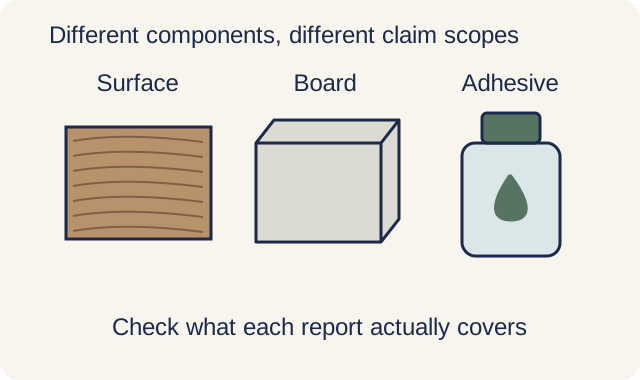
Ask the supplier to explain the phrase in the quotation. Does it refer to a particular panel, the adhesive, a decorative surface, the assembled cabinet or an indoor-air measurement after installation? Those are different subjects. A test performed on one panel cannot automatically stand in for a claim about the whole room.
Singapore’s formaldehyde controls for interior paint do not certify the boards and adhesives inside a cabinet. Ask for reports or certification that apply to those materials. A broad statement such as “compliant materials” leaves you unable to tell what was tested.
Once you have chosen the materials, put their product names and references in the order so the fabricator can supply what you selected. You do not need to become a laboratory specialist: start by checking that each report names the same product as the quotation. If it does not, ask for the matching report before accepting the claim.
List the boards, finishes and adhesives in the cabinets
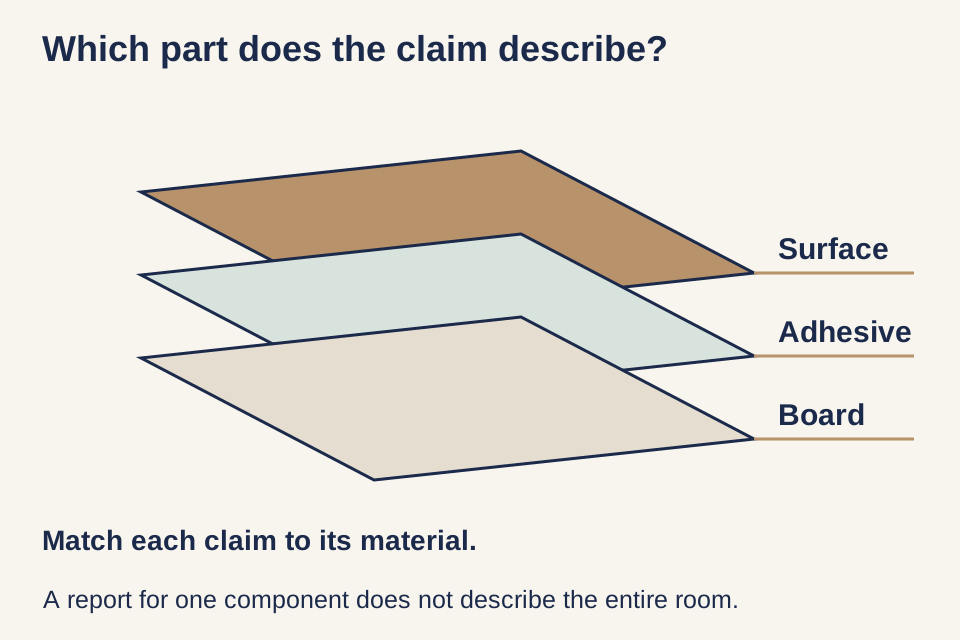
List the supporting panels, door and exposed finishes, backing, edge treatment and adhesives relevant to the proposed work. The list should be understandable enough to connect a product reference with a physical part of the cabinet. Ask the fabricator to identify any component that remains undecided.
The decorative surface and its supporting substrate are separate choices. This matters when a quotation gives a surface brand prominently but leaves the panel underneath generic. Ask for the actual board reference rather than assuming the most visible name explains the concealed material.
You may decide that some components need different evidence or selection criteria. Make that distinction explicit. For instance, moisture suitability and emissions are separate questions: a claim about one does not by itself settle the other. A wardrobe still has to suit its room, dimensions and intended use as well as the agreed material requirements.
Check that the emission report names the board you are buying
| Document question | Useful answer | What remains unresolved otherwise |
|---|---|---|
| What was tested? | A named sample linked to the specified product | Whether the order and report describe the same material |
| Which characteristic? | The measured emission or other stated property | Whether the evidence supports the advertised claim |
| Under what method? | The applicable method and assessment basis | Whether results can be compared meaningfully |
| Who issued it? | Identifiable laboratory or certification body and relevant scope | Whether the document can be verified |
| What will be supplied? | The same specified product or an approved documented change | Whether the evidence follows through to fabrication |
For furniture containing composite wood panels, NEA recommends requesting panel formaldehyde-emission reports from appropriately accredited laboratories. Ask the supplier for the complete relevant report or a clear verifiable reference, not only a cropped result detached from its sample description.
Match the manufacturer, product identification, panel description and tested characteristic with the proposed item. Record the test method, report date and the basis for the pass or classification being claimed. Where a supplier offers a different thickness or product variant, ask it to explain how the evidence applies rather than making that extension yourself.
Be cautious about comparing two numbers when the methods or samples differ. A lower figure is only a useful comparison if the basis is comparable. Ask the supplier to state the reason for the classification in plain language, and seek competent technical interpretation where a material choice depends on a distinction you cannot resolve.
Check which product the certificate covers
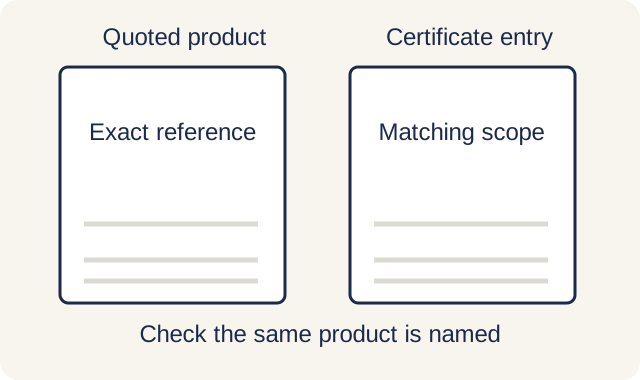
Where a certification or label is offered, check the exact product entry, issuer, validity and scope. Keep the reference beside the product schedule so it can be checked again if the material changes. Certification of one product family should not become an unqualified endorsement of everything the workshop supplies.
A supplier that provides a clear schedule and traceable evidence makes the choice easier to assess. A missing document does not by itself establish that the material is harmful; it means the claimed attribute has not been substantiated for your purchase. Keep that distinction when deciding whether to seek more information or choose another documented option.
Make sure the agreed materials are used
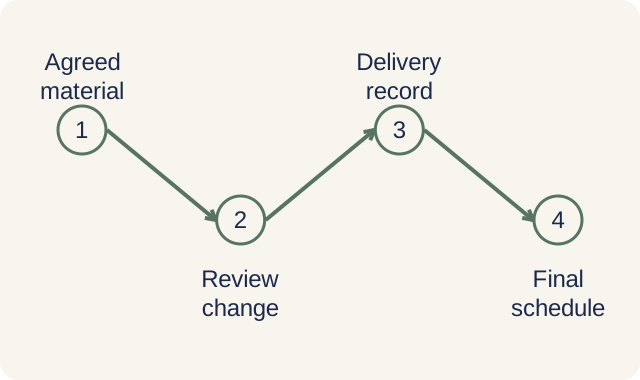
Name the agreed material references in the quotation or accompanying specification and record how substitutions are approved. Availability can change, and similar-looking panels can be offered as alternatives. Require the replacement’s evidence and suitability to be reviewed before it is treated as equivalent.
Agree what reasonable delivery or fabrication records will identify the materials used, such as supplier references, labelled packaging or a material confirmation tied to the cabinet schedule. Avoid demanding a photograph of every offcut without knowing what it would prove. The evidence should connect the agreed specification to the work being supplied.
Keep the final schedule at handover. It can help with later repairs, matching finishes and questions about the installed materials. If a component was changed with approval, retain the revised reference so the record describes the cabinet actually in the house.
A board report does not measure the air in your finished room
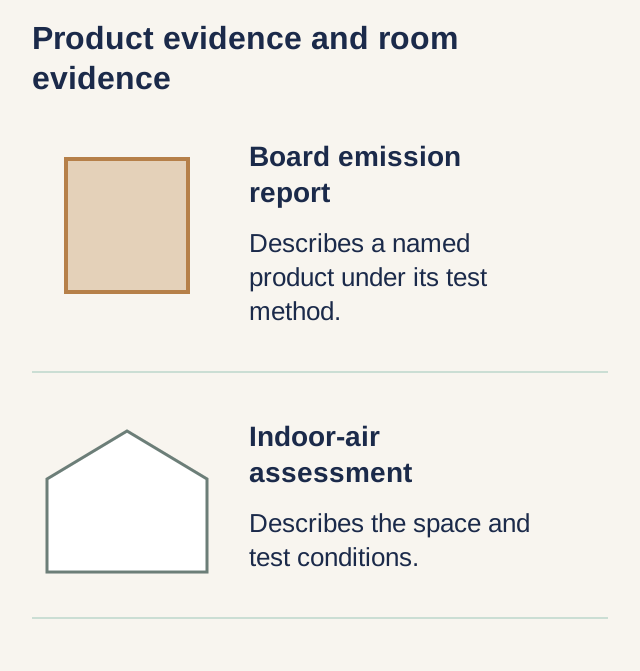
A panel report answers a product question. Indoor-air testing answers a different question about the conditions of the space at the time and under the method used. If the household needs the latter assessed, agree the scope with a competent testing provider rather than treating a material certificate as a room measurement.
NEA also advises planning ventilation with the contractor and allowing it in the renovation programme. The materials, room conditions and occupancy decision need to be considered together; a low-emission claim is not a promise that every newly renovated space is immediately ready for occupation.
Use the carpentry buying guide to review the rest of the cabinet design and quotation. Before ordering, bring the proposed material list and its supporting reports to the discussion, and agree how any substitution will be checked. Keep the ventilation plan alongside that choice: selecting lower-emission materials is one part of preparing the renovated home for use.
Need help with your project?
Tell us what you need on WhatsApp and send a few photos. We'll arrange a free site assessment, then give you a fixed-price quote within 3 to 5 working days.