Part of our complete guide
Aircon for Singapore Landed Homes: A Buying Guide →Key takeaways
- Room area alone is an incomplete cooling brief for a landed home.
- Check the exact outdoor/indoor combination under the household’s simultaneous-use pattern.
- Use NEA labels to compare efficiency after suitability and capacity have been established.
Start with the rooms and their use
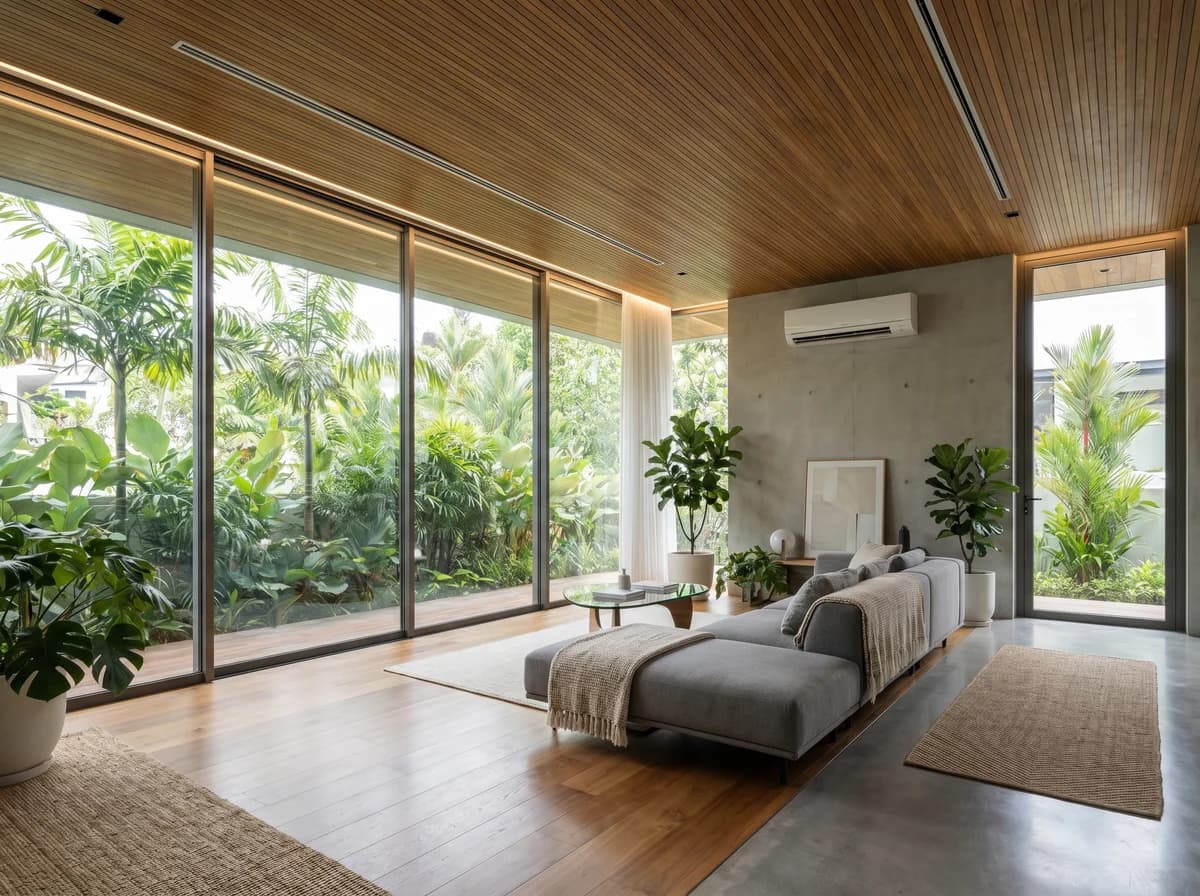
List which rooms need cooling, when they are occupied and which are usually used together. Include afternoon sun, glazing, roof exposure, ceiling height and openings to adjacent spaces. Tell the contractor whether a study runs all day while bedrooms run at night.
Daikin Singapore confirms that direct sunlight affects equipment selection. A useful site assessment should explain how the property’s conditions influenced the recommendation, rather than assign a unit solely from a room-area shortcut.
Sources: Daikin Airconditioning Singapore: Daikin Singapore FAQs
Request a room-by-room design explanation
Ask the contractor to record the estimated cooling requirement and chosen indoor unit for each room, with the assumptions behind the estimate. Where a large space is open to a stairwell or another floor, ask what area the proposal is intended to condition and what doors or partitions it assumes are closed.
The homeowner does not need to reproduce the engineering calculation. The objective is to make assumptions visible enough to compare proposals and avoid discovering after installation that a key space was excluded.
| Room input | Why the contractor needs it |
|---|---|
| Use and occupancy | Distinguishes a rarely used guest room from a daily work space |
| Sun and glazing | Identifies changing heat gains across the day |
| Roof and ceiling conditions | Highlights top-floor and high-volume spaces |
| Openings and connected areas | Defines the intended cooled zone |
| Simultaneous operation | Shows which room demands occur together |
| Future changes | Flags an enclosed balcony, changed room use or later renovation |
Give factual inputs; the contractor should calculate and document the resulting equipment selection.
Then check the shared outdoor unit
A multi-split arrangement connects several indoor units to an outdoor unit. Do not assume the sum of indoor-unit labels is the output available to every room at once. Ask for the manufacturer’s supported combination and capacity information for the exact models proposed.
Mitsubishi Electric publishes combination-specific capacity tables in its technical documentation. Its Australian guide demonstrates the type of evidence to request, while the actual Singapore selection must use the relevant local model data. The Singapore Starmex page also states its rating conditions, which matters when interpreting headline capacity.
Sources: Mitsubishi Electric Asia: Starmex R32 multi split · Mitsubishi Electric Australia: Multi split compatibility and capacity tables
Compare grouping alternatives using household consequences
Ask whether the proposed grouping is best for the expected room schedule, service access and interruption tolerance. Multiple outdoor units may allow different groupings and spread the consequences of a fault, but need more space and associated installation work. A larger shared system can reduce the number of outdoor units while requiring careful combination and layout review.
For a whole-house or concealed system, request the same clarity about zones, controls and the area served. A more elaborate system does not remove the need to explain what happens when only one small room is occupied.
Read the energy label after the design is credible
NEA’s tick labels help consumers compare regulated appliance efficiency. They do not establish that a unit suits the room or predict a particular household’s bill. Compare the relevant registered equipment and stated rating information on an equivalent basis.
Ask the contractor to distinguish an equipment-efficiency claim from a projection based on operating hours. If a savings estimate is provided, request the old and new models, assumed use and tariff so the calculation can be evaluated.
Sources: National Environment Agency: Energy efficiency tick rating
Make the selection reviewable before ordering
The accepted proposal should list indoor and outdoor model numbers, room assignments, supported combinations and the agreed use assumptions. Include outdoor locations, service access and any electrical or building work as separate scope.
If the layout or room use changes, revisit the selection before equipment is ordered. That is more useful than paying for a larger system without understanding which design assumption it solves.
Sources and scope
Our editorial team checked the references below. Manufacturer guidance applies to the products and arrangements it describes; confirm the documents for your proposed installation.
- Daikin Singapore FAQs
Daikin Airconditioning Singapore · Checked
Direct sunlight affects selection; piping insulation, drainage and access matter; published compressor warranty exclusions illustrate the need to read the actual terms.
- Starmex R32 multi split
Mitsubishi Electric Asia · Checked
Singapore product range separates system capacity and model combinations; capacity is stated at specified rating conditions.
- Multi split compatibility and capacity tables
Mitsubishi Electric Australia · Checked
Manufacturer example of combination-specific capacity tables; Australian models and capacities are not substituted for Singapore selections.
- Energy efficiency tick rating
National Environment Agency · Checked
Singapore energy labels help compare regulated appliance efficiency; they are not a room-load calculation or a bill guarantee.
All air-conditioning resources →
Related Services
Need Help With Your Project?
Get a free site assessment and no-obligation quote.
About the author
Written by the DirectHome team, Singapore home-upgrade contractors coordinating licensed lift, pool, roofing and gate specialists. We coordinate BCA-permitted works through licensed specialist partners across landed property in Singapore.