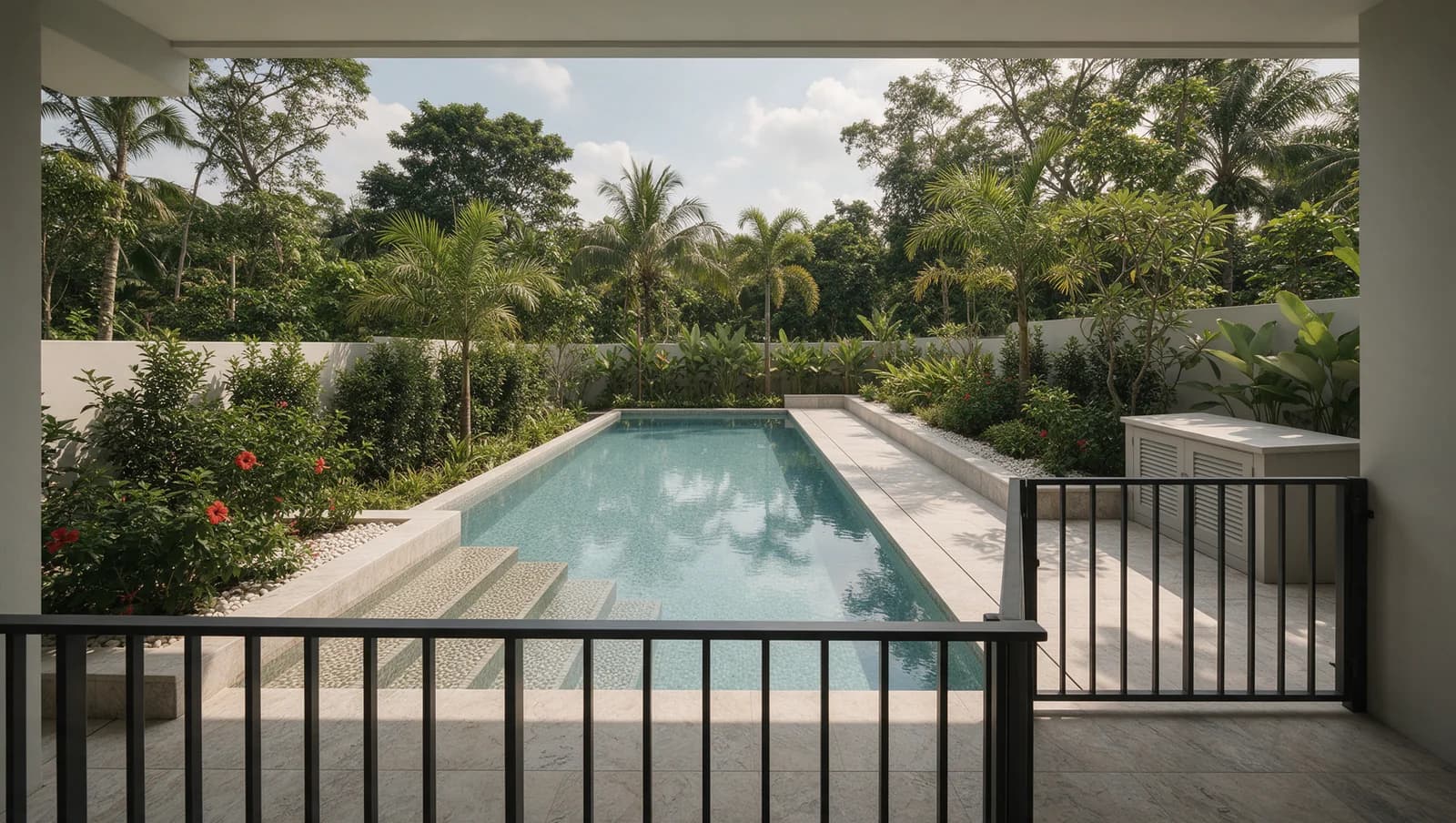
A home pool should be designed around its intended use and the space needed to build, operate and maintain it. Start with the swimming or relaxation brief, then draw the water area together with the deck, access controls, equipment, drainage and maintenance route.
Plunge, family and lap pools describe different uses; they are not standard price or permit packages. A compact pool still needs water treatment, safe access and care. A longer pool only helps a swimmer if its usable length, shape and depth suit the intended activity.
Resolve site planning, construction and long-term operation together. Before committing to excavation, obtain professional confirmation for the actual site and a quotation that includes the equipment, surrounding works and handover needed to use the pool.
Choose the use before the dimensions
For cooling and sitting in water, a plunge pool may serve the brief without reserving a long swimming lane. For family recreation, consider how users enter, where adults supervise and how different activities share the space. For exercise, test whether the usable swimming length and turning arrangement meet the swimmer’s expectations.
Write down who will use the pool, when, and what they want to do. Include children, visitors and people who need assistance entering or leaving. Do not select depth from a generic pool category, and do not assume a domestic pool is suitable for diving.
Compare the pool with alternatives such as a smaller water feature, access to a club pool or keeping more garden space. These deliver different benefits. The decision should reflect household use, maintenance capacity and the property plan rather than an assumed resale premium.
| Intended use | Design question |
|---|---|
| Cooling and relaxation | Comfortable entry, seating and supervision arrangement |
| Family recreation | Circulation, depth transitions and access control |
| Swimming exercise | Usable length, turns and clear swimming route |
| Architectural water feature | Whether swimming is needed at all |
Draw the pool and the space around it
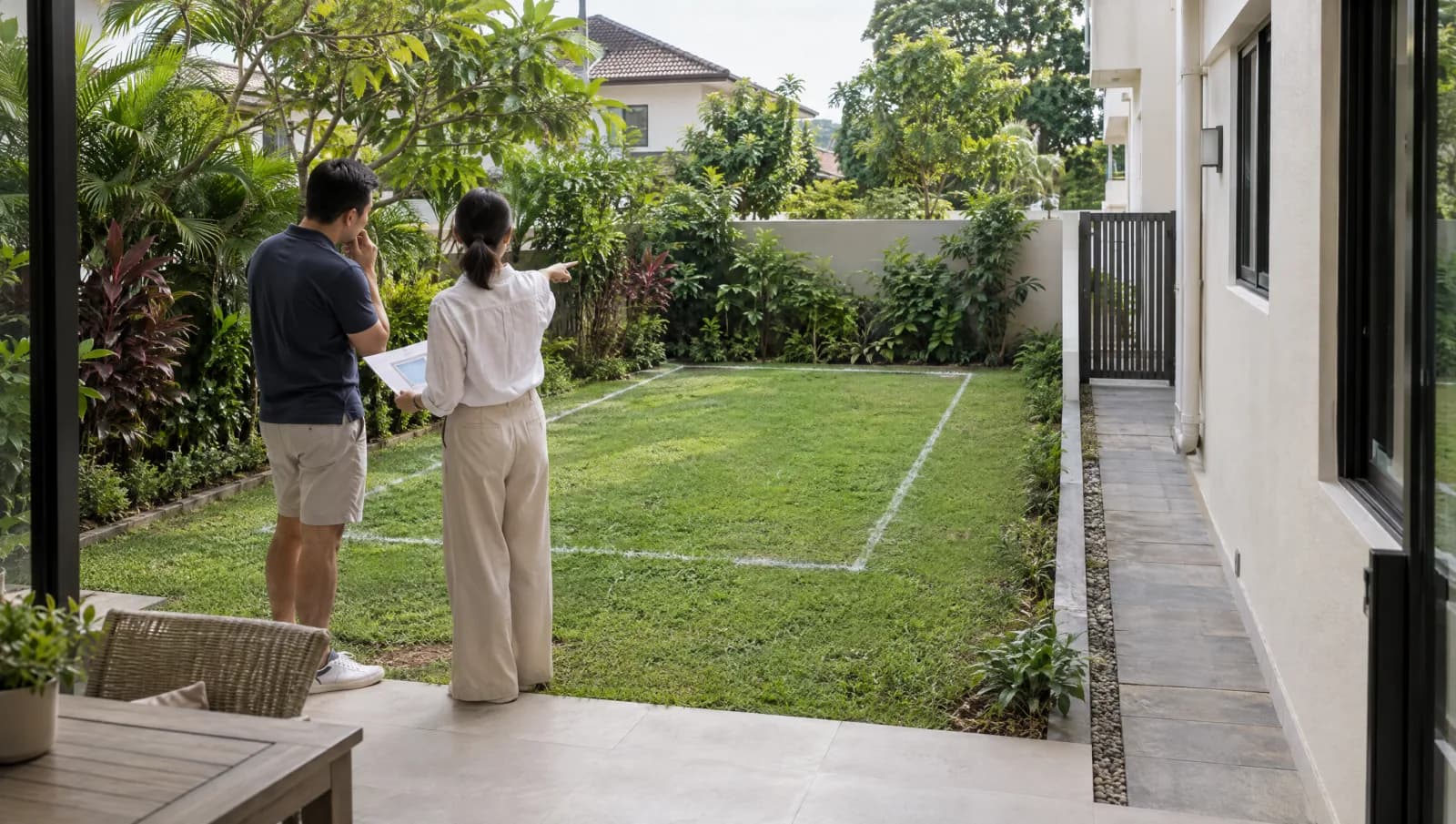
Show boundaries, existing levels, nearby structures, access for excavation and spoil removal, equipment location and all water routes. The buildable pool area cannot be decided from the garden’s apparent empty rectangle alone.
URA’s detached-house guidance distinguishes sunken pools, which may abut common boundaries, from raised pools with specified setbacks. It also requires measures against splashing into neighbouring property. Apply the correct housing-type and site guidance; there is no universal pool setback that can safely be copied across every landed plot.
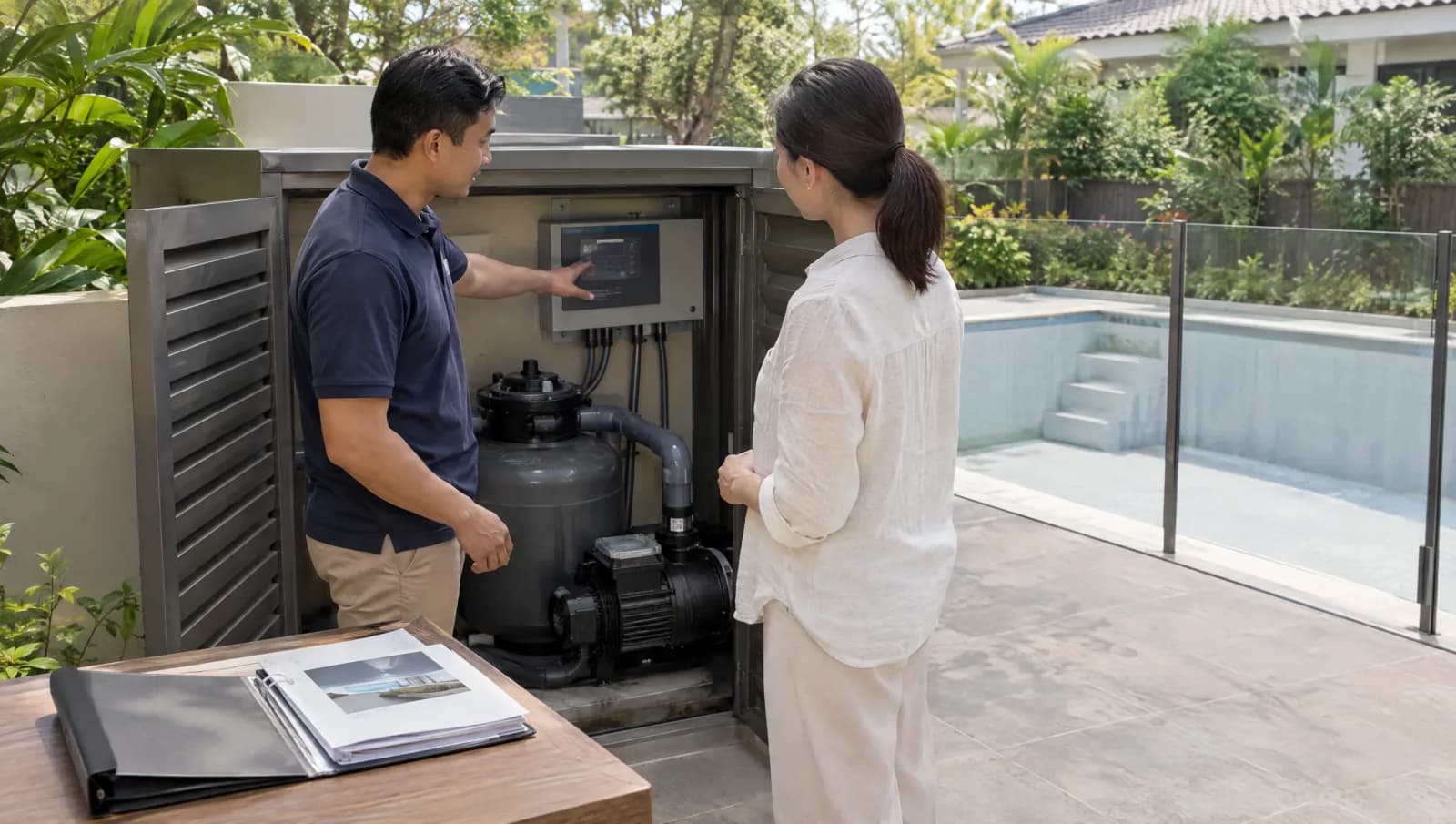
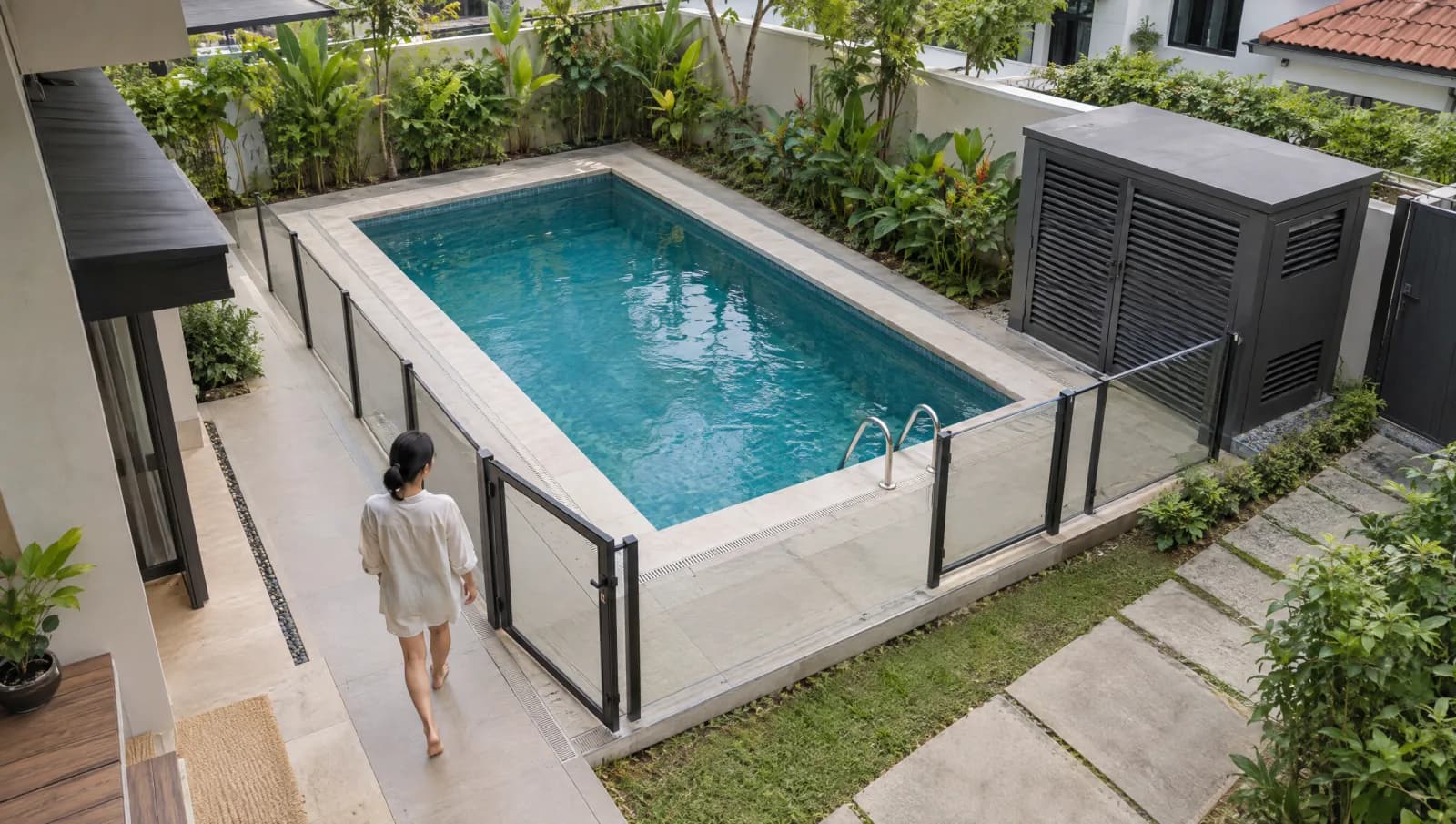
Locate pumps and other equipment as part of the planning exercise. The pool edge and the equipment enclosure can have different constraints. Review service access, ventilation and noise implications before the landscape design leaves only a residual cupboard for plant.
Separate planning, building work and operating requirements
Have the responsible professionals establish the permissions and submissions for the proposed pool, excavation, structural work and associated services. URA describes a limited exemption for changing an existing pool’s shape without increasing its size or reducing setbacks. That is not a blanket exemption for a new pool.
BCA’s structural-plan guidance sets out the Qualified Person’s role and the applicable plan and permit process, subject to exceptions. Establish the structural scheme and effect on nearby buildings before excavation. Do not use the pool’s marketing name to determine its approval route.
NEA’s published FAQ states that an aquatic facility in a residential house does not require an AF licence. That is distinct from the licensing and testing duties for licensable facilities, including relevant non-residential uses. Confirm any unusual use arrangement; the residential licensing position does not remove the need for safe water care or other approvals.
Understand circulation, filtration and treatment
Circulation moves water through the system, filtration removes particles and treatment manages water quality. A quotation should identify how those functions are provided and maintained, rather than list a pump and assume the rest is understood.
Request a coordinated equipment schedule with model numbers, pipe and valve information, control arrangement and the manuals for the installed products. Salt chlorination is still a form of chlorine disinfection; it does not make water testing and treatment management unnecessary.
Show the space needed to remove a filter element, reach valves and replace a pump. A filter’s required service height can exceed its installed height. Use the selected model’s requirements so the enclosure leaves room to lift out its serviceable parts.
Resolve each water route and chemical-storage area
Pool overflow, filter backwash, draining and cleaning are different discharge categories in PUB’s published requirements. Ask the responsible professional to mark each route and correct connection on the design. A single note saying “drain to existing drain” does not demonstrate that every discharge is appropriate.
Design chemical storage and handling around the selected products and professional guidance. Keep labels and instructions, separate incompatible materials and restrict access. Do not leave chemical containers in an improvised equipment corner simply because the room has spare floor space.
Agree who replenishes treatment materials and how the household reports a spill, suspected contamination or equipment fault. Chemical mixing and adjustments should follow the product and trained provider’s instructions; a general buying guide is not a dosing procedure.
Plan access control and supervision from the start
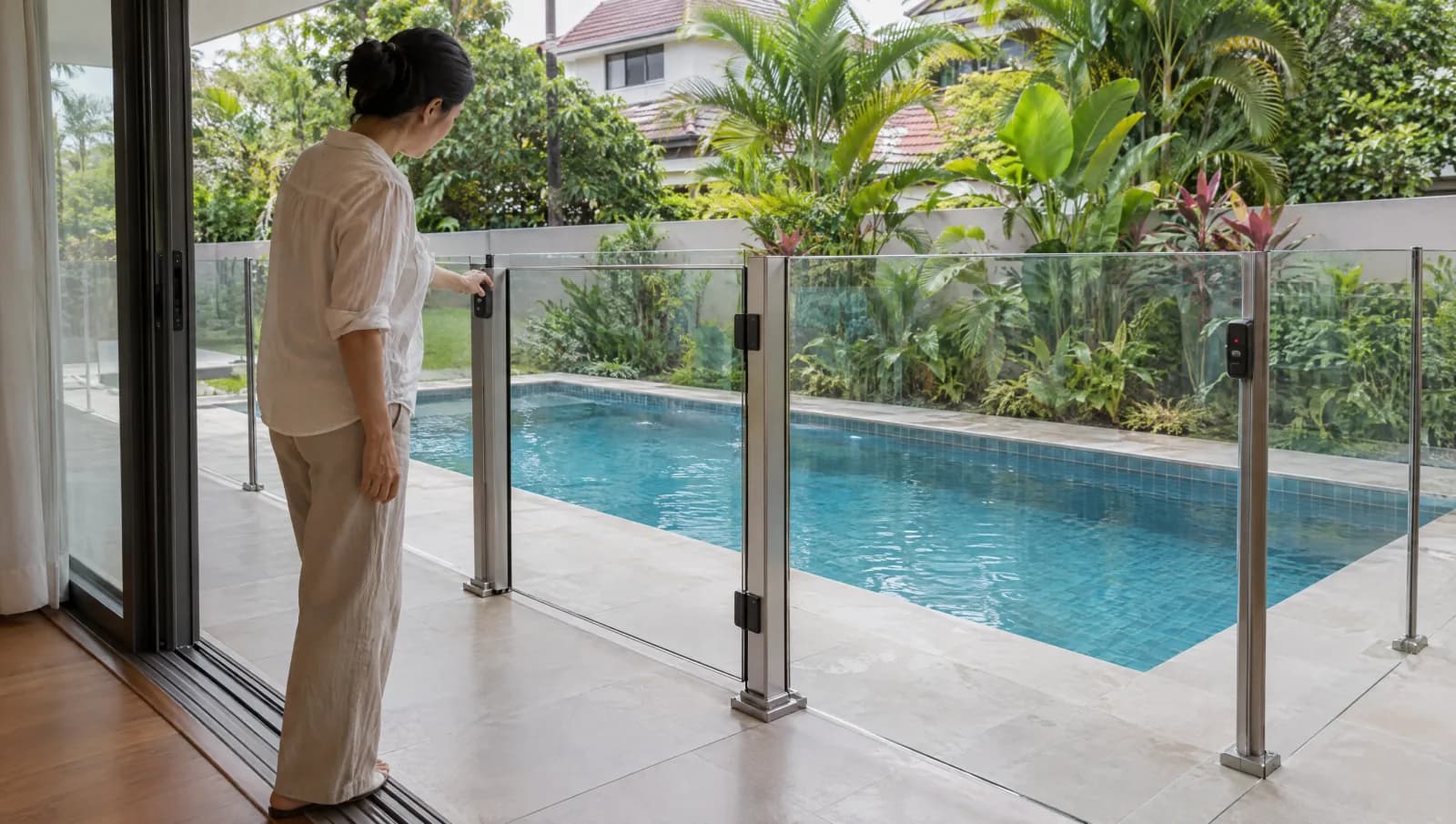
Discuss barriers, gates, covers and the route from the house as part of design. Different covers have different purposes; a cover used to reduce debris or evaporation should not be assumed to be a safety cover. Have the provider explain the exact protection and limitations of the proposed system.
Assign active supervision when children are near or in the water, and consider visiting children as well as those living in the house. A barrier or alarm does not replace supervision. Keep the deck and access route suitable for wet conditions and establish a clear process for closing the pool when it is unsafe to use.
CDC’s home-pool safety guidance supports layered precautions and supervision. Its recommendations are used here as safety principles, not as a claim that a particular US barrier dimension is Singapore law.
Use inspection points to manage construction
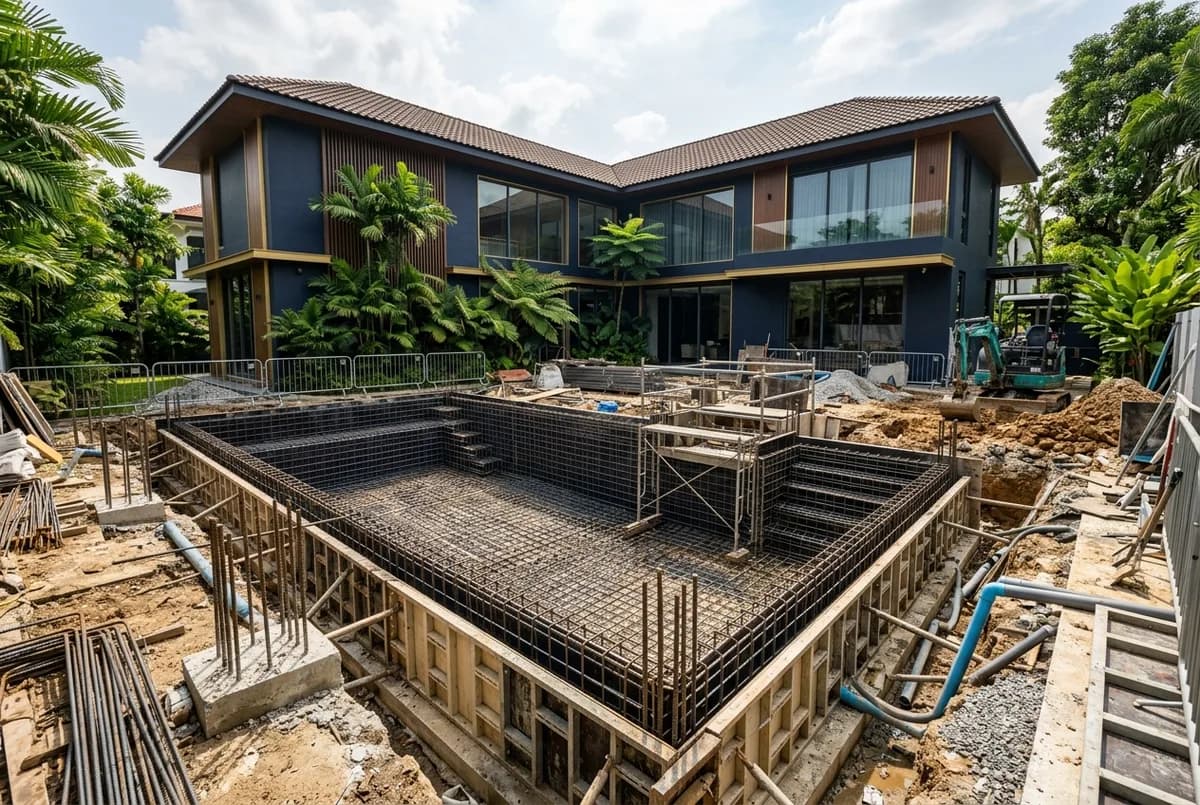
Agree the design and site set-out before excavation. The programme should identify earthworks and temporary works, structure, pipework, waterproofing, finishes, equipment, deck interfaces and commissioning. Some activities can overlap, but concealed work should not disappear before the agreed checks.
Ask for inspection and test records appropriate to the structural, waterproofing and service systems. Clarify who signs off each stage and what happens if a test reveals a defect. Taking photographs is useful, but it does not replace the responsible professional’s required inspection.
Coordinate the final pool level, coping and adjoining drainage so rain and splash water are handled as designed. Before payment milestones are agreed, distinguish a completed shell, a filled pool and a commissioned system ready for normal use.
| Stage | Record or decision to secure |
|---|---|
| Before excavation | Set-out, levels, access and approved design where required |
| Before concealment | Inspection and testing for structure, waterproofing and services |
| Before finishes | Junctions, equipment routes and deck drainage |
| Before use | Commissioning, water-care plan, training and unresolved defects |
Compare construction and ownership scope separately
Request a quotation that identifies design and professional work, excavation and disposal, structural shell, waterproofing, finish, coping, deck, equipment, services, access controls and making good. Mark allowances and exclusions, especially where ground conditions or existing services are not yet established.
Obtain the maintenance proposal before choosing the equipment. Ask which visits, tests, cleaning tasks, consumables and repairs are included. A construction price and a monthly service fee do not necessarily include all electricity, water, chemicals and replacement components.
For an existing pool in a house purchase, request drawings, approvals where applicable, equipment identity, service records and outstanding leak or repair reports. A clear appearance on viewing day is not evidence of the concealed construction or equipment condition.
Budget for care even when the pool is unused
Build an operating budget from the selected equipment and service plan: electricity, make-up water, treatment materials, cleaning, professional visits and replacement parts. Ask the provider for the assumptions behind estimates, such as operating settings and included consumables, rather than accepting a universal monthly figure.
Water testing and treatment remain necessary when the pool is not being used. CDC’s home-pool guidance explains why disinfection and water balance need attention; clear water alone does not establish safe conditions. Follow the plan set for the actual pool and equipment.
Arrange care during holidays, including access, reporting and authority to respond to faults. Ask for service reports that record observations, readings, work completed and unresolved recommendations rather than only a message that the visit occurred.
Collect a system record and practise normal operation
Collect as-built service information, equipment manuals, serial numbers, settings, test and commissioning records, warranties and the maintenance plan. Have the provider label valves and explain routine controls without asking the household to perform work reserved for trained personnel.
Record baseline operating observations recommended for the selected equipment. A recorded starting pressure gives the maintenance team a reference for the selected filter and operating mode. Have the trained provider explain which readings matter; do not open pressurised equipment or apply a threshold from another model.
Practise the normal opening and closing routine, access controls and the process for reporting water-quality or equipment concerns. Confirm who decides when use can resume after a fault or contamination event.
Pause if the operating plan is missing
Pause if no one will manage care between visits, the required equipment access has been designed out, or a safe access-control and supervision arrangement remains unresolved. Resolve those ownership questions before expanding the water area.
Treat alternative water features as different projects
An above-ground pool, spa, swim-current system or decorative pond can suit a different brief. Compare the use, structure, water treatment, electrical and safety needs of each; portability or a smaller footprint does not automatically make a proposal suitable for DIY installation or exempt from all requirements.
Regulatory compliance
Check which requirements apply to your proposed scope. Agree the responsible qualified professionals, submissions and inspections before work begins.
URA (Urban Redevelopment Authority)
Check site levels, pool form, associated works and the applicable planning route.
Primary source: www.ura.gov.sg/guidelines/property-and-business-owners/property/renovating-private-residential-property/landed-housing-e-advisor/detached-houses/exteriorPUB (Public Utilities Board)
Identify the proper discharge route for each pool water stream.
Primary source: www.pub.gov.sg/-/media/PUB/PDF/Compliance/Used-Water/legislation/Specific-Requirements-for-Water-Discharge_Jun-2020.pdfNEA (National Environment Agency)
Distinguish a pool in a residential house from a licensable aquatic facility.
Primary source: www.nea.gov.sg/our-services/pollution-control/water-quality/aquatic-facilitiesGlossary
- Coping
- The finished edge around a pool.
- Circulation
- Movement of water through the pool and its treatment system.
- Backwash
- A filter-cleaning discharge used by some filter systems; its route must be designed appropriately.
- Commissioning
- Documented checks and setup that establish operation of the installed system.
- Service clearance
- Space needed to inspect, maintain and replace equipment, beyond its static footprint.
Frequently asked questions
Do all home pools need an NEA licence?
NEA’s published FAQ states that an aquatic facility in a residential house does not require an AF licence. Licensable facilities and unusual use arrangements must be assessed separately. Planning, building and safe-care responsibilities are different questions.
Is there one pool setback for every landed house?
No. URA distinguishes sunken and raised pools, and the relevant housing-type and site rules must be applied. Have the designer verify both the pool and associated equipment location.
How much does a pool cost to run?
Request a budget for the selected system covering power, water, treatment, visits and replacement parts. A service fee alone may omit several of these costs.
Does salt chlorination remove the need to test the water?
No. It produces chlorine as part of treatment. Water quality still needs testing and management according to the pool’s care plan.
If you read nothing else
Talk through the options for your home
Tell us what you want to change, how your household uses the space and when you hope to start. Share photos or plans on WhatsApp if you have them.
Browse all swimming pools articles →
Go deeper: swimming pools articles
In-depth pieces that expand on the sections above: real costs, brand and system comparisons, the installation process, and the edge cases most homeowners hit.
swimming-pools · 8 min read
Pool Handover Checklist: Before You Take Your First Swim
swimming-pools · 7 min read
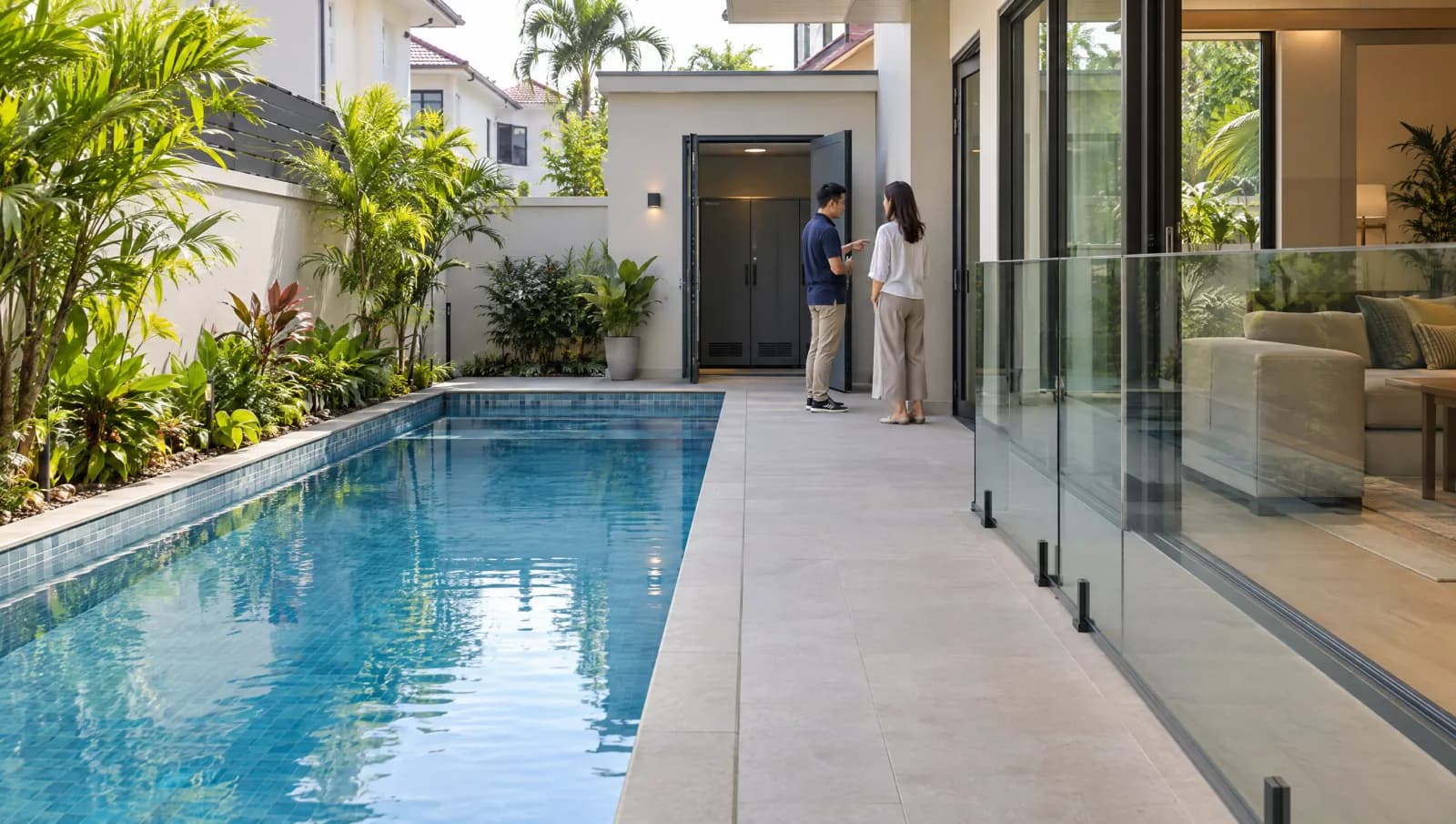
Pool Equipment Layout: Make Future Servicing Easier
swimming-pools · 8 min read
Swimming Pool Construction Timeline in Singapore from Design to Handover
swimming-pools · 7 min read
Pool Safety at Home: Fences, Covers and Alarms Explained
swimming-pools · 8 min read
Pool Losing Water? How to Tell When It Needs Investigating
swimming-pools · 8 min read
Sand vs Cartridge vs DE: 3 Pool Filters Compared
swimming-pools · 7 min read
Swimming Pool Monthly Maintenance Cost in Singapore
swimming-pools · 5 min read
3 Small Pool Options for Singapore Landed Homes
swimming-pools · 5 min read
Choosing a Pool Builder: Questions to Ask Before You Sign
swimming-pools · 6 min read
Infinity Pool Cost: What Are You Paying Extra For?
swimming-pools · 5 min read
Swimming Pool Renovation: Refurbish or Start Again?
swimming-pools · 12 min read
Should you choose a concrete or fibreglass pool?
Still deciding? Compare options & estimate cost
Side-by-side comparisons and an instant cost estimate for your Singapore home.