On this page
View In PDFAt Singapore’s July–September 2026 regulated tariff of S$0.3478/kWh including GST, a home lift using 300 kWh a year would cost S$104.34 in electricity, or about S$8.70 a month. The 300 kWh is an example, not a typical consumption figure. The full running budget also includes servicing, annual inspection and testing, permit-related work and repairs, which must be priced separately for the selected lift.
For a home lift installation, ask for the energy information and local service terms while choosing the equipment. A small monthly electricity number can feel reassuring, but it does not tell you what you will pay when a service contract renews or a part needs replacement.
The Question Owners Ask After the Quote
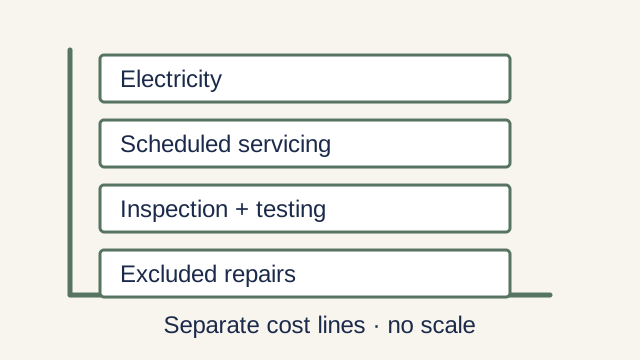
After the installation price, ask what the chosen lift will cost to operate and maintain. Separate electricity, scheduled servicing, statutory inspection and testing, and excluded repairs. Their relative size depends on the model, usage and service agreement.
Use the categories below to assemble a budget from the equipment documentation and written quotations. Keep consumption, scheduled work and irregular repairs separate so that a low electricity estimate does not conceal a significant service exclusion.
Electricity: Estimate Travel and Standby Separately
| Component | Assumed input and calculation | Annual energy |
|---|---|---|
| Travel | 1.5 kW average electrical input while moving × 20 one-way journeys/day × 30 seconds ÷ 3,600 × 365 | 91.25 kWh |
| Standby | 0.020 kW × (8,760 − 60.833 moving hours) | 173.98 kWh |
| Total | 91.25 + 173.98 | 265.23 kWh |
| Cost at S$0.3478/kWh | 265.2333 × 0.3478 | S$92.25/year, about S$7.69/month |
In this example, twenty one-way journeys mean ten return journeys. The lift moves for about 60.8 hours across the year and spends the other 8,699.2 hours in standby. We use average electrical input during movement, not a motor’s mechanical output rating, and deduct moving time from standby hours so the two periods do not overlap.
The calculation explains why usage alone is not enough. Holding the other assumptions constant, a 10 W standby input would bring electricity to about S$61.99 a year; 40 W would bring it to about S$152.76. Those are sensitivity examples, not measured models or a market range. Controls, lighting, battery charging and other functions must be represented in the consumption data used for your lift.
A manufacturer’s measured energy per journey can be more useful than a power figure. Multiply kWh per journey by the expected annual journeys, then add the documented standby consumption for the remaining time. If a complete annual measurement already includes standby, do not add it again.
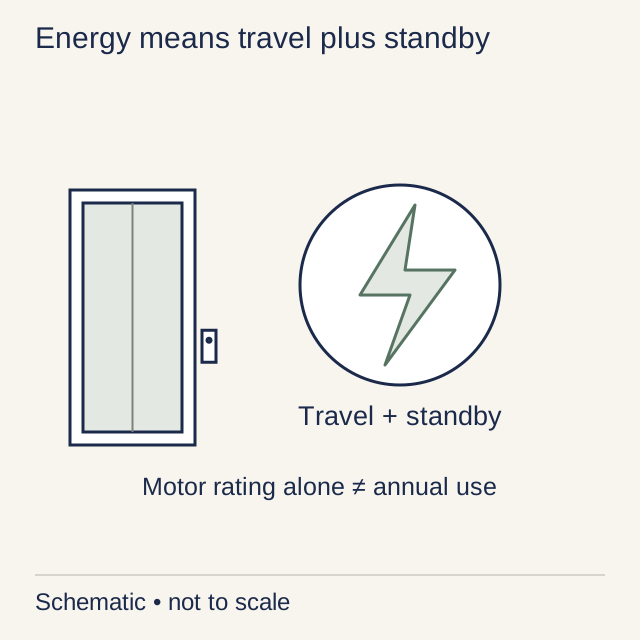
Ask for energy-consumption information relevant to the selected model, travel and usage, including standby demand. If suitable measured consumption is available for the installed lift, use it to refine the estimate. A motor rating alone is not an annual consumption figure.
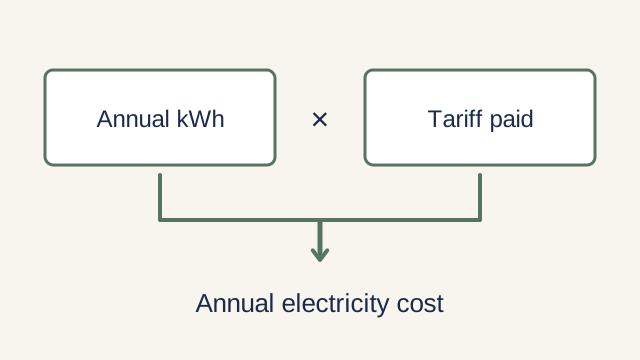
Multiply estimated or measured kilowatt-hours by the tariff you actually pay, including the relevant taxes. Date the tariff assumption and review it when rates change; do not present an older quarterly rate as the current rate.
For a simpler example, 300 kWh a year at S$0.3478 per kWh costs S$104.34. The energy use is assumed, and the calculation holds the July–September 2026 tariff constant for a year. Replace both inputs with your model’s consumption and the rate on your electricity contract.
Compare Energy Information for the Actual Model
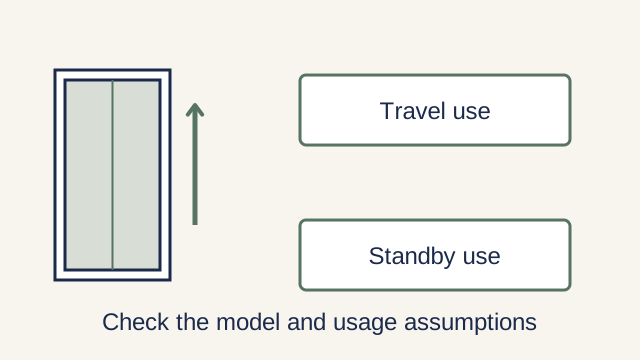
Compare two lifts using the same number of journeys, travel distance and electricity rate. An annual figure based on occasional use cannot be compared fairly with one based on a busy household. Keep the consumption assumptions beside each estimate.
Energy use depends on the complete model and operating pattern, including travel, load, frequency of use and standby functions. Compare supplier information on a consistent basis. A broad ranking of hydraulic, traction and vacuum systems does not establish the cost of your installation.
Standby demand also matters. Depending on the model, controls and other functions can use electricity between journeys. On lightly used equipment, those idle hours can be a meaningful part of annual consumption. Compare documented standby modes and their assumptions rather than assuming every modern lift is cheaper to operate.
Ask whether quoted energy data describes travel consumption, standby consumption or both, and what use assumptions produced it. Keep energy comparison separate from maintenance-contract comparison.
Maintenance: The Real Annual Cost
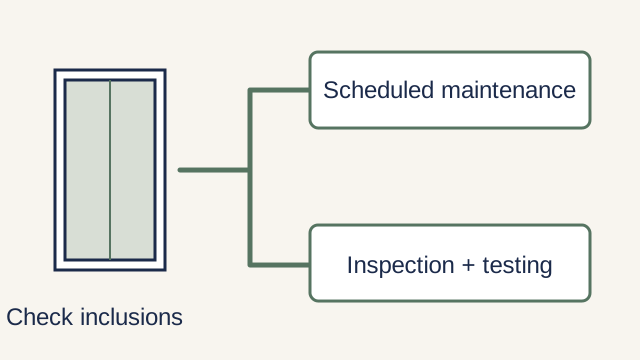
Obtain separate prices for maintenance, inspection and testing, permit-related work and excluded repairs. Check whether a renewal service includes the official fee or only the provider’s work; these are different charges.
For a lift serving a single residential unit, BCA specifies maintenance according to the manufacturer's recommendation, or every three months if no recommendation is provided. Obtain the schedule for the installed model and a written scope covering service visits, labour, call-outs and parts.
BCA's current framework specifies annual inspection and testing for regulated lifts, carried out by a BCA-registered FI service contractor with an independent SPE/FI Inspector present. This is distinct from routine maintenance. Ask whether the service agreement includes inspection and testing, related documentation and PTO application or renewal work.
Variable costs include call-outs outside the agreement and excluded parts or repairs. Request the charging basis and approval process. Avoid assuming that major components will fail only within a particular age range.
Putting It Together: A Realistic Annual Budget
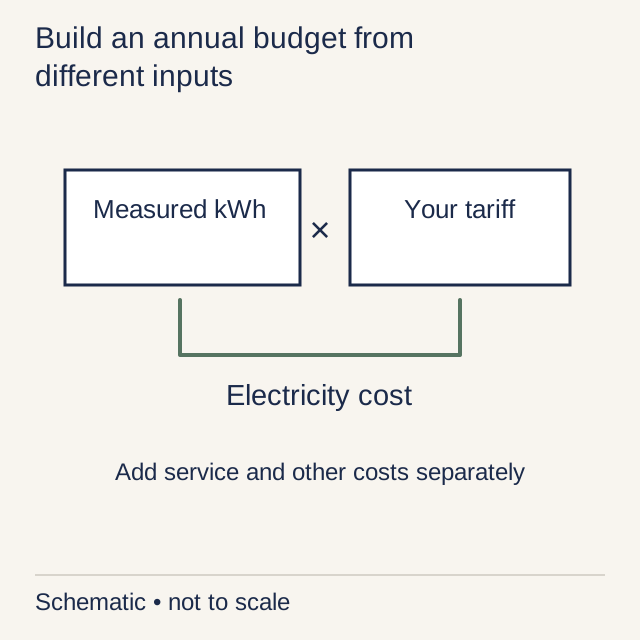
| Cost item | Annual amount | Scope |
|---|---|---|
| Maintenance | Use the selected service quotation | Confirm visits, labour, call-outs, parts and GST |
| Inspection, testing and permit-related work | Price separately unless expressly included | Separate official fees from the provider’s work |
| Electricity | S$92.25 in this example | Hypothetical travel and standby use at a constant Q3 2026 tariff |
| Repairs and replacement parts | Allow for the selected equipment and cover | Do not count covered items again |
Divide the complete annual budget by twelve to see what to set aside each month. Changing standby consumption alters the electricity calculation, but that alone cannot establish the cheapest lift to own. Compare service terms and parts cover as well as energy use.
Build an annual budget from the installed model's service quotation, annual inspection and testing, PTO-related work, electricity, call-outs and excluded parts. Check which items are bundled to avoid double-counting. A single market-wide price is not a reliable substitute for the actual equipment and contract scope.
Keep recurring obligations separate from a reserve for irregular repairs. Confirm that any multi-year estimate uses the installed model and actual service terms. A reserve is an allowance for uncertainty, not a prediction that a particular component will fail on schedule.
How to Keep Running Costs Down
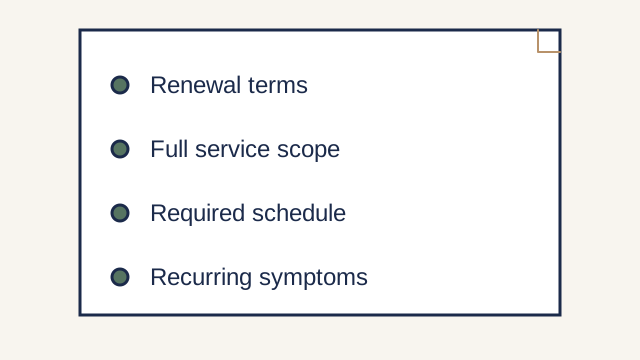
Read the renewal terms and compare the full service scope, including call-outs and annual inspection/testing. Follow the required maintenance schedule and report developing faults. Do not assume a drive type guarantees lower service costs or that routine maintenance guarantees an inspection outcome.
For the specific lift under consideration, request a complete local service offer and relevant energy information before signing. Keep the assumptions and exclusions with the installation quotation so that both the first-year and later ownership costs remain visible in the purchase decision.
Frequently asked questions
How much does it cost to run a home lift per year in Singapore?
In the hypothetical travel-and-standby example, electricity is S$92.25 a year at the stated Q3 2026 tariff. Add the actual maintenance, inspection, testing, permit-related work and uncovered repairs to calculate your annual total. The electricity example is not a complete running-cost quote.
How much electricity does a home lift use?
The worked travel-and-standby example uses 265.23 kWh/year and costs about S$92.25 at S$0.3478/kWh. Its 1.5 kW moving input, 20 daily journeys of 30 seconds, and 20 W standby are hypothetical. Replace them with model-specific or measured data; do not use a motor nameplate as if it drew that power all day.
Which type of home lift is cheapest to run?
Compare the actual models using consistent energy assumptions and complete local maintenance quotations. A drive-type label alone does not establish which lift has the lowest total running cost.
Is the BCA inspection included in a lift maintenance contract?
Annual inspection and testing are distinct from routine servicing. BCA identifies a registered FI service contractor and an independent SPE/FI Inspector for this work. Commercial agreements may bundle these items, so ask whether inspection/testing, documentation and PTO application or renewal work are included in the quoted price.
Home Lifts across Singapore
Need help with your project?
Tell us what you need on WhatsApp and send a few photos. We'll arrange a free site assessment, then give you a fixed-price quote within 3 to 5 working days.