On this page
View In PDFSingapore installers advertise a home lift, supplied and installed, from about S$30,000 to S$80,000 on their own websites (checked October 2026). Those are starting prices, not quotes for your house, and the lift is only part of the bill. You pay for its type and cabin size, the floors it stops at, the shaft and finishes, then floor and structural work, power supply and approvals, plus yearly servicing and inspection.
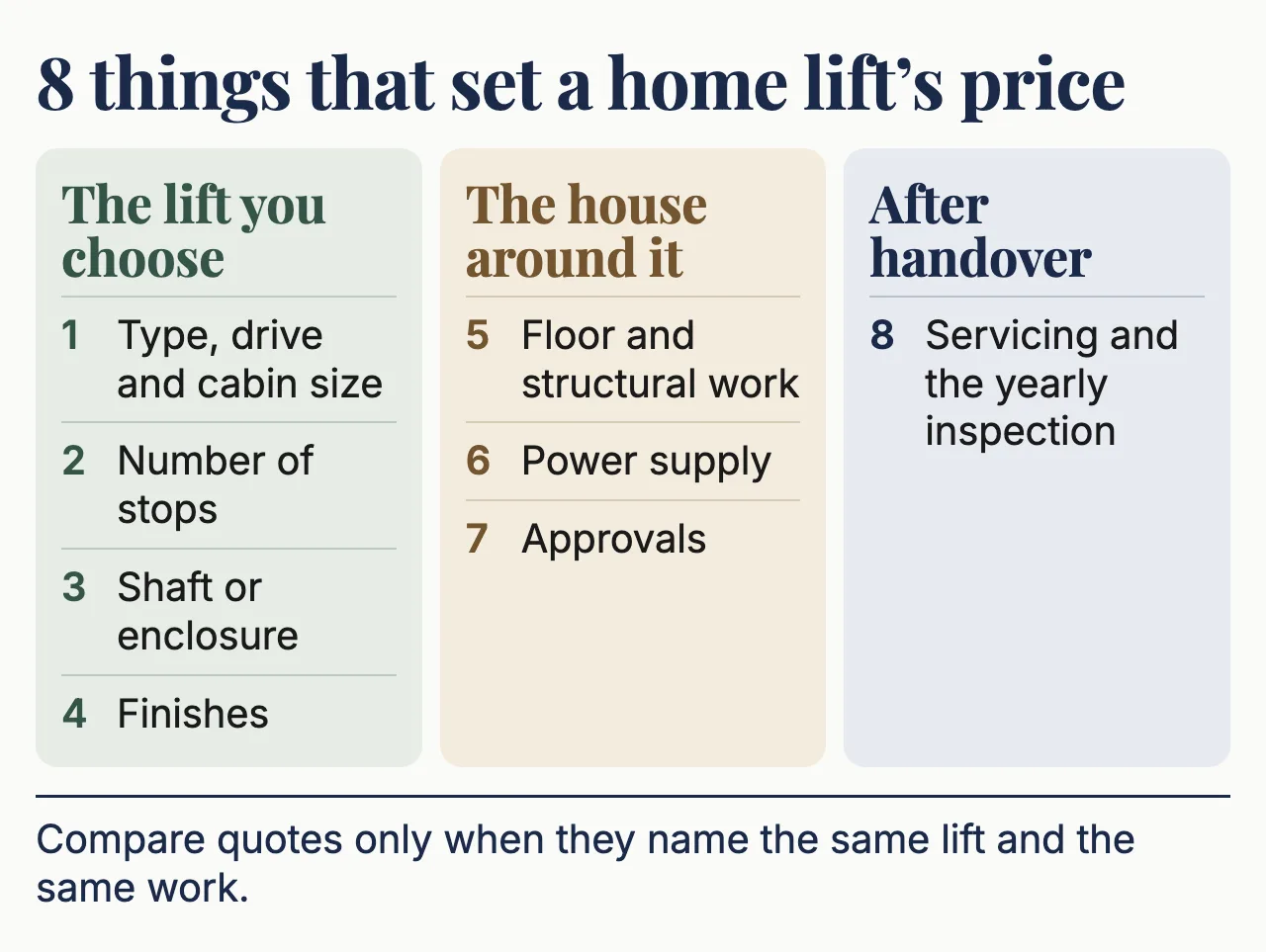
For a home lift installation, start with who will use the lift and which floors they need to reach. A compact platform for one standing passenger and a cabin that takes a wheelchair with a helper are different purchases, and the cheaper one is only good value if the household can actually use it. Once that is settled, the eight things decide what the lift and the work around it will cost.
Key takeaways
| What decides the price | How it moves the cost | Where to find it in a quote |
|---|---|---|
| 1. Lift type, drive and cabin size | The drive and cabin size set the space, supports and openings needed for the proposed layout | Model, drive, rated load, cabin and door size |
| 2. Number of stops | Another landing needs access and controls; extending the served range also adds travel | Stops listed floor by floor |
| 3. Shaft or enclosure | A built shaft is building work, while some platform lifts come with their own | Who builds the shaft or enclosure, and to whose drawing |
| 4. Finishes | Glass, custom colours, wall panels and extras cost more than the standard trim | Finish schedule with standard items marked |
| 5. Floor and structural work | Cutting slabs, adding supports, forming a pit and making good the rooms around the lift | Engineer's scope, openings, pit and making good |
| 6. Power supply | A supply wired from your switchboard by a licensed electrical worker | Supply type, cable route and who wires it |
| 7. Approvals | Engineers' plans and supervision, testing and the Permit to Operate | Named engineers, submissions and government fees |
| 8. Servicing and yearly inspection | The maker's maintenance schedule, or every three months if none is given, plus the annual test | Maintenance contract, annual test and permit renewal |
- Compare quotes only when they name the same lift model, stops, cabin size and installed scope.
- Ask for the lift package, building work, electrical work, professional fees and government fees as separate lines.
- An existing shaft or lift provision has to be measured and checked for the proposed model before it counts as a saving.
- Budget for the years after handover too, because the lift needs regular servicing, an annual inspection and test, and a renewed Permit to Operate.
What Determines Home Lift Pricing?
The first four things come down to the lift you choose. Aritco, which makes platform home lifts, says there is no universal price tag because the cost of a residential lift depends on the model, number of floors, design preferences and installation conditions. The model, the floors it serves and the design are choices you control, so settle them before you ask anyone for a figure. Installation conditions come from the house, and the sections on the shaft and on floor and structural work explain them.
1. The type of lift, its drive and its cabin size
Home lifts move in different ways, and each drive asks something different of the house. A screw-driven platform lift such as the Aritco HomeLift has a self-contained structure with no separate machine room, and can sit in a 37 mm recess or on the floor with a ramp. One hydraulic model, the Savaria Infinity, needs a separate machine room for its fluid tank and controller, plus a shallow pit. A vacuum lift such as the PVE52 is listed by its maker as needing no pit, hoistway or machine room. So the lift with the lowest package price isn't automatically the cheapest to install, because the pit, headroom and machine space it needs all become building work. Our comparison of hydraulic, traction and vacuum home lifts explains how each one works.
Cabin size moves the price a second way. A cabin big enough for a wheelchair and a helper needs enough space at each landing. The installer and engineer should check the openings and supports for the chosen model and position. Within its own range, Aritco describes the HomeLift Compact as its most affordable model and the HomeLift Access as built to take a full-size wheelchair and a companion. If anyone in the household uses a wheelchair now or may later, size the cabin for that first, because enlarging the opening after the floors are finished means cutting them again. What a wheelchair-accessible home lift needs covers the space a wheelchair user needs to enter and turn.
2. How many floors it stops at
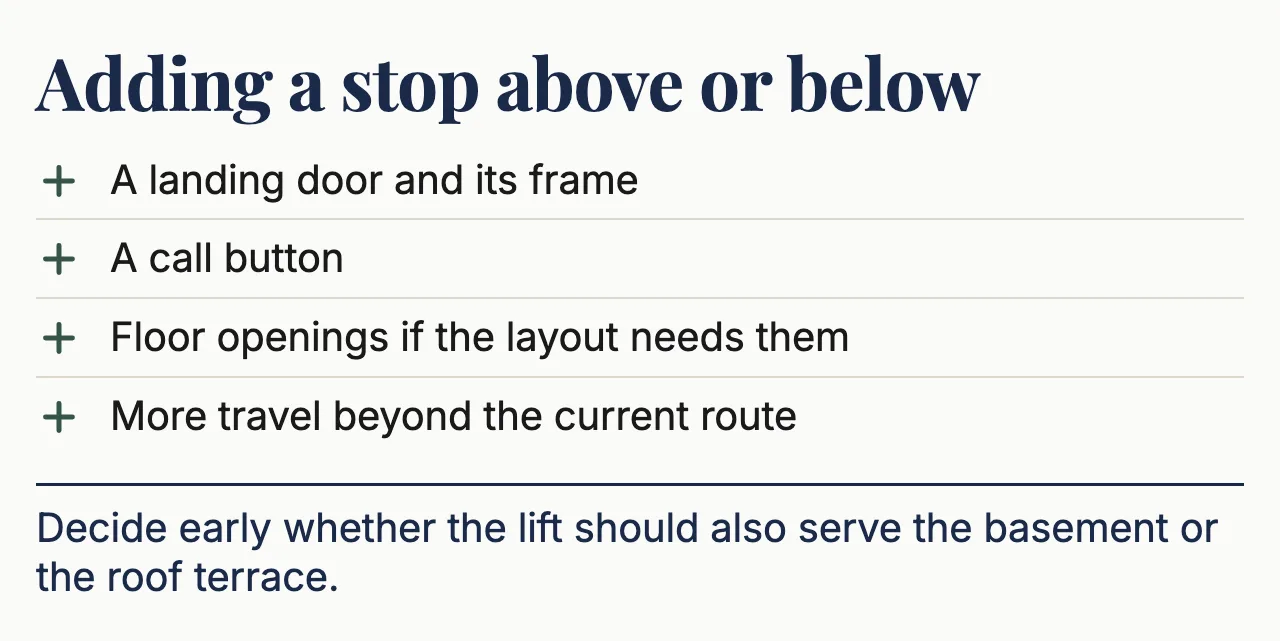
An extra stop needs landing access and controls. Extending the lift beyond its current served levels also adds travel; any new floor or wall opening depends on its position and the existing house. Aritco notes that adding more stops or levels naturally increases cost, as it involves additional materials and installation time. In a landed house, decide early whether the lift should also serve the basement or the roof terrace. Ask the installer what adding that stop later would involve. It can require changes to the lift and finished building work, so settle the intended route before the first quote.
3. Whether it needs a shaft built
A conventional lift runs in a shaft that is built as part of the house, so the shaft is building work with its own drawings and cost. Some platform lifts come with their own shaft as part of the package instead. Either way the lift sits inside the home, because URA's landed-housing guidance says vertical circulation spaces such as staircases and lifts to the upper storeys should be located within the house. The same guidance lists lift overruns among the few features allowed beyond the height and setback envelope, so a lift that needs extra headroom above the top floor can project above the roofline, and the roof work around it then belongs in the quote.
An existing shaft or lift provision can reduce this work if it fits the proposed model and the structure is still suitable. Have it measured and assessed rather than assuming a fixed saving, because a mismatch in pit depth, headroom, openings or supports can still mean changes. How much space a home lift needs explains the measurements to check, and no-pit home lifts covers what changes when digging isn't possible.
4. The finishes
Finishes change the price without changing who can use the lift. Aritco says standard colours cost nothing extra, while custom finishes, decorative wall panels or a glass shaft raise the price, and that extras such as remote controls, emergency phones or external call stations also affect the total. We recommend fixing the cabin size, doors and stops first, then choosing finishes with the budget that is left, so a glass shaft never squeezes out the wider door someone actually needs. Whether a glass home lift is worth the extra looks at that trade in more detail.
Compare Like-for-Like Equipment and Installed Scope
| Line | What it should name | Why it matters |
|---|---|---|
| Lift package | Model, drive, rated load, cabin and door size, stops, finishes and warranty | Shows which lift you're actually buying |
| Shaft or enclosure | Who builds it and to whose drawing | It is building work if the lift doesn't bring its own |
| Building and structural work | Floor openings, supports, pit, any roof work at the overrun, and making good walls, floors and ceilings | A brochure footprint is not the whole installation |
| Electrical work | The supply, the cable route, any switchboard change and who wires it | It has to be done by a licensed electrical worker |
| Professional services | The structural engineer, and the lift's plan submission and supervising engineers | Plans are approved before work starts |
| Government fees | Listed on their own, apart from the services around them | So a fee isn't hidden in a service or counted twice |
| Testing and handover | Testing, the Permit to Operate application and owner training | A fitted lift can't be used until it has its permit |
| Maintenance | The first servicing arrangement and what the warranty requires | Servicing is required once the lift is in use |
| GST and exclusions | Whether GST is included, and every provisional sum or exclusion | Otherwise two totals aren't comparable |
Compare quotes line by line rather than by the total. If one quote leaves the building work to the owner and another includes it, the lower total may simply be buying less. A provisional sum is an allowance for work that can't be priced yet, so ask what it covers and how the final figure will be agreed. Tax needs the same care, because GST-registered businesses are required to charge GST at 9%, and a quote that leaves it out isn't comparable with one that includes it. Our checklist of seven things to check before accepting a home lift quote goes through each part of the scope.
Installation Costs Beyond the Lift
The next three things sit outside the lift package. They depend on your house more than on the lift you choose, and they are the lines to look for first when one quote is far below another.
5. The floor and structural work
Fitting a lift into an existing house can require floor or wall openings, supports, a pit and repairs to adjoining finishes. The model, its position and any existing lift provision determine which work is needed. BCA says a permit is required for all building works except those classified as insignificant, with only a registered civil or structural Professional Engineer able to apply for structural plan approval, and it advises owners to engage a Qualified Person to advise on the clearances needed before building work starts. Where your lift openings and supports need plans and a permit, expect the engineer's design, the submission and the permit as lines of their own in a complete quote.
Landing doors need openings in walls too, so ask the engineer which walls carry load before the lift's position is fixed. If the lift comes with an extension or other work that adds floor area, check planning permission as well, because URA says alterations and additions generally need planning permission if the works increase gross floor area. Whether to install a lift now, prepare for one or retrofit later explains what preparing during a rebuild changes.
6. The power supply
A home lift needs an electrical supply wired back to your switchboard, and the model decides what kind. The Aritco HomeLift, for example, is specified for either a 230 V single-phase or a 400 V three-phase supply, so the quote should confirm which one the lift needs and whether your switchboard can provide it without changes. Running that supply is electrical work, and EMA says only licensed electrical workers are allowed to install, repair, inspect and test electrical installations. Ask whose licensed electrical worker connects the lift and whether that is inside the lift price or a separate line. What the lift then costs to run is covered in home lift running costs.
7. The approvals
A home lift is regulated as a fixed installation. A narrow exemption covers a stairlift or vertical platform lift that serves a single home, travels less than 1,000 millimetres and exerts less than 150 newtons of downward force. All three conditions must be met; a lift travelling more than a metre between floors does not meet that exemption. For lift work carried out on or after 1 October 2025, plans have to be approved before the work starts, unless it forms part of building works whose plan application was submitted before that date. That means appointing a qualified person to submit the lift plans before installation and a supervising qualified person who is physically present for the testing, and the same person can do both.
After testing, the owner applies for the Permit to Operate, which BCA says must be valid before owners can operate their lifts. The government's own application fee is S$20 per lift under the Building Control (Fixed Installations) Regulations 2025, which is separate from the price of the work around it. The engineers' design and supervision, the contractor's testing and the paperwork are services with their own fees, so ask for them as separate lines. BCA also asks owners to engage only BCA-registered contractors to install and maintain lifts, and our guide to home lift approvals in Singapore sets out who handles each step.
Annual Maintenance Costs
8. Servicing and the yearly inspection
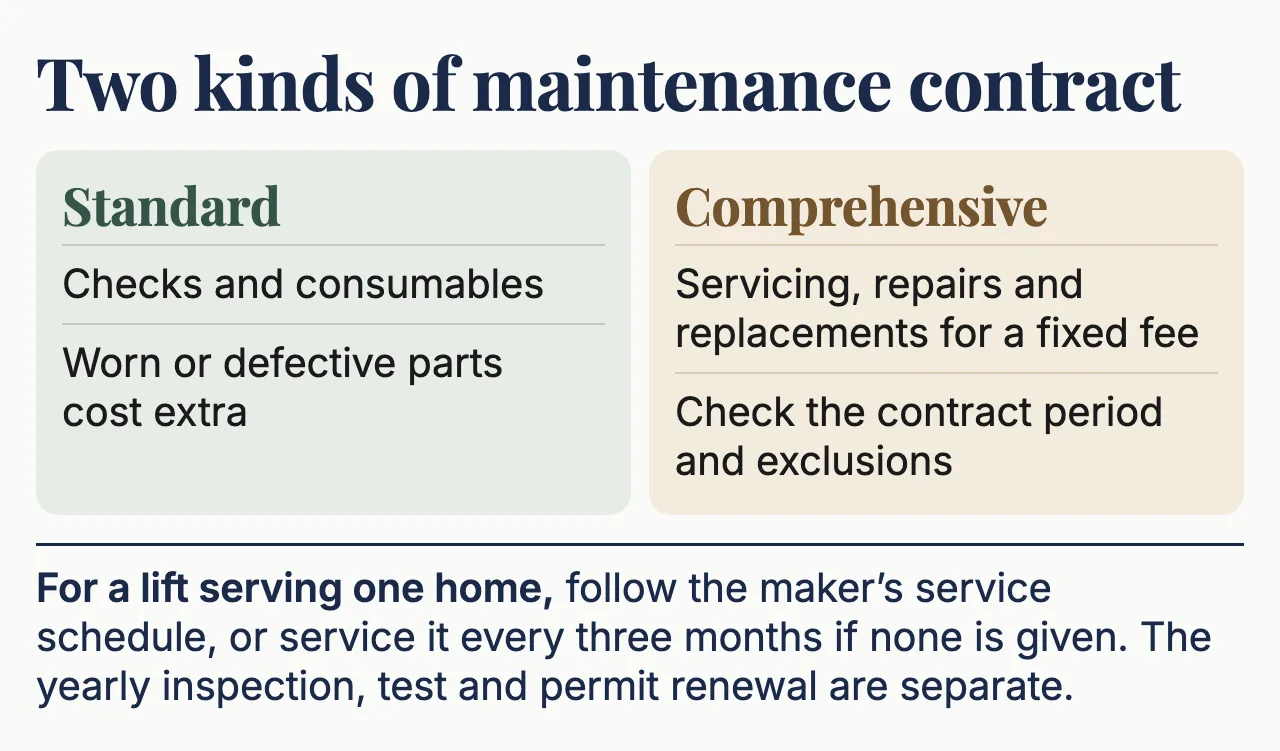
The last thing that decides the price arrives after handover. BCA requires a lift that serves a single home to be maintained as per the manufacturer's recommendation, or every 3 months if there isn't one, by a BCA-registered service contractor. Every lift also needs annual inspection and testing by a registered contractor with an independent Specialist Professional Engineer (SPE) or FI Inspector present, and a Permit to Operate is valid for 12 months, so the test and the renewal come round every year.
Singapore installers advertise home lift maintenance from about S$800 to S$2,000 a year on their own websites (checked October 2026), and those figures are starting prices, not quotes for your lift. Ask how many visits a year the price covers, and whether your yearly test and permit renewal are in it or charged on top.
The type of maintenance contract decides how much of the repair risk stays with you. BCA's good practices guide for lift owners describes a standard contract that covers checks and consumables, where replacing worn or defective parts costs extra, and a comprehensive contract that includes servicing, repairs and replacements for a fixed fee, with exclusions such as vandalism and parts users can reach. These are contract types described in the guide; the actual offer may have other exclusions. If an unexpected repair bill would strain the household, price the comprehensive option first and read its full terms. If you would rather keep a reserve and accept variable bills, a standard contract can make sense.
Ask for the maintenance quote at the same time as the installation quote, for the same model. Parts availability, what each visit covers, callout terms and warranty conditions all feed into what the lift costs to own, and a drive label alone doesn't tell you which lift will be cheaper to keep running. Home lift maintenance costs goes through the annual budget in detail.
Getting the Best Value
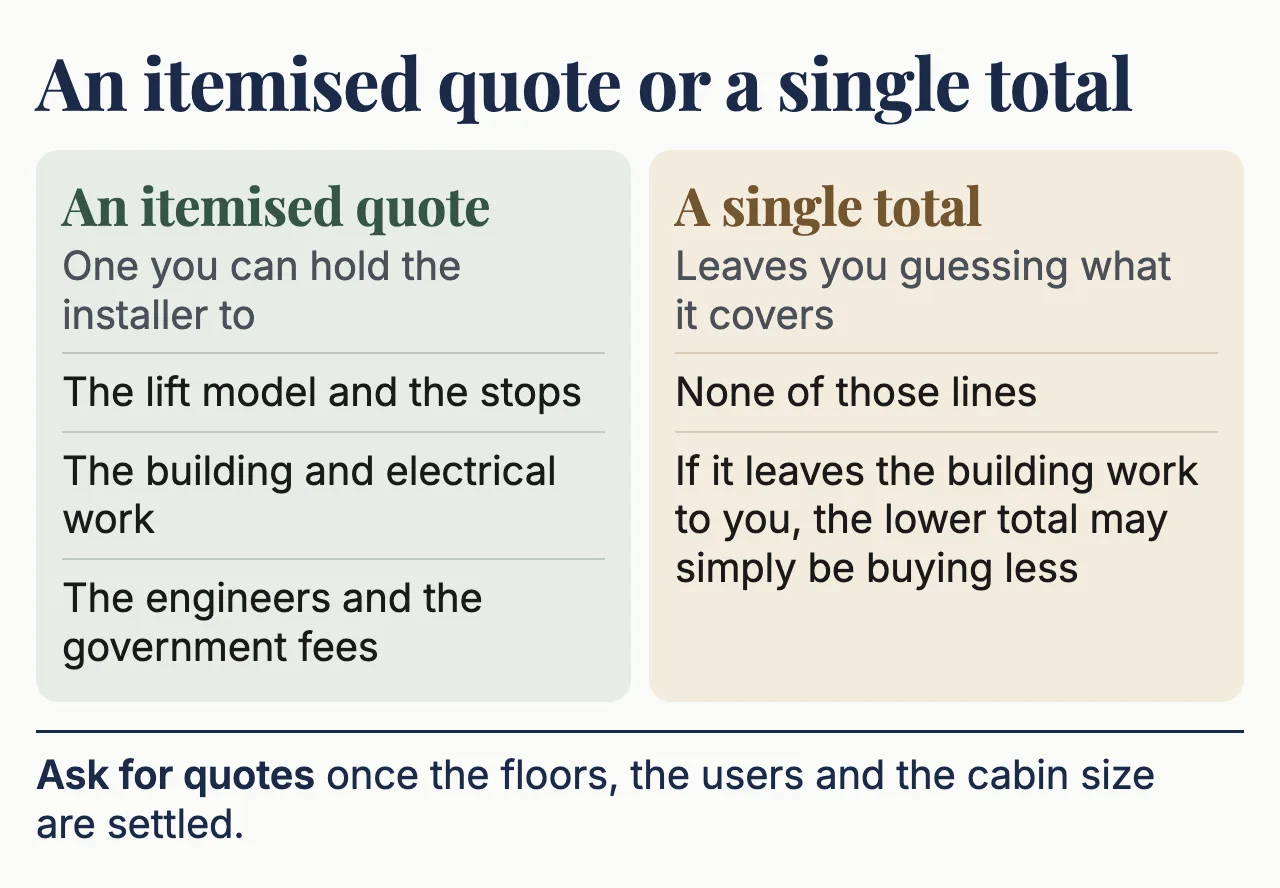
We recommend asking for quotes only after you've settled the floors, the users and the cabin size, then comparing them against the eight things above. A quote that names the model, the stops, the building and electrical work, the engineers and the government fees is one you can hold the installer to. A single total without those lines leaves you guessing what it covers.
If you're still deciding whether a lift is the right answer at all, our stairlift and home lift comparison sets out who each one suits, and the home lift buying guide covers the wider decision.
As the principal contractor, DirectHome takes on the lift and the building work around it as one project. On WhatsApp, send us the floors you need to reach, who will use the lift, and any floor plans or photos of the stairs and landings. With those we can tell you which of the eight things will weigh most in your house and what a site assessment needs to check.
Common questions
Is there an average price for a home lift in Singapore?
Not one that fits every house, because one figure would lump together compact platform lifts and wheelchair-sized cabins, two stops and four, and houses with a ready shaft and houses that need floors cut and strengthened. The closest you'll get is the range Singapore installers advertise on their own websites (checked October 2026), from about S$30,000 to S$80,000 for a home lift supplied and installed, as starting prices rather than quotes. Before you set any figure against a quote, check which lift, how many stops and what building work it covers, and whether it includes GST.
Does a small home lift cost less?
The lift package can cost less, and Aritco describes its compact model as the most affordable in its range. The fixed parts of the project don't shrink with the cabin, though. Structural plans and a permit where the floor openings need them, the power supply, the lift's plan approval and testing, the Permit to Operate and yearly servicing apply to a small lift as much as a large one.
Is it cheaper to add a lift during a rebuild than to an existing house?
Planning the lift into a rebuild or major renovation lets the opening, pit and supports be designed in from the start, while adding one to a finished house can require openings and repairs to finished floors or walls, depending on the layout. Aritco notes that in new builds, architects can integrate a lift from the start, while existing homes may need floor openings or a shallow pit. Whether that works out cheaper depends on the house and the timing, so if a rebuild is on the horizon, have both routes priced.
What government fees does a home lift involve?
The Permit to Operate application fee is S$20 per lift under the Building Control (Fixed Installations) Regulations 2025, and the permit has to be renewed each year. Where the lift's floor openings need structural plans, BCA's plan fees are computed from the statistical gross floor area. Everything else in the approvals line is professional work around those fees, from the engineers' drawings to the supervised testing, so ask for the fees and the services to be listed apart.
Home Lifts across Singapore
Need help with your project?
Tell us what you need on WhatsApp and send a few photos. We'll arrange a free site assessment, then give you a fixed-price quote within 3 to 5 working days.