On this page
View In PDFVacuum and hydraulic home lifts offer different cabin layouts, operating systems and installation requirements. Compare them through the trips your household will make, including carrying belongings or using mobility aids. The useful choice needs to fit the people, the space at each floor and the building work your home can accommodate.
Two Very Different Mechanisms
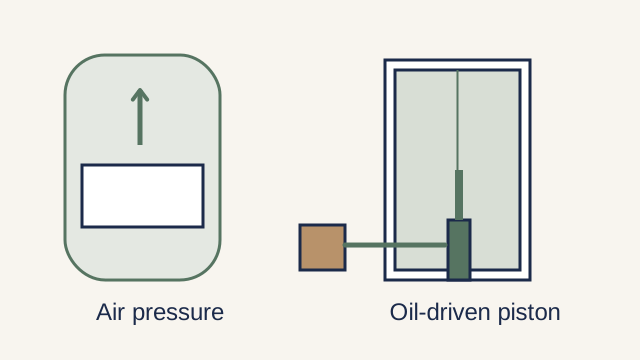
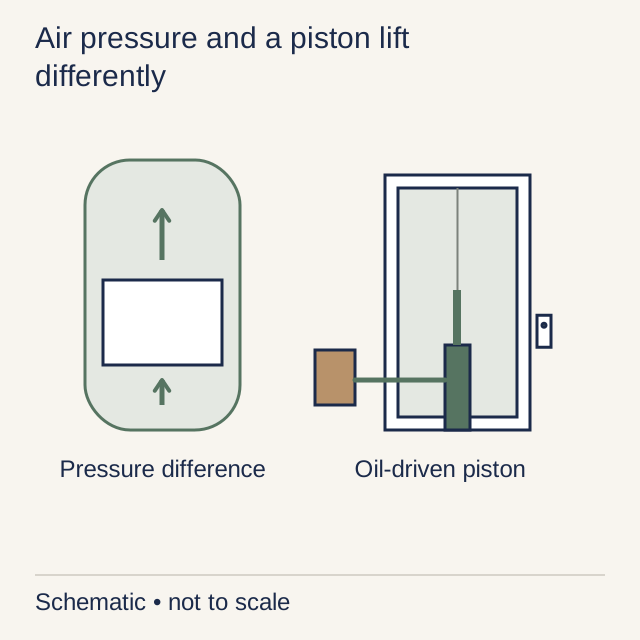
A hydraulic lift uses pressurised fluid acting through a cylinder or related lifting arrangement. A pneumatic lift uses an air-pressure difference to move its cabin. These drive principles explain why their equipment arrangements differ, but they do not determine every dimension, capacity or installation requirement.
Compare complete models that serve the same household journey. The important questions are whether the user and mobility aid fit, what the house must provide and how the installation will be supported. A drive label alone cannot establish which proposal costs less or feels better to ride.
Footprint and Installation
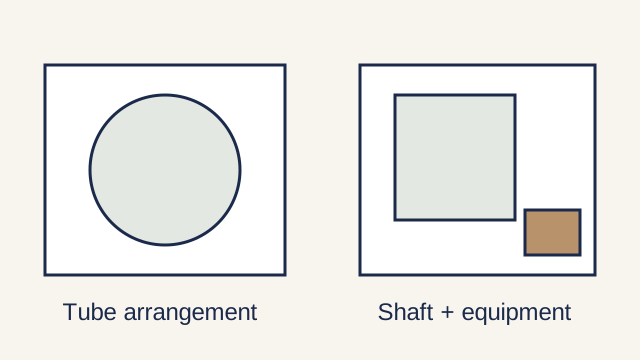
Some pneumatic products use an integrated cylindrical enclosure and are designed without a conventional pit or separate machine room. Confirm the exact model’s support, overhead and floor-opening requirements. The tube may carry its own components while still imposing loads and interface requirements on the existing house.
Hydraulic arrangements vary in their shaft, pit and machinery requirements. Locate any pump unit or cabinet on the proposal and preserve the access it needs. Compare the two complete installation drawings, including landings, power and making good; do not add a universal pit depth or construction duration based on drive type.
| Model-specific example | PVE52 pneumatic | Infinity hydraulic: standard cabin |
|---|---|---|
| Cabin and load | 44-inch circular cabin; 525 lb (about 238 kg) | 914 × 1219 mm rectangular cabin; 431 kg selected version |
| Ground and top provision | No pit; 107-inch standard or 97-inch split overhead | 203 mm pit; 2337 mm overhead with 2032 mm cabin |
| Equipment away from the cabin | Optional remote turbine package and air-pipe route | Hydraulic tank/pump/controller and service space |
The PVE52 specifications put the entrance at 32 inches (about 813 mm) and the through-floor opening at 54 11/16 inches (about 1389 mm). That hole is not the cabin: its 44-inch internal circle is smaller, and an occupied wheelchair still needs a workable approach. The Infinity example offers a rectangular cabin and more load capacity, but asks the building to provide a shaft, pit and hydraulic equipment location.
If excavation is unsuitable and the user fits the PVE52, its pitless arrangement is a concrete reason to assess it first. If a powered chair, attendant and carried equipment weigh 270 kg together, that exceeds the PVE52’s approximately 238 kg rating; the selected 431 kg Infinity clears that load test, though the actual positions and doorway still need assessment. A smaller building opening is not a useful saving if it leaves someone behind.
Cost and Lifetime Running Expense
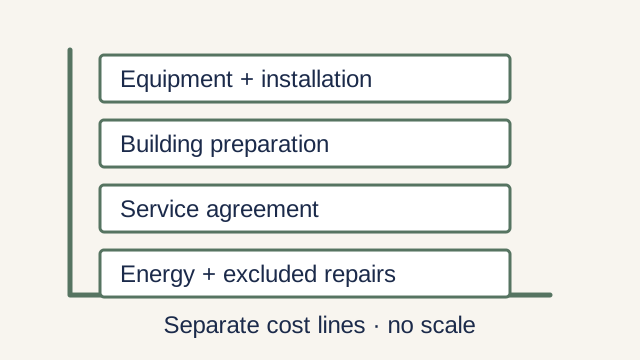
Ask for two complete project totals for the same stops and user requirements. Separate lift supply and options from openings, supports, enclosure work, power, professional services, testing and PTO work. A pneumatic equipment price and a hydraulic whole-project price cannot be compared directly.
For ownership, use model-specific energy information and written local service terms. Include the required maintenance schedule, inspection/testing, call-outs, excluded parts and warranty conditions. A lower initial building cost does not establish a lower long-term total when the equipment and service arrangements differ.
The operating difference is more precise than “vacuum uses no power coming down”. PVE turbines run during ascent and stop driving the cabin during gravity-assisted descent; lights, controls and other auxiliaries can still consume electricity. Hydraulic descent also uses controlled fluid release, so downward travel alone does not prove that one system has the smaller bill. Motor ratings and the size of the supply circuit are not annual kWh consumption.
For a household budget, use measured or properly calculated whole-system energy for the same trips. If two proposals were assumed to use 20 kWh and 30 kWh a month at an invented S$0.30/kWh, their annual electricity figures would be S$72 and S$108: (30 − 20) × 12 × S$0.30 = S$36 apart. These invented inputs do not predict either model’s consumption or today’s tariff. They show how an annual service-price difference can outweigh the electricity difference.
The service work differs too. Infinity maintenance includes hydraulic fluid level, hoses and cylinder seals, as well as its suspension cables and safety components. PVE52 care includes checking its seals and cleaning the system. Keep Singapore’s required maintenance and annual examination/testing in both ownership budgets; an overseas “low maintenance” description does not remove those duties.
Ride Quality and Capacity
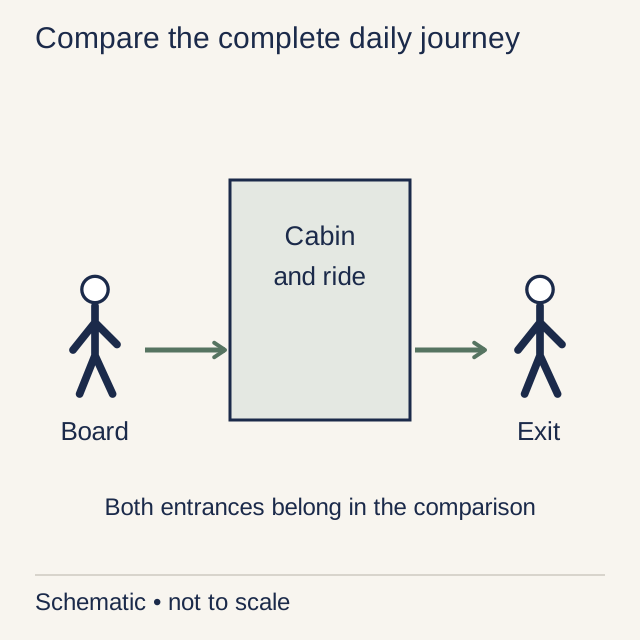
Try the proposed models with attention to boarding, standing or sitting space, door movement, controls, acceleration and stopping. Noise and vibration depend on the installation as well as the drive. Avoid treating one demonstration or an unspecified model as proof that an entire drive family is smoother.
For the ride, Infinity uses a variable-speed pressure valve for gradual starting and stopping, with its pump separated from the cabin. PVE52 can place the turbines above the top landing or use a remote split unit to move that noise source elsewhere. The split option trades extra air-pipe routing and a machinery location for reduced overhead at the tube. Listen inside the cabin and in the nearest bedroom; a published noise figure taken at a pump cannot be compared directly with one taken beside the rider.
Use the actual rated load, permitted passenger arrangement, usable carrier and clear door opening. A load rating does not prove wheelchair or stretcher access, and a large shaft does not identify the cabin within it. If moving a person with an attendant is part of the brief, demonstrate that complete arrangement on a suitable layout.
Aesthetics and Visibility
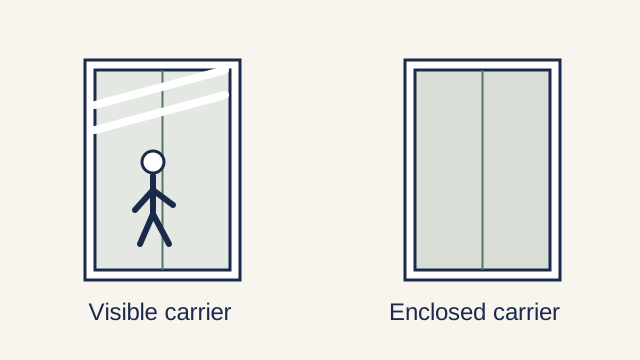
A transparent cylindrical enclosure can preserve views across a room while making the lift visibly part of the interior. It also exposes more of the moving equipment and passenger journey to people nearby. Look at sightlines from the seating area and upper landings rather than only at the manufacturer’s front-on image.
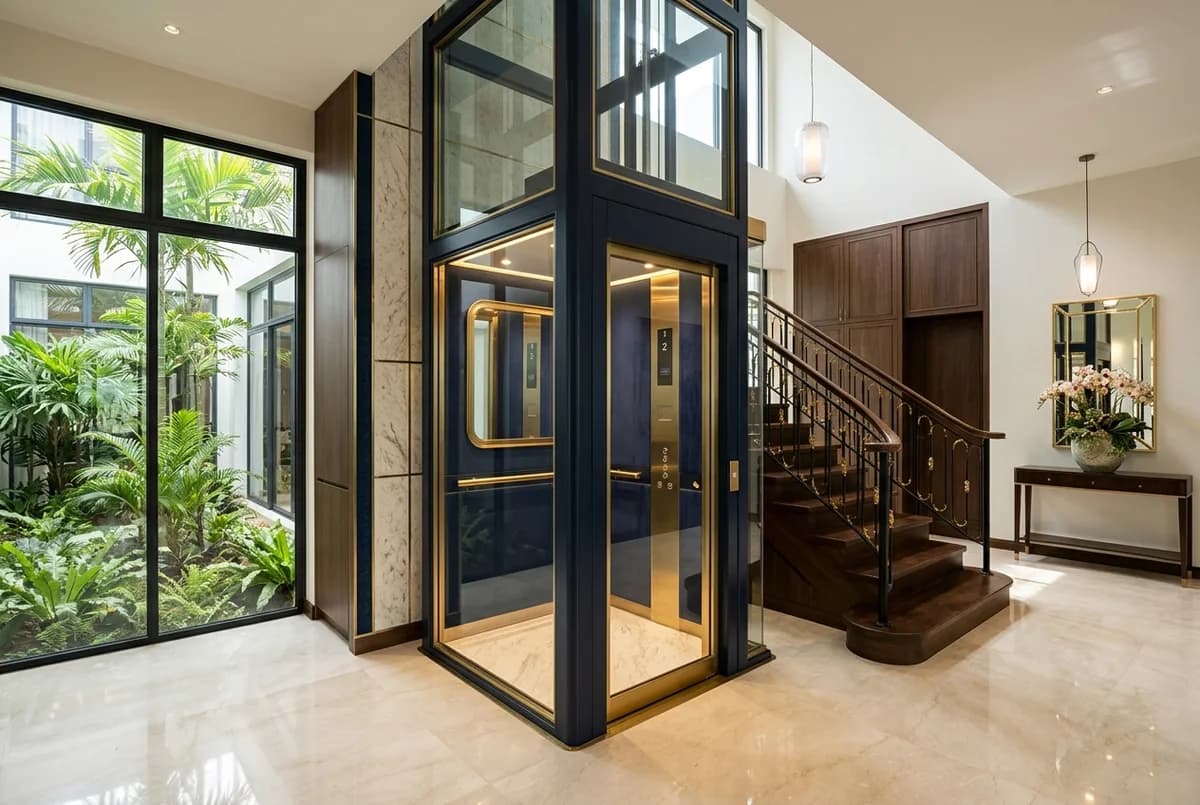
An enclosed shaft can integrate with walls and finishes, but may reduce light or usable space. Glazing, cleaning access, direct sun and acoustic treatment belong in either design comparison where relevant. Choose the enclosure and location for the house; neither drive type automatically delivers a particular architectural result.
Which One Makes Sense for You
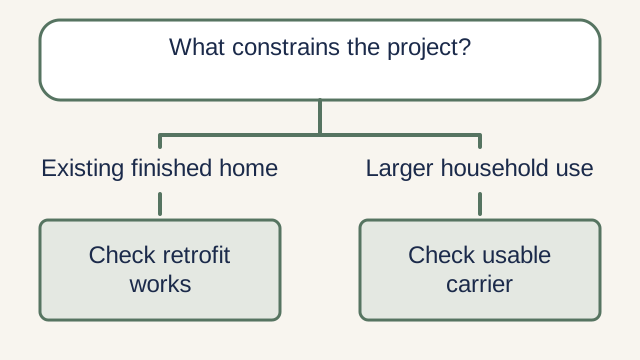
Shortlist the models that fit the user and the house, then compare building work, complete cost and local support. A limited-space retrofit may favour one arrangement, while a new build can accommodate another without the same disruption. The conclusion should follow the surveyed configuration rather than a universal vacuum-versus-hydraulic ranking.
Have the responsible professionals confirm the applicable building process and valid PTO before operation. Keep installation, testing, certification and handover as separate milestones. A unit assembled quickly still needs the full route to lawful, supported use.
Frequently asked questions
| Decision | Key distinction |
|---|---|
| PVE52 | Pitless; approximately 238 kg rated load |
| Selected Infinity | 203 mm pit; 431 kg rated load |
| Running costs | Whole-system electricity plus local maintenance and statutory work |
Common questions
Is a vacuum lift or hydraulic lift cheaper for a Singapore home?
Compare complete surveyed quotations for the same stops and user needs. Include building work, power, professional services, testing and permit work; the drive label does not establish which total is lower.
Which lift is easier to install in an existing home?
It depends on the exact equipment and house. Some pneumatic models reduce conventional shaft or pit work, but their support, openings and overhead requirements still need assessment.
Which home lift has lower running costs?
PVE turbines run on ascent and its descent is gravity-assisted, but hydraulic descent also uses controlled fluid release. That does not establish an annual-cost winner. Compare whole-system kWh for the same journeys, then add local servicing, annual examination/testing and excluded repairs. The worked electricity example shows the arithmetic; its inputs are hypothetical and are not measurements of either model.
How many people can a vacuum lift carry compared with hydraulic?
The PVE52 example is rated at 525 lb, about 238 kg, with a circular 44-inch cabin. The selected Infinity configuration is rated at 431 kg with a 914 × 1219 mm cabin. Add the real person, chair, attendant and equipment weights, then verify their positions and doorway fit. A passenger count alone cannot establish that the complete group can travel.
Home Lifts across Singapore
Need help with your project?
Tell us what you need on WhatsApp and send a few photos. We'll arrange a free site assessment, then give you a fixed-price quote within 3 to 5 working days.