On this page
View In PDFAn auto gate that's stuck or ignoring the remote doesn't automatically need replacing. The five common problems are a gate that won't open or close at all, a struggling motor, a remote that stops working, a gate that won't stay shut or opens on its own, and rust or wear that makes it drag. Some just need a new remote or motor battery.

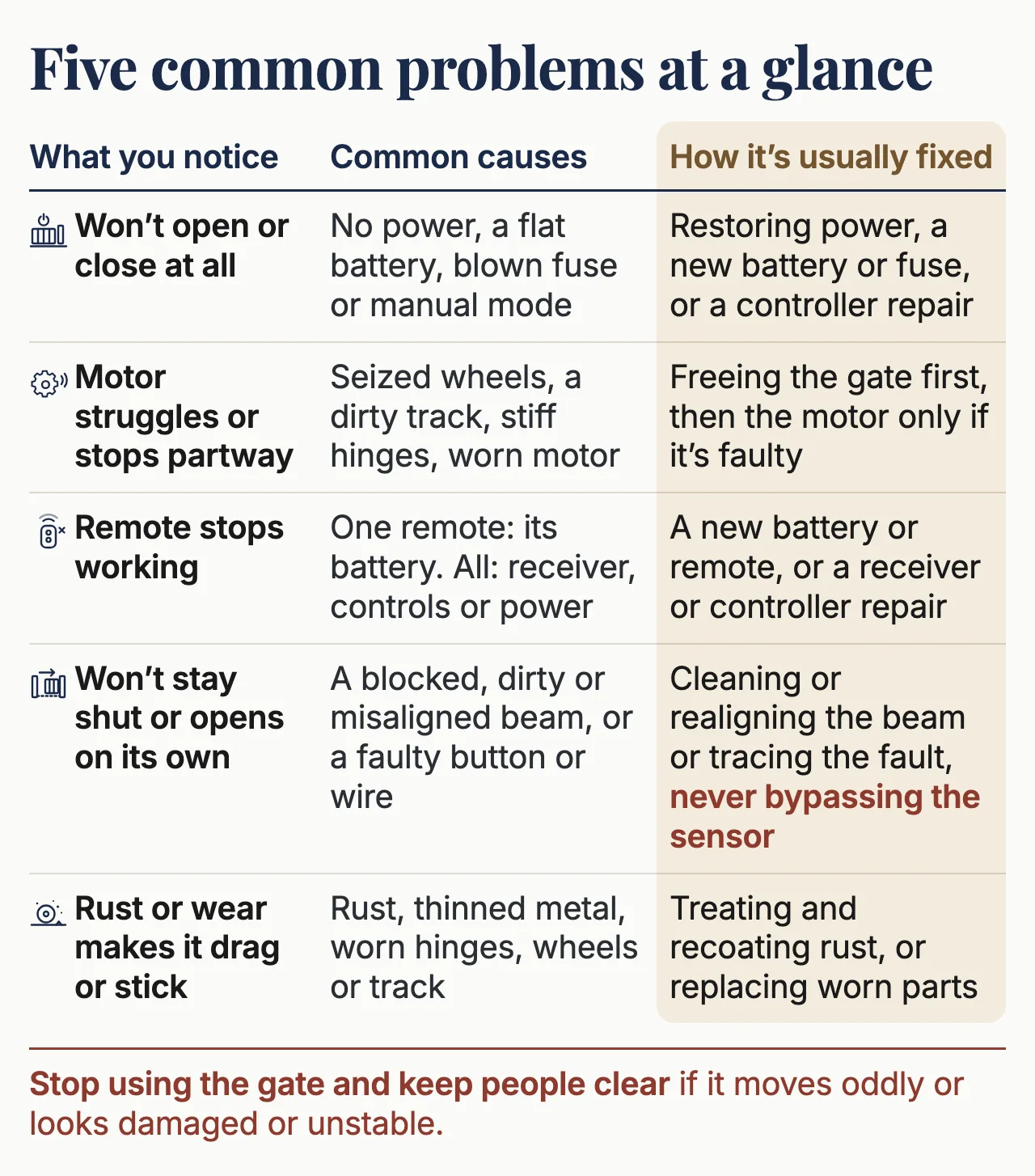
Start with the Problem You Notice
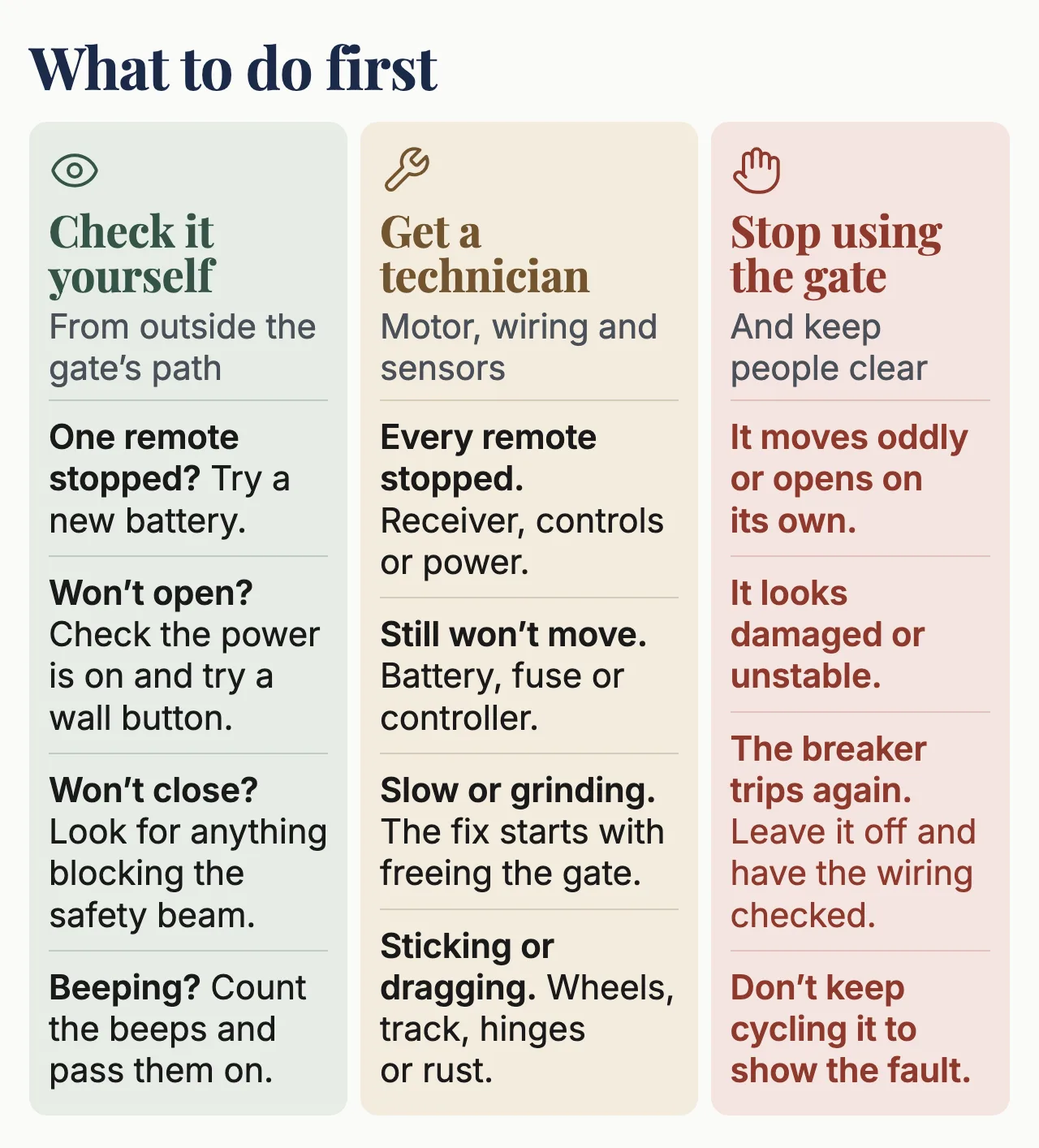
What the gate does when you press the remote is your best clue. A gate that stops halfway, one that ignores every remote and one whose motor runs while the gate stays still each point to different parts, and swing and sliding gates wear in different places. A technician will ask for exactly these details, and so will our auto gate service if the answer turns out to be a new gate.
| What you notice | Common causes to check | What the fix can involve |
|---|---|---|
| 1. The gate won't open or close at all | No power, a flat or worn-out battery, a blown fuse, a lockout setting, or the motor left in manual mode | Restoring power, a new battery or fuse, or a controller repair |
| 2. The motor struggles, grinds or stops partway | Stiff hinges, seized wheels or a dirty track, loose motor wiring, or worn motor parts | Freeing the gate first, then fixing or replacing the motor only if it's faulty |
| 3. The remote stops working | A flat battery if one remote fails; reception, the controls or power if they all fail | A new battery or remote, or a receiver or controller repair |
| 4. The gate won't stay shut or opens on its own | A blocked, dirty or misaligned safety beam, or on some systems a faulty button, intercom or trigger wire | Cleaning or realigning the beam or tracing the faulty input, never bypassing the sensor |
| 5. Rust or wear makes the gate drag or stick | Surface rust, metal thinned by corrosion, worn hinges, wheels or rollers, or a damaged track | Treating and recoating rust, replacing worn parts or rebuilding a weak section |
When the Gate Won't Open or Close at All
Before trying anything, keep people clear, and stop using the gate if it moves oddly or looks damaged or unstable. UK safety guidance for powered gates says a dangerous gate should be taken out of use immediately. Don't keep cycling a faulty gate to show the fault.
If your automatic gate won't open, work through the checks you can do from outside its path. Confirm the house has power and the gate's supply is on, try a second remote and any wall button or intercom, look for anything blocking the gate or its safety beams, and count any beeps. That's where troubleshooting stops for a homeowner, because gate motor manuals leave repair and service work to a suitably qualified person.
Some gate motors run on a battery that the mains keeps charged. The gate keeps working through a power cut, then the controller shuts it down to protect the battery once the charge runs low. A click from the control box with no movement can mean a blown motor fuse or a flat battery, and batteries age, with one maker rating those in its sliding-gate motors for three to four years.
If the gate's breaker in your DB box trips again after being switched back on, leave it off and have the wiring checked. Water in cabling, control boxes and connections can create a shock risk as well as stop the gate working safely.
A gate left in manual mode after someone used the release key won't move under power either, because the motor's gearbox is disengaged. The release isn't automatically safe on a damaged, unrestrained or sloping gate, which can drop or move unexpectedly, so use it only as your manual describes and leave a damaged gate to a technician. Our guide to getting in during a power cut explains what the manual release is for.
There's no universal way to reset an auto gate, because it depends on the controller, so follow your own model's instructions and leave anything inside the control box to a technician. On some controllers, a gate that stops after sensing an obstruction resets with the next press of the remote or button, while others ask for the power to be reset, a warning linked to a weak battery, a poor connection or a faulty controller. If a gate needs resetting again and again, the reset isn't the fix.
Gate Moving Slowly, Unevenly or Noisily
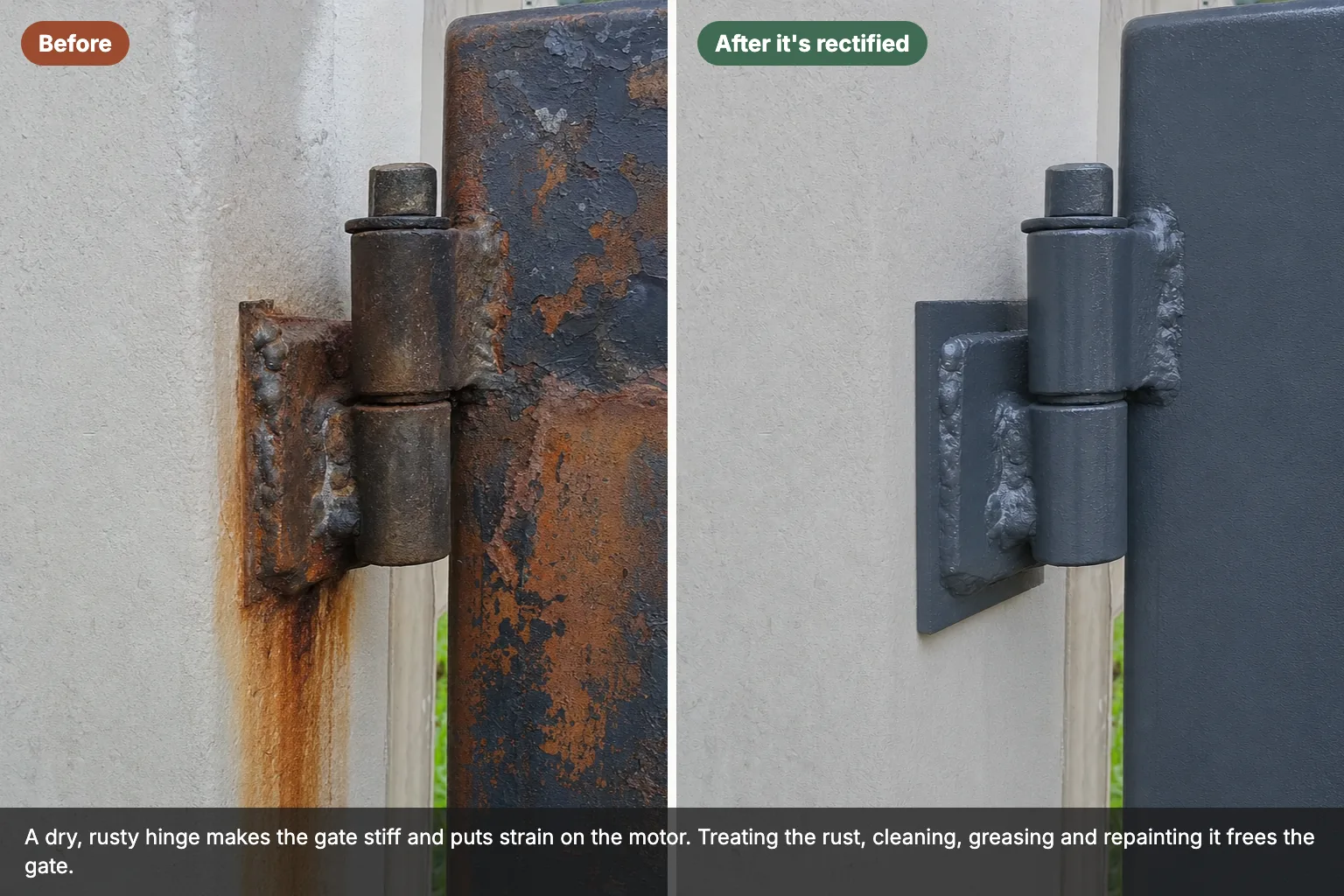
When a gate moves slowly, jerks, grinds or stops partway, the motor may be struggling against the gate rather than failing. Seized wheels, stones or dirt on the rail and a toothed rack pressing on the drive gear can all make a gate stall, and on a swing gate the hinges have to let it move freely. A neglected gate puts unnecessary strain on the motor, so the motor can be the part that complains when the gate is the part at fault.
To tell whether the gate motor is bad, a technician checks the motor and the gate separately. One documented check is to unpin the motor arm and see whether the motor runs correctly on its own, alongside checks on the battery, wiring and controller. A motor that runs well unloaded points the technician towards the gate's movement or the controller's obstruction setting, while one that doesn't points towards the motor, its wiring or the controller.
Sticking motor brushes or a failed commutator (the part that feeds current to the spinning motor) are motor faults in their own right. A motor you can hear running while the gate stays still may not be engaged with the gate. A gate that opens a little and then stops can have an obstruction, a loose motor connection, a faulty motor or a controller problem.
Inside the opener, one maker's fault guide lists a flat or ageing battery, a blown fuse, loose motor or sensor connections, worn brushes and a faulty controller among the possible causes. Other causes of gate motor failure start outside it. Years of pushing a gate that doesn't run freely add strain, and water getting into cabling and control boxes can stop a gate working safely, which matters in Singapore's humid, rainy climate.
So the fix starts with the gate. Freeing it can mean clearing the track, replacing worn wheels or guide rollers, adjusting the rack or greasing the hinges, before anyone decides the motor needs work. If the motor has failed, the replacement has to suit the gate's weight and how often it runs and work with the existing controls and safety devices.
Servicing helps reduce the strain a stiff gate puts on its motor, and one maker recommends basic checks every six months for its swing-gate motor. Our auto gate maintenance checklist shows what you can safely watch for between visits.
Remote Control Not Working
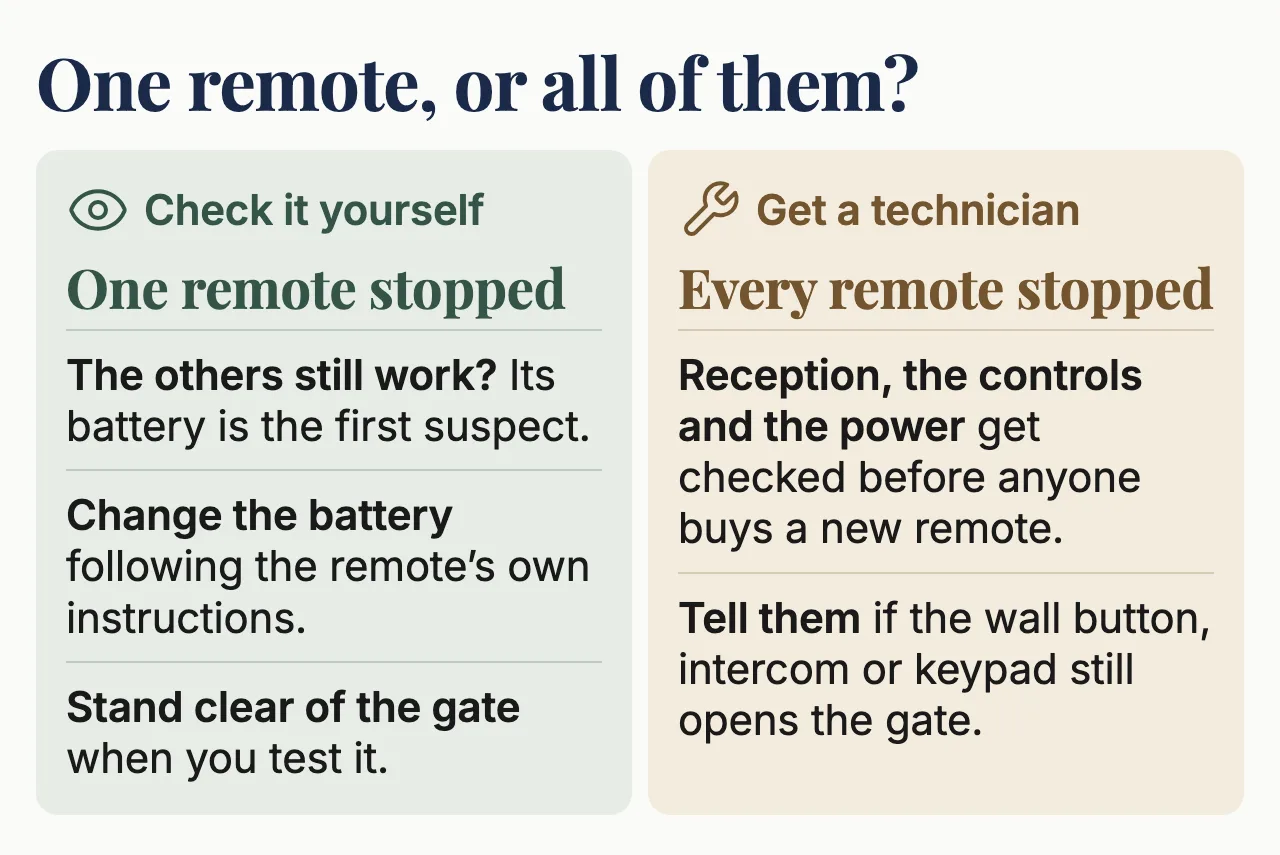
First, check whether one remote has stopped or all of them have. If only one fails while the others still work, its battery is the first suspect, so change it following the remote's own instructions and stand clear of the gate when you test it. Our guide to auto gate remotes covers replacements and compatibility.
If every remote stops at once, the technician needs to check reception, the controls and the power before anyone buys a new remote. Tell them whether the wall button, intercom or keypad still opens the gate, because that helps separate a receiver that isn't picking up the signal properly from a wider power or controller fault. Some controllers also have a holiday lockout that ignores remotes, and the buzzer beeps if someone tries to open the gate while it's on.
For a lost or stolen remote, ask whether your controller can erase that one remote without affecting the others. Phone control is a separate upgrade, so ask whether the existing controller supports it. A phone doesn't show you the gate, and motor manuals say not to operate a gate unless you can see it and its path is clear.
Sensor Faults and Unexpected Gate Movement
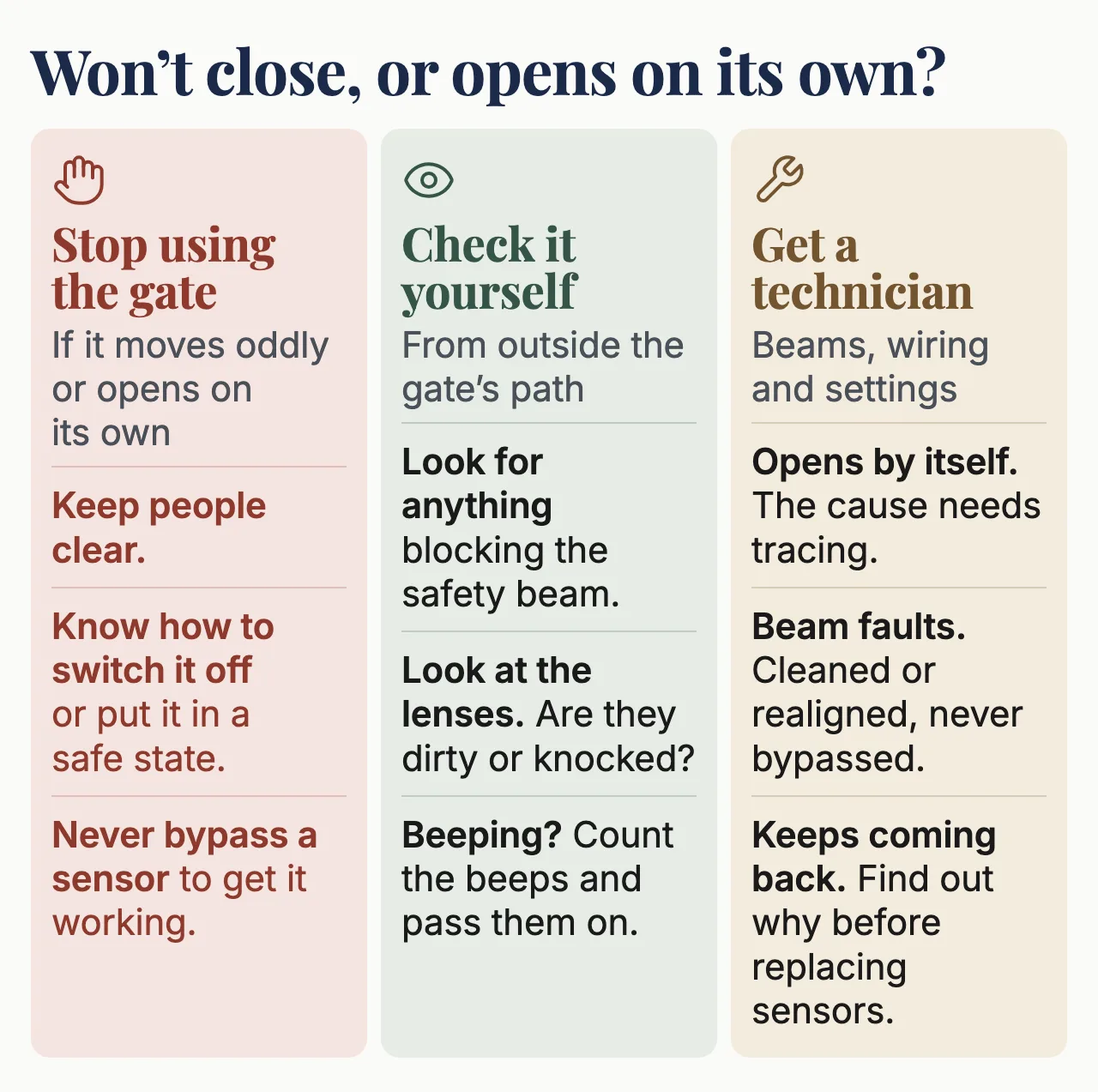
When a gate opens normally but won't close, or starts closing and then reopens, check the safety beam first. The pair of photocells across the opening tells the controller when something is in the way, so an object in the beam, a dirty or knocked lens, or a beam that works only intermittently can hold the gate open. On some systems, an anti-crush setting that's too sensitive or a remote or intercom button held down too long can have the same effect.
A gate that opens by itself needs a technician to trace the cause. On some systems it's a trigger input stuck on or damaged trigger cables, for example from a faulty button, intercom or keypad connection. Until it's found, make sure someone at home knows how to switch the gate off or put it in a safe state, and ask your installer to show you if nobody has.
Beeping is the controller reporting what it has detected, and the pattern matters. On one swing-gate motor, one beep repeating means something is breaking the safety beam or a stop or lockout mode is on, two beeps every two seconds means the mains supply has failed, and three beeps every two seconds means the battery is low. Other models use other codes, so count the beeps and pass them on.
Never bypass a safety sensor to get the gate working, because bridging the safety inputs disables that protection. Beams have limits even when they work, since many are only designed to prevent a gate closing on a vehicle, so they don't cover every point where a person can be trapped.
If sensor faults keep coming back, ask the technician to find out why before replacing the sensors again. Loose mounting, poor alignment, damaged wiring, the controller's response or movement in the gate's supports may be the real cause.
Rust, Damaged Tracks and Sticking Gates
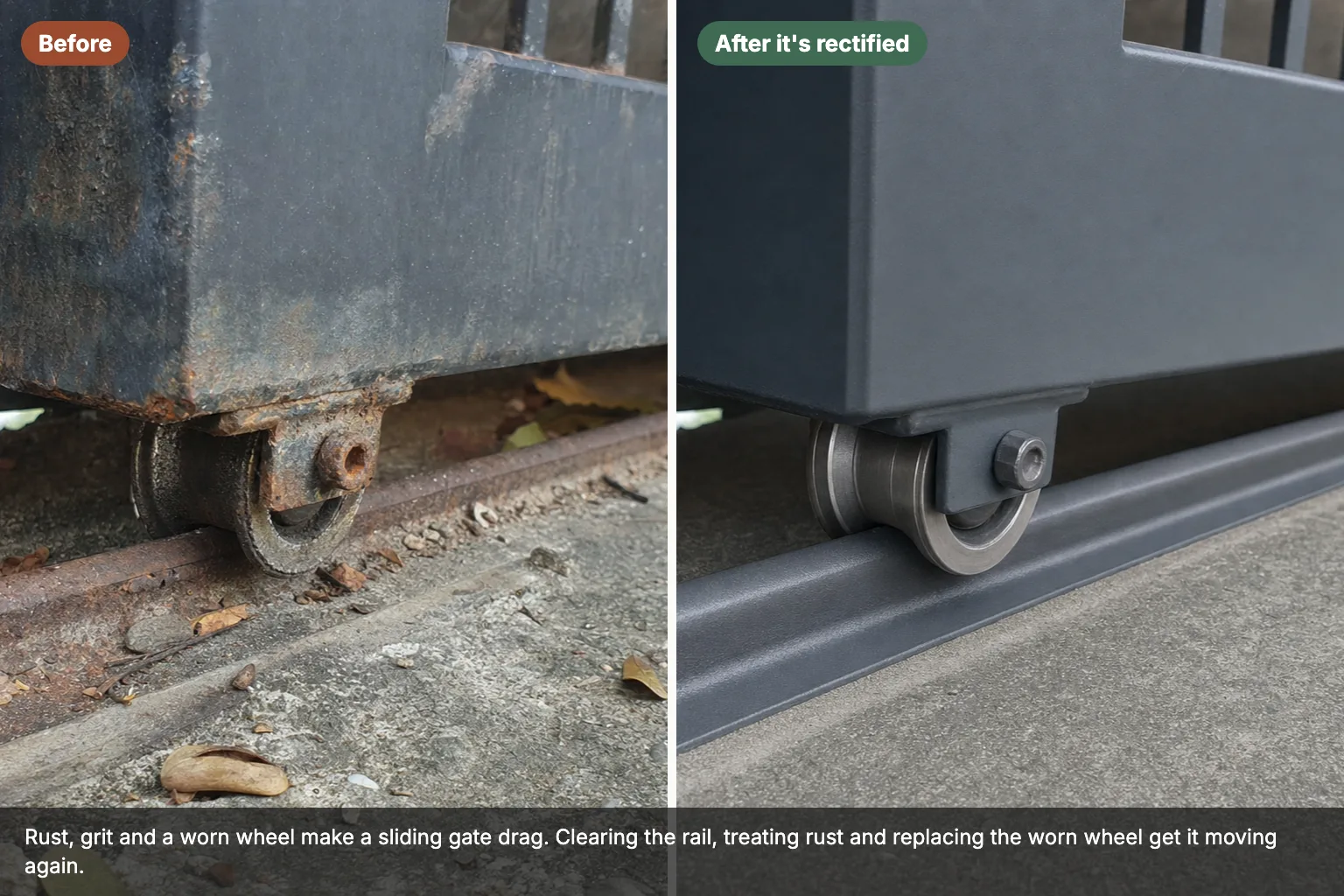
An outdoor gate in Singapore is exposed to humidity and rain all year, so any rust you see is worth having assessed for how deep it goes. Surface rust and corrosion that has thinned the metal need different repairs. The Building and Construction Authority's corrosion guide for steel structures notes that corrosion at the back of a metal can reduce its thickness significantly without affecting the front surface.
On a gate, that means hinge plates, joints, the bottom rail and hollow sections should be checked for sound metal before anyone agrees to repaint. Depending on how far the damage goes, corroded steel can be recoated, strengthened and recoated, or replaced with a new section, and strengthening may be more economical where corrosion is limited to a small area. Paint can hide a mark but can't restore lost metal, and because surface preparation has a major influence on how well a coating protects, a rust repair quote should say how the rust will be removed first.
Sticking also has mechanical causes that depend on the gate type. On a tracked sliding gate, the wheels carry the gate's weight and guide rollers hold it upright, while the rail can become corrugated and uneven with use, so worn wheels and rollers, a damaged track and debris are standard checks. On a swing gate the hinges carry the load, and the motor's brackets take very large forces and can work loose.
Routine upkeep such as clearing leaves and dirt from the track should follow your gate's own manual, with the gate isolated from mains and battery power and secured against moving under its own weight. If the gate is already faulty, or the isolation or release steps are unfamiliar, leave it to a technician, along with realigning a track, changing wheels or rollers and repairing hinges or brackets. Our swing and sliding gate comparison explains how the two layouts differ.
If a section needs replacing, choose the material and finish for the exposure, since sea spray can pit and rust even stainless steel unless the grade is resistant enough, as our stainless steel gate comparison explains.
When to Repair vs Replace
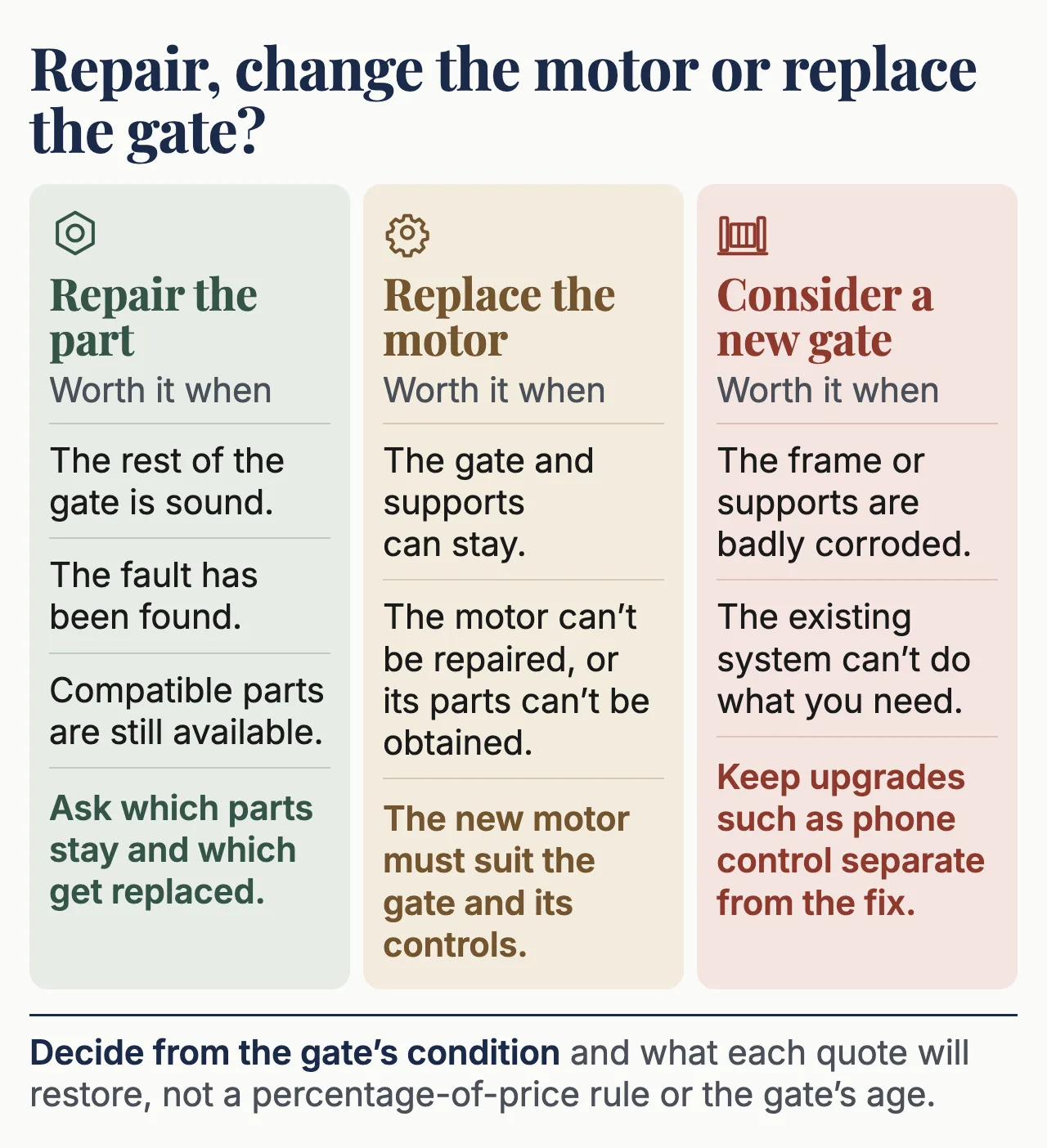
A repair makes sense when the gate is otherwise sound, the fault has been found and compatible parts are still available. Many of the fixes above are local, so a battery, a beam, a fuse, a set of wheels or one rusted section can be dealt with without touching the rest of the gate. Ask which parts stay and which get replaced.
Replacement deserves a closer look when the frame or supports are badly corroded, parts for the motor can no longer be obtained, or the existing system can't do what you need. Keep optional upgrades, such as phone control or battery backup, separate from the work needed to fix the fault. Our guide to repairing, re-motoring or replacing an old gate goes through that choice, and the auto gate buying guide covers gate types, materials and motors if you're starting again.
| Option | When it is worth considering | What the quote needs to include |
|---|---|---|
| Repair the identified fault | The rest of the gate is sound and suitable parts remain available. | The faulty part, labour and checks before the gate returns to use. |
| Replace the motor and compatible controls | The gate and supports can stay, but the existing motor cannot be repaired or supported on acceptable terms. | Compatibility with existing controls and safety devices, installation and testing. |
| Replace the complete gate | Damage, unsuitable supports or an opening arrangement that no longer works requires wider changes. | Removal, new gate and automation, supporting work, safety checks and aftercare. |
Compare complete scopes, not headline prices. Ask each quote to itemise parts, labour, any visit or diagnosis charge and the checks before use, and to say what the work will restore and who supports the gate afterwards, because a new remote won't help if the receiver has failed and a new motor will still struggle on a gate whose wheels have seized.
Decide from the condition of the installation and what each proposal will restore, rather than an arbitrary rule that repairs above a certain percentage of the replacement price are never worthwhile, or a rule of thumb about the gate's age. If replacement is on the table, the auto gate cost guide compares a new gate with keeping yours and changing the motor.
Have these details ready when you get in touch, so the technician can arrive with a likely cause in mind.
- Whether it's a swing or sliding gate, the motor brand or model if you know it, and roughly how old the gate, motor and battery are.
- Which of the five problems you're seeing and exactly what happens, such as which controls fail, how the movement has changed, how many beeps you hear, or where rust or damage shows.
- When it started and anything that happened just before, such as a storm, a power cut, work on the gate or use of the manual release, plus photos taken from a safe position rather than by cycling the gate.
Common questions
How much does auto gate repair cost in Singapore?
A new remote battery is a small job, while a control board or a replacement motor costs more in parts and labour, and a visit or diagnosis charge may be added on top. Our auto gate repair cost guide gives examples for control boards and motors and shows how to weigh them against replacement.
Why does my auto gate stop working when it rains?
Water getting into cabling, control boxes and connections can stop a gate working safely, and safety beams may need to avoid over-sensitive tripping from rain and leaves, so a beam that stops the gate in wet weather needs checking. Much of Singapore's rain is heavy and comes with thunder, so mention any recent storm too, because some controllers' lightning protection only works with a proper lightning earth.
Can I repair my auto gate myself?
Only the outside checks. You can change a remote battery following its instructions and note exactly what the gate is doing, and routine cleaning should follow your gate's own manual with the gate made safe against powered and uncontrolled movement. Gate motor manuals leave repair and service work to a suitably qualified person and unauthorised work may void the warranty, so the control box, motor, wiring, sensors, hinges and wheels are for a technician.
Auto Gates across Singapore
Need help with your project?
Tell us what you need on WhatsApp and send a few photos. We'll arrange a free site assessment, then give you a fixed-price quote within 3 to 5 working days.