On this page
View In PDFRepairing a faulty part, changing the motor and replacing the whole gate solve different problems. A new motor cannot correct a damaged gate or unsuitable supporting structure, while a sound gate may not need replacing because a control has failed. Establish the condition of the complete installation before comparing those three options.
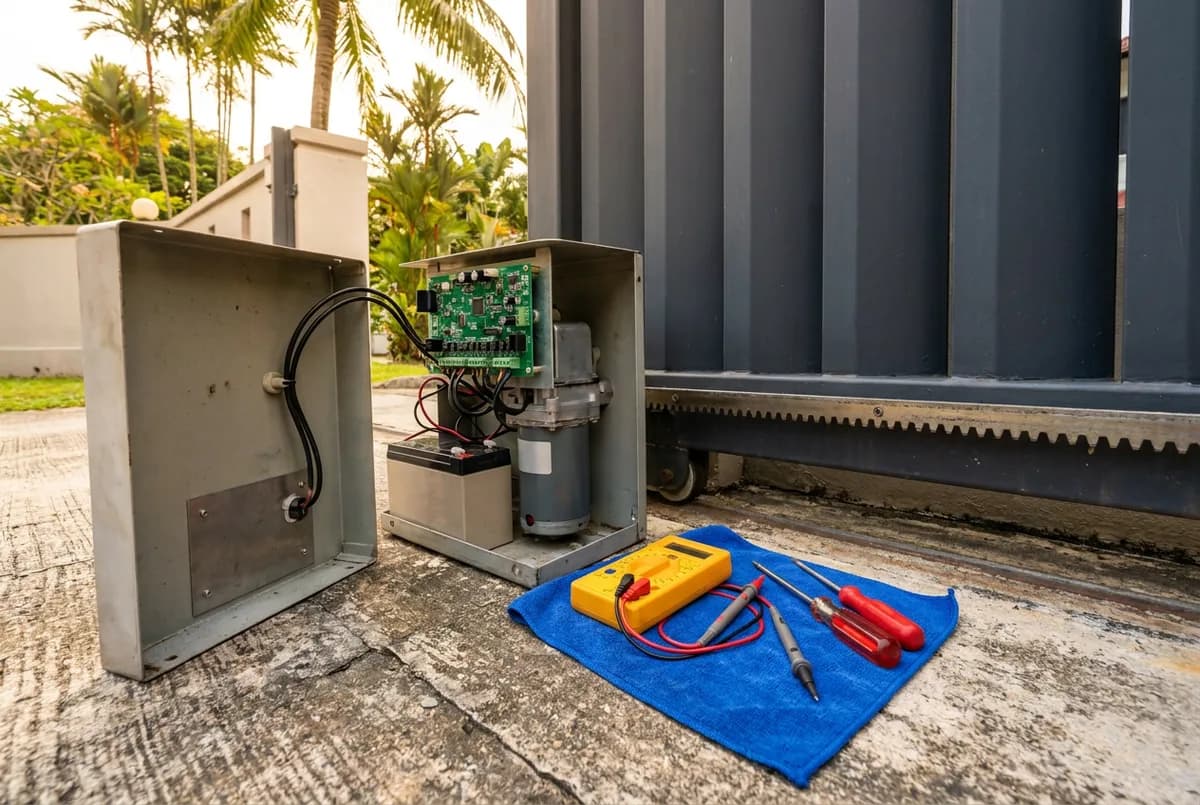
When discussing auto-gate repairs or replacement, describe what happened during normal use: whether the gate will not move, stops partway or behaves differently from one control to another. Add its repair history and any technician’s report. The proposal should explain which fault was found, which parts can stay and why the recommended work will address it.
Separate the gate itself from the equipment that drives it
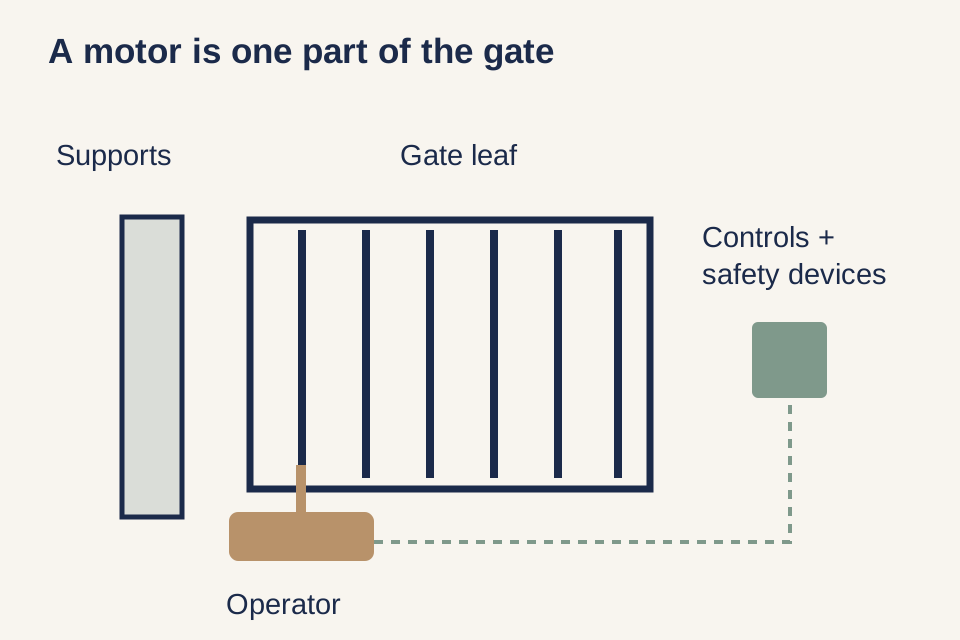
A powered gate has a moving panel, often called a leaf, supported by hinges, tracks or guides. The equipment that drives it is often called the operator; electrical controls and safety devices govern its response. A fault can sit in one of those parts while the others remain usable. That is why the quotation needs more detail than 'new motor' or 'new gate'.
The physical hazards identified for powered gates include impact, trapping, uncontrolled movement and problems caused by weather or damaged electrical components. A competent assessment therefore considers the installation as a machine in its actual setting. A new motor does not make the rest of the installation sound by association.
This separation also improves a replacement quotation. “New auto gate” should identify whether it includes the leaves, posts or pillars, track or hinges, operator, wiring, safety devices and finishing. “Motor replacement” should say what existing parts it relies on and what evidence supports retaining them.
Have the gate, hinges, guides and supports checked
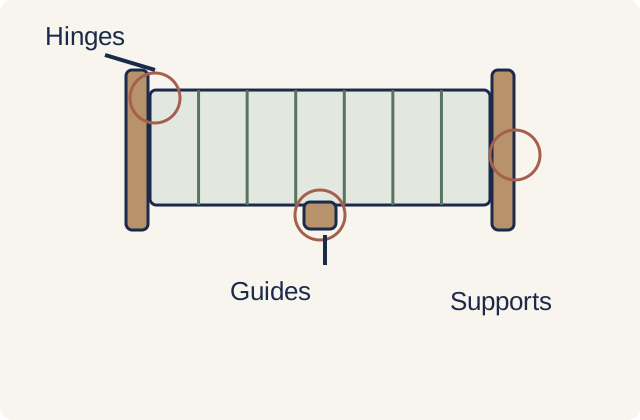
The professional assessment should establish whether the gate is properly supported and able to move as intended, and whether the guides, hinges, stops and surrounding structure are suitable. The homeowner should not release or push a heavy gate to perform this assessment.
If the gate is damaged, catches as it moves or has a shifting support, the repair needs to address that problem. Fitting a more powerful motor could leave the underlying fault in place. The gate should move properly on its hinges or guides, with a motor matched to the repaired installation.
A localised mechanical issue may be repairable without discarding the entire gate. A damaged finish is also a different finding from loss of structural integrity. Let the report distinguish appearance, serviceability and safety so the proposed work responds to the actual condition.
Where deterioration is widespread or the support arrangement needs substantial rebuilding, a complete renewal may become more coherent than several disconnected repairs. That conclusion should be explained through what must change and why. The age of the equipment can provide context, but it is not a diagnosis.
Find the fault in the motor, power supply or controls
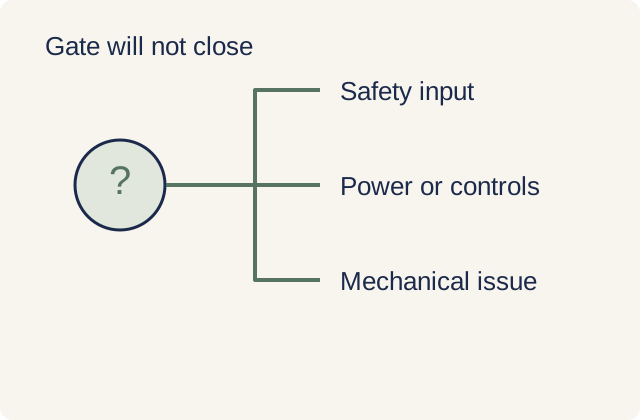
With the mechanical assessment understood, the technician can explain whether the problem concerns the operator, power supply, controls, access device or safety system. The same visible symptom can originate in more than one of these places.
A gate that will not close, for example, might be responding to a safety input rather than suffering a failed motor. A gate that works from one control but not another gives a different clue from one that does not respond at all. Those observations help frame a service visit; they do not justify bypassing a sensor or opening a control box.
Record what happened before the failure, which normal control was used, whether one or both leaves were affected, and any visible message or light pattern from a safe position. Include recent work, rain-related changes and previous repairs. Avoid repeatedly operating a gate that moves unexpectedly or appears damaged.
The repair proposal should connect a finding to a remedy. “Control board fault identified; replacement includes configuration and system checks” is a defined scope. “Old gate needs a new motor” leaves the diagnostic chain unclear. You need enough explanation to understand why the recommended part addresses the reported behaviour.
Compare a repair, new motor and controls, or full replacement
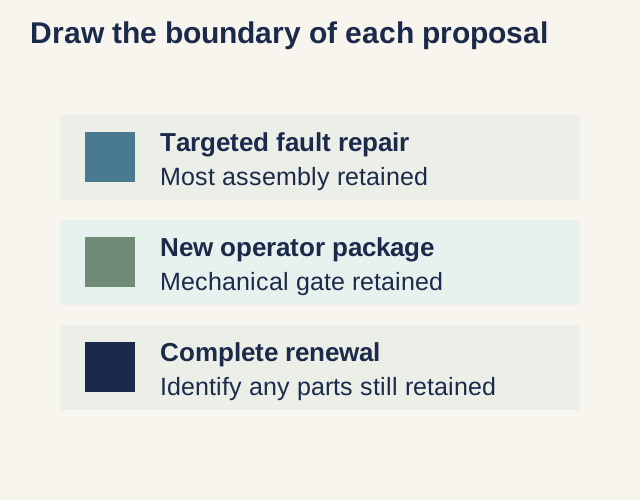
| Scope | Finding that can support it | Retained condition to establish |
|---|---|---|
| Targeted repair | A diagnosed, repairable component fault | Gate, supports, compatible controls and safety measures |
| Operator-package replacement | Automation fault or support limitation with a suitable gate | Mechanical assembly and all retained interfaces |
| Complete assembly renewal | Wider condition, geometry or access arrangement needs change | Any foundations, pillars, wiring or devices still retained |
A limited repair is attractive when it resolves a defined fault and the remaining gate, supports and controls have been assessed as suitable to keep. Its limitation is that it does not renew unrelated components. The quotation should leave the condition and support of those components visible.
An operator-package replacement can make sense when the gate remains suitable but the existing automation cannot be reliably supported or repaired on acceptable terms. Compare the complete compatible package, including the controls and safety devices connected to it. A motor name alone does not establish that older connected devices will work correctly with it.
Consider a complete new gate when the existing one is badly deteriorated or its size, supports and opening arrangement no longer suit the driveway and household. If you want to change from one movement type to another, evaluate the new driveway and pedestrian routes as a design decision. A different gate needs a fresh layout, not just an exchange of parts.
Safety devices must be assessed as part of the retained system
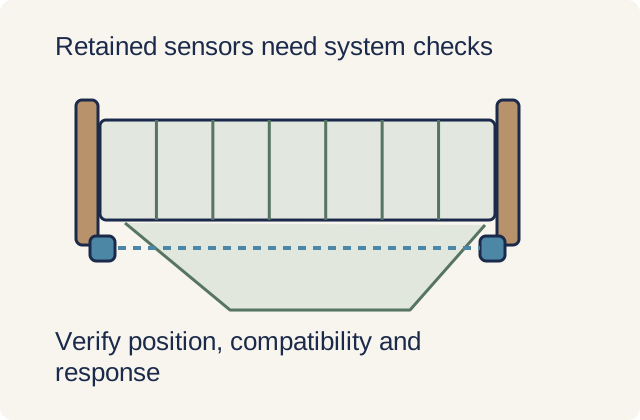
Retaining a photocell or edge device because it is physically present is not enough. Its position, condition, compatibility and effect on the controller need to be established. The photocell’s product instructions illustrate that detection and the automation’s response are connected checks.
Changing the operator can change the control arrangement. The completed installation therefore needs appropriate professional verification after the work, including the safety measures affected by the change. Gate-safety guidance emphasises assessment of the actual environment and verification of protective measures. A parts invoice does not establish that the system was accepted as a whole.
For the homeowner, the useful evidence is a handover record explaining the completed work, the retained components, operating instruction and any outstanding concerns. Do not test trapping protection with a person, vehicle, pet or improvised obstacle. The contractor should use the appropriate professional methods.
Compare disruption and continuing support with the price
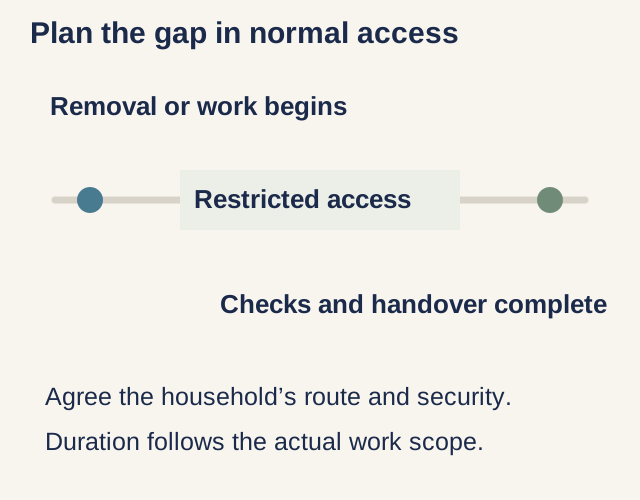
A repair and a complete replacement may have very different effects on access. Fabrication, support work, electrical changes and finishing can extend beyond the period spent fitting equipment. Establish when the driveway is unavailable and how the property will be secured during the work.
The lowest initial cost may leave a planned second phase. That can be acceptable when the retained parts are suitable and the future work is clear. It becomes less useful when several quotes each exclude the next unresolved problem. Compare the known total scope, not a sequence of optimistic first steps.
Support also matters after handover. Identify the actual operator and controls, the provider responsible for warranty work, the maintenance requirements and the route to suitable parts. A complete new gate and a replacement motor may carry different warranty boundaries because different amounts of existing equipment remain.
Choose the work that addresses the fault and any unsuitable parts
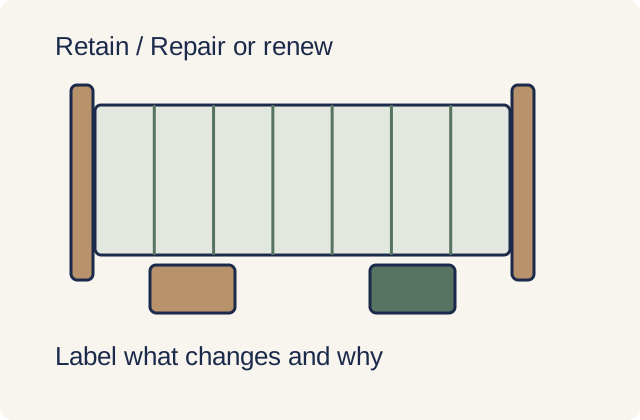
Use the auto-gate buying guide when the condition review points towards a new layout or installation. Keep the technician’s findings beside your access requirements so a replacement addresses both the present defect and the way the household uses the driveway.
Ask for a quotation that names what will stay, what will be repaired and what will be replaced, with the reasons beside each item. Bring that assessment, photographs and the existing model details to an auto-gate replacement discussion. It should let you see whether the price buys a working arrangement for the whole driveway or only one part of the work still needed.
Auto Gates across Singapore
Need help with your project?
Tell us what you need on WhatsApp and send a few photos. We'll arrange a free site assessment, then give you a fixed-price quote within 3 to 5 working days.