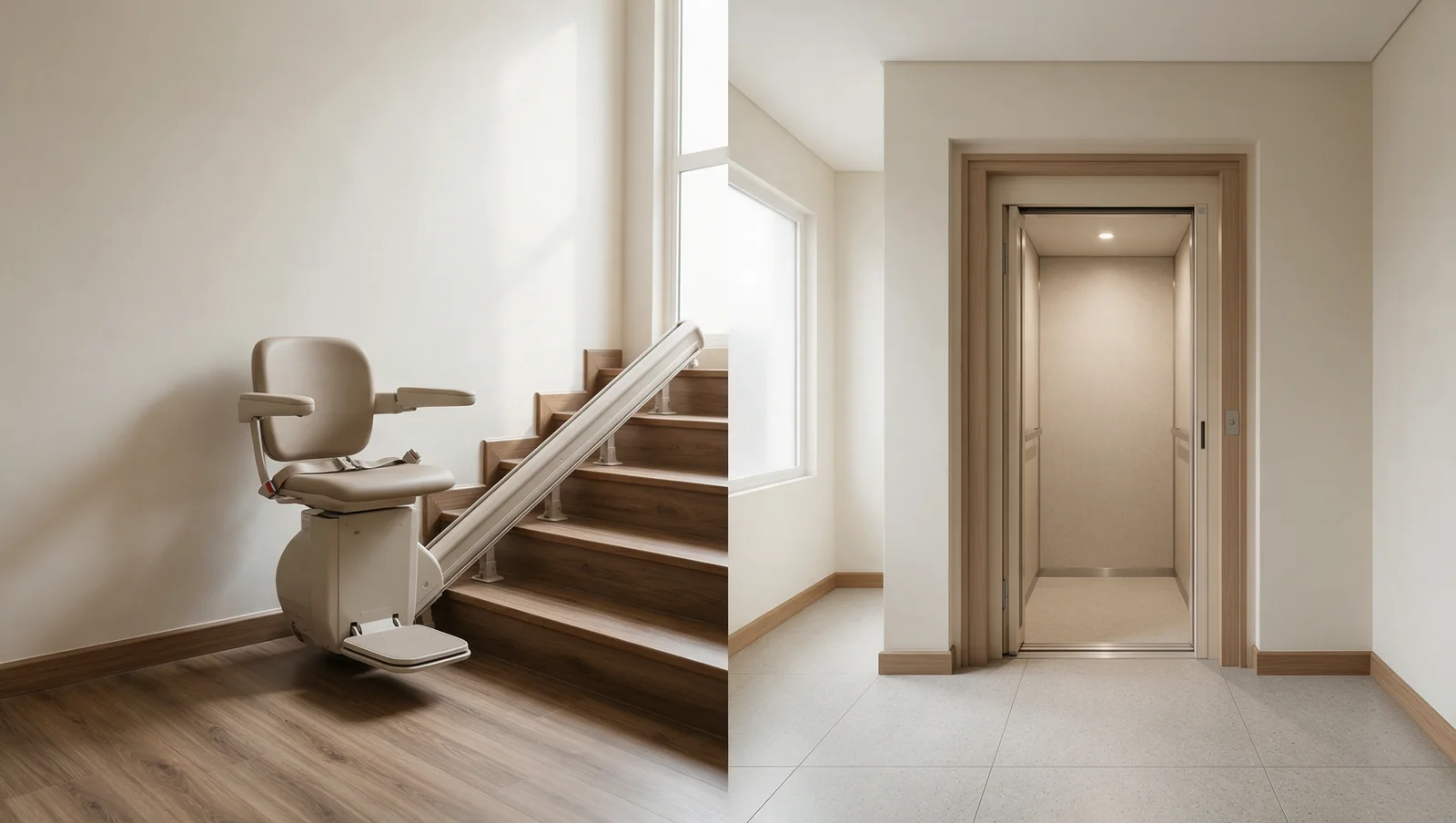
Comparison
Should you get a stairlift or a home lift?
A stairlift rides up the staircase you already have. A home lift needs its own way up through your floors, and it is the one that can take a wheelchair or a carer when it is big enough.
Option A
Stairlift
A chair runs on a rail fixed to your staircase. It works when the person can get on and off safely at both ends and the rail suits the stairs.
Best for
A user who can transfer safely to and from the seat, with any necessary assistance, where the rail leaves practical stair and landing access.
Price range
Quoted after a site visit
Timeframe
Confirmed after a site visit
Option B
Home lift
A small lift car or platform rises through an opening in each floor it serves. Its size and doors decide whether a wheelchair or a carer fits.
Best for
A user who needs to remain in a wheelchair, or a household needing shared lift access, where the building and landings can accommodate it.
Price range
Quoted after a site visit
Timeframe
Confirmed after a site visit
If the person can move onto a chair at the bottom of the stairs and off it at the top, with whatever help they have, a stairlift can do the job. If they need to stay in their wheelchair, or someone has to ride up with them, look at a home lift big enough for both.
A seated stairlift is a chair on a rail fixed to your staircase, and it carries one seated person at a time. A home lift, sometimes written homelift, is a small lift car or platform that travels straight up through an opening in each floor it serves; depending on the system, it may also need a pit below the lowest floor or a shaft built around it. How many people a home lift carries, and whether a wheelchair fits, depends on the model. So a wheelchair user who can transfer safely may still be well served by a stairlift, while a compact home lift may be too small for their chair.
Think through the person’s whole trip, from the bedroom to the rooms they use downstairs. Getting on, reaching the controls and getting off safely at each floor can settle the choice before price or looks come into it. If you are unsure about transfers, or the person’s mobility is changing, an occupational therapist can help work out what they and their carer need.
The verdict
Pick Stairlift
Go for a seated stairlift when the person can get on and off safely at both landings, the seat and controls suit them and the rail can reach the floors they need. More than one person can use it, one at a time, if each of them can transfer safely.
Pick Home lift
Go for a home lift when the person needs to stay in their wheelchair or travel with a carer, and choose a size that takes both. Check the space inside, the rated load, the door width and the approach at every floor. Serving three floors or several daily users strengthens the case for a lift once you know one fits.
Pick neither
Consider adapting the ground floor if a bedroom and a usable bathroom can be arranged there and the person is happy to live downstairs. Price that building work alongside the lift options so you are comparing like with like.
Side-by-side comparison
The row-by-row matrix. Hover or read the note row for the nuance behind each dimension.
| Dimension | Stairlift | Home lift |
|---|---|---|
How the user travels Seated on the chair, following the line of the stairs. Standing or in a wheelchair, in a small lift car or on a platform that rises straight up between floors. Start with the person’s ability to get on and off, not their age. | ||
Wheelchair journey Transfer is required for a seated stairlift; plan the arrangement at both ends. Staying in the wheelchair is possible only with a suitable model and accessible landings. The wheelchair, carer, clear doorway and turning space must be assessed together. | ||
Space used Stannah’s straight rail sits about 15 cm (6 in) onto the stairs and runs about 45 cm (18 in) past the bottom step so the chair can land. Stannah offers a powered folding rail where a door or walkway is at the foot. A footprint on every floor it serves, plus room to approach the door at each landing. Measure where the chair parks and how the lift door is reached, not only the folded size or the advertised footprint. | ||
Building work Depends on fixing support, rail layout and any electrical or access changes. May include openings, supports, pit or shaft work according to the selected system. Be wary of any quote that promises no building work before someone has measured the stairs and checked the floors. | ||
BCA requirements Regulated fixed installation unless a specific exemption applies. Regulated lift requirements apply unless a specific exemption applies. The narrow stairlift/platform exemption is explained below; a normal full-flight stairlift is not exempt through it. | ||
More than one user One seated user at a time, with each user assessed for suitability. Capacity depends on the model. In Aritco’s HomeLift Access range, the largest size carries up to six people or a wheelchair with an attendant. Think about who needs to go up or down at the same time of day. | ||
Cost comparison A rail and chair fixed to the existing stairs. A curved rail is designed around the turns, but no floor is opened up. The lift itself, an opening through each floor it serves and the structural work around it. Ask for approvals and servicing in both quotes, so the two totals cover the same things. | ||
Future needs Transfers and seating may need reassessment if needs change. Future wheelchair or carer needs must be allowed for in the chosen design. If a wheelchair or a carer may be needed later, raise it before the design is fixed. | ||
When a seated stairlift fits the user and the stairs
A seated stairlift can solve the climb while keeping the existing route between floors. The important test is whether the person can sit, remain supported and transfer at both ends with the assistance available. A trial of the relevant seat and controls can reveal difficulties that a floor plan cannot.
Rail layout determines where that transfer happens. Stannah describes straight rails cut to the flight and curved rails made for the staircase; its fitting guidance fixes the rail to the treads. Those details concern Stannah’s systems, but they illustrate why a bend, doorway or small landing needs more than a measurement of stair width.
Check how the rest of the household passes the chair in use and when parked. A rail ending beside a doorway may need a different parking or folding arrangement. The stairlift buying guide and straight-versus-curved rail comparison develop those choices.
When a home lift provides the journey you need
A home lift becomes useful when a person needs a continuous journey in their wheelchair or a carer needs to travel alongside. The requirement is more than a large-looking cabin. Check the clear doorway, usable floor space, load and the approach to the door at each floor.
Aritco’s largest HomeLift Access size takes a wheelchair with an attendant. That is one maker’s biggest model, so check any quoted lift against the actual wheelchair, the carer and the way in at each floor.
The building then has to accommodate that route. A lift location can take useful space from several rooms, and openings or supports may need structural work. Read the home lift guide and wheelchair-accessible home lift planning article before settling on an advertised minimum footprint.
When adapting the ground floor deserves consideration
If a suitable bedroom and bathroom can be reached on the ground floor, adapting them may remove the immediate need to travel upstairs. That can mean a ground-floor bathroom renovation as well as moving a bedroom. Discuss privacy, bathing, doorways, carer access and the person’s preferences. Moving a bed alone does not make an accessible daily routine.
Temporary needs deserve their own comparison. If a rented or reconditioned stairlift is available, include fitting, removal, servicing and the appropriate approvals in its total, as the stairlift rent-or-buy comparison sets out. Price the cost and disruption of adapting rooms too; neither route is automatically the cheaper one.
A good decision leaves essential rooms usable while work is underway and during equipment downtime. If neither lifting option fits safely, reassess the room arrangement and care needs with the appropriate professionals. Budget pressure does not make an unsafe transfer or obstructed stair acceptable.
The decision in three questions
First, can the person transfer onto a stairlift seat and off again safely at both landings? If that is uncertain, resolve it before ordering. If they must stay in the wheelchair, look at a home lift big enough for the chair. Where a home lift won’t fit, a wheelchair platform that runs along the stairs may, if the staircase is wide enough. Savaria’s Delta inclined platform lift carries a wheelchair user over a single straight flight and folds up when it isn’t in use. The stairlift versus wheelchair platform lift comparison covers that choice.
Second, can the house accommodate the complete route? Compare the stairlift’s occupied and parked positions with the home lift’s openings, landings and approach space. Third, what does each viable option cost to install and keep in service? Request the whole scope after suitability is established.
One last check applies whichever you choose, because a stairlift has BCA rules to meet as well as a home lift. BCA regulates stairlifts and vertical platform lifts as fixed installations. A narrow exemption requires all three conditions together: one residential unit, vertical travel below 1,000 mm and maximum downward force below 150 N. A normal full-flight stairlift does not meet that exemption, so confirm the applicable installation approvals and a valid Permit to Operate before anyone uses it.
Frequently asked questions
Which is better for stairs, a chair lift or a home lift?
A chair lift is the better fit when the person can get on and off safely at both ends and the rail suits the stairs. A home lift is the better fit when they need to stay in a wheelchair or travel with a carer, and the house has room for one big enough. The person and the route through the house decide which one works.
Is a stairlift cheaper than a home lift?
For the same floors, expect the stairlift to cost less, because it is the smaller job. It is a chair and a rail fixed to the stairs you already have, and even a curved rail designed around the turns needs no opening through a floor. A home lift adds the lift itself, an opening through each floor it serves and the structural work around those openings, and both need BCA approvals. A March 2025 Stacked Homes guide to elderly-friendly landed homes likewise ranks a chair lift as the priciest change short of an actual elevator. This page gives no figures because we have no independent published Singapore price for either. Our stairlift cost guide and home lift cost guide go through what each budget includes.
Can several family members share a stairlift?
Yes, if each person can use the seat and controls safely and is within its rated load. It carries one person at a time, so if two people often need to go up at the same time of day, weigh that wait against a home lift that carries more than one.
Can I install a stairlift now and a home lift later?
It may be possible, but assess the later lift’s structural and space needs before relying on that plan. Include the first equipment’s removal and making good in the comparison. An assumed future wheelchair requirement should be discussed with the person and appropriate care professionals.
Does either option guarantee a higher resale price?
A buyer may value accessible travel or prefer a different room arrangement. Choose equipment for the household’s use and an affordable ownership plan; neither option comes with a guaranteed property premium.
What if the lift or stairlift breaks down?
Keep people clear of the fault and contact the qualified service provider. Close inspection needs the equipment secured and isolated by the technician; do not bypass controls or open machinery covers. Plan access to essential rooms while it is unavailable.
Decision still unclear?
Get help comparing the options for your home
Tell us which options you are considering, what matters to your household and when you hope to start. Share photos or plans on WhatsApp if you have them.
Related reading
Compare
Hydraulic lift vs Traction MRL lift
Hydraulic and traction are the two real choices for residential home lifts in Singapore (vacuum is a separate retrofit conversation). The defaults you'll hear, 'hydraulic is cheaper, traction is premium', are technically true and operationally misleading. The actual decision is driven by stops and daily-cycle count, with energy use and ride quality as second-order factors. Hydraulic for 2-3 stops with low daily use, traction (MRL) for 4 stops or heavy daily use, full stop.
Compare
Vacuum (pneumatic) lift vs Hydraulic lift
Vacuum lifts and hydraulic lifts solve the same problem (vertical transport between floors in a landed home) with two completely different engineering paths. The shorthand most people use, 'vacuum is for retrofit, hydraulic is for new build', is roughly right and worth understanding properly. The trade-off is real: vacuum buys you minimal structural intervention at the cost of a smaller cabin; hydraulic buys you a larger cabin and full wheelchair access at the cost of substantial structural work in retrofit cases.
Service
Stairlifts
Your parents keep the upstairs bedroom and their independence. Fitted to your exact staircase, straight or curved.
Service
Home Lifts
A lift inside your own house. We build the shaft, install the lift and finish everything around it.
Buying Guide
Stairlifts in Singapore: A Practical Buying Guide
Choose a stairlift around the user, stair geometry, landing access and local aftercare. Compare rail layouts, quotations, safety and handover.
Buying Guide
Home Lifts in Singapore: A Landed Home Buying Guide
Compare home-lift suitability, landing space, building works, quotations, BCA owner duties and ongoing care before choosing a system.