Comparison
Vacuum vs Hydraulic Home Lift in Singapore: Which to Pick in 2026
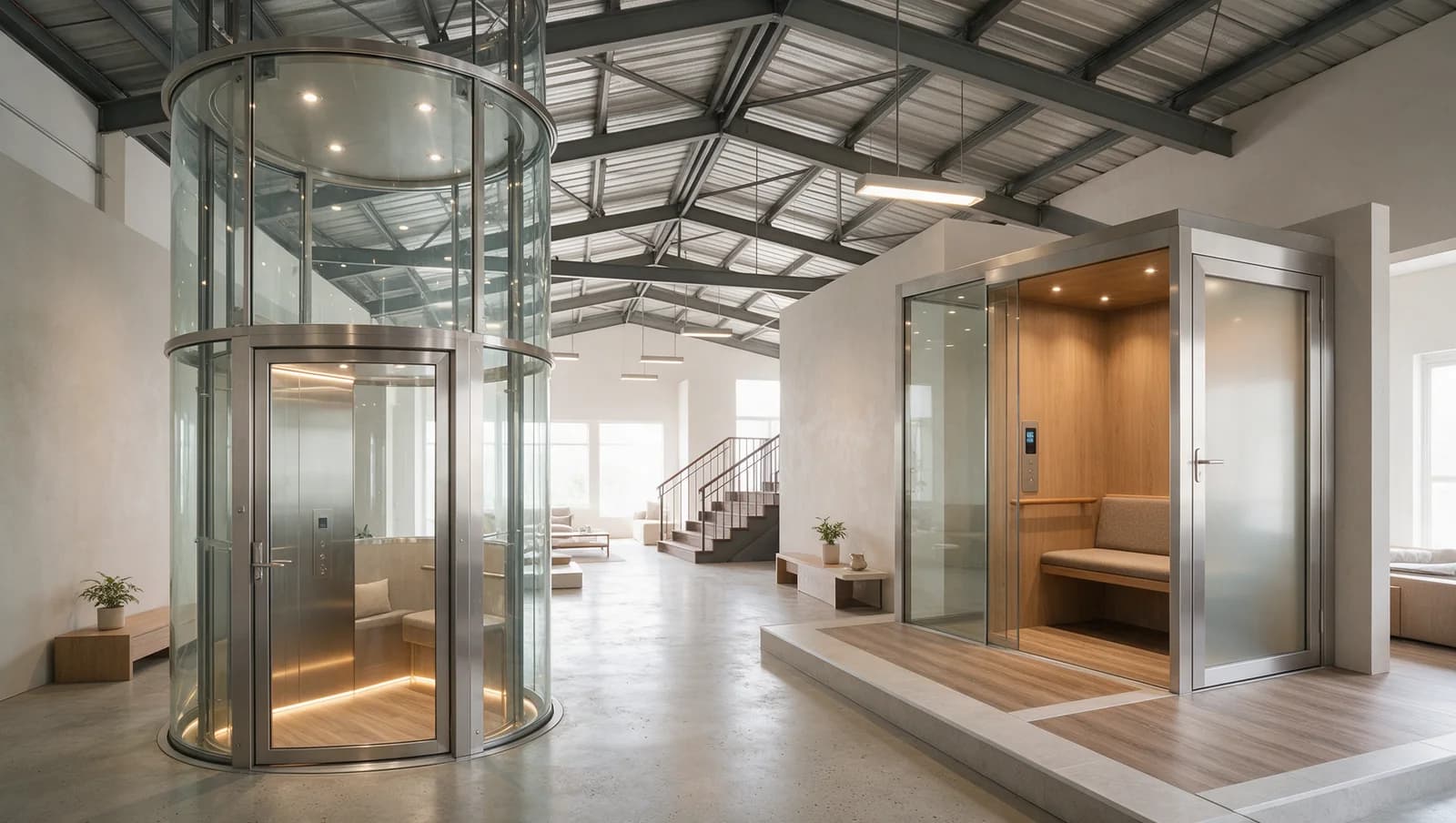
Vacuum lifts and hydraulic lifts solve the same problem (vertical transport between floors in a landed home) with two completely different engineering paths. The shorthand most people use, 'vacuum is for retrofit, hydraulic is for new build', is roughly right and worth understanding properly. The trade-off is real: vacuum buys you minimal structural intervention at the cost of a smaller cabin; hydraulic buys you a larger cabin and full wheelchair access at the cost of substantial structural work in retrofit cases.
Option A
Vacuum (pneumatic) lift
Sealed cylindrical tube using air-pressure differentials to lift the cabin. No pit, no machine room, minimal structural intervention: the only realistic option for retrofitting a finished home with no shaft provision.
Best for
Finished landed homes with no existing shaft, minimal-disruption priority, architectural-glass-tube aesthetic, 2-stop is enough.
Price range
S$55,000 to S$80,000
Timeframe
6-8 weeks (no structural shaft works needed)
Option B
Hydraulic lift
Oil-pressure piston drive inside a permanent vertical shaft. Larger cabin, full wheelchair access at the right specification, longer-term ride quality, but needs a shaft.
Best for
New builds with shaft provision; retrofits where the structural intervention is feasible; households needing wheelchair access; 3-stop installations.
Price range
S$45,000 to S$90,000 (excluding S$15K to S$40K retrofit shaft cost)
Timeframe
8-10 weeks (clean shaft); 12-16 weeks (retrofit including shaft construction)
Vacuum and hydraulic are the two residential lift systems most often weighed against each other when a landed homeowner is retrofitting a finished home. Traction MRL is the third option but it has the same shaft requirement as hydraulic, so the practical decision in retrofit cases collapses to vacuum versus hydraulic. The right answer is almost always determined by your home's existing structure, not by your preference between the two technologies.
Vacuum lifts (sometimes marketed as 'pneumatic' or 'PVE') use a sealed cylindrical tube with air-pressure differentials to lift the cabin. A vacuum is created above the cabin to draw it upward; pressure equalization (with the descent rate controlled by a valve) brings it back down. The mechanism needs no pit, no machine room, no shaft construction in the traditional sense. The entire tube is the structure and it is self-supporting. This is what makes vacuum the retrofit answer: you can install one in a finished home with limited disruption. The trade-off is cabin size. Typical vacuum cabin internal diameter is 750mm to 900mm, which holds two to three people but does not accommodate a standard manual wheelchair with the user facing forward.
Hydraulic lifts need a real vertical shaft. In a new build with shaft provision, that is no problem. In a retrofit, it means slab cutting, pit excavation, structural framing, adding S$15,000 to S$40,000 to the cost and four to eight weeks to the timeline. What you buy with that intervention is a much larger cabin (1.1m × 1.4m or larger), full wheelchair access at the right specification, and the option to go to three stops cleanly. Our verdict before the matrix: if your home already has a shaft (or is being built fresh), hydraulic is the right answer. If your home is finished, the structural intervention is impractical or prohibitively expensive, and 2-to-3 stops with a smaller cabin solves your use case, vacuum is the answer.
The verdict
Pick Vacuum (pneumatic) lift
Pick vacuum if your home is already built out, there is no existing shaft provision, the cost or disruption of constructing a shaft is unacceptable, and either (a) wheelchair access is not currently needed or (b) the smaller cabin can be tolerated. The vacuum lift's defining advantage is that it makes a previously impossible install possible. It is also the right pick for design-led projects where the glass-tube architectural look is part of the brief. S$55,000 to S$80,000, installed in 6 to 8 weeks with minimal mess.
Pick Hydraulic lift
Pick hydraulic if your home is a new build with shaft provision, or a retrofit where the structural intervention is feasible (90% of landed retrofits assessed are structurally feasible). Hydraulic gives you a larger cabin (1.1m × 1.4m minimum, scalable to wheelchair-ready 1.3m × 1.6m), the option of three stops cleanly, and a longer-term ride quality at lower capital cost than vacuum on equivalent cabin size. S$45,000 to S$90,000 for the lift, plus S$15,000 to S$40,000 for retrofit shaft construction if needed.
Side-by-side comparison
The row-by-row matrix. Hover or read the note row for the nuance behind each dimension.
| Dimension | Vacuum (pneumatic) lift | Hydraulic lift |
|---|---|---|
Pit requirement None 150-300mm typical The no-pit advantage is what makes vacuum the retrofit pick: you avoid demolishing finished floor slab and the protection-and-rebuild costs that go with it. | ||
Retrofit difficulty Low; self-supporting tube, minimal structural intervention, 6-to-8 week install High in retrofit cases; slab cutting, pit excavation, structural framing add 4-8 weeks and S$15K to S$40K cost About 90% of landed retrofits are structurally feasible for hydraulic but 'feasible' is not the same as 'cheap'. | ||
Cabin internal dimensions (typical) 750mm to 900mm internal diameter (cylindrical) 0.85m × 1.1m internal (standard); 1.1m × 1.4m internal (wheelchair-ready) Vacuum cabin is materially smaller. The shape (cylindrical) also reduces useful loading area versus hydraulic's rectangular cabin. | ||
Wheelchair accessibility Limited; most models will not accept a standard manual wheelchair facing forward Yes at the right specification (1.1m × 1.4m internal minimum) Wheelchair access is the most common reason households pick hydraulic over vacuum despite the higher retrofit cost. | ||
Capital cost (lift only, ex GST) S$55,000 to S$80,000 S$45,000 to S$90,000 Vacuum and hydraulic overlap significantly on lift cost. The decisive cost factor in retrofit cases is the S$15K to S$40K structural shaft works that vacuum avoids. | ||
Install disruption to finished home Minimal; penetrate the floor slabs at each level for the tube, no shaft construction Substantial; full structural shaft works, demolition, pit excavation, multi-week dust-and-noise period On a finished, occupied home, the disruption difference is often more decisive than the capital cost difference. | ||
Structural intervention Low; circular cuts at each floor level for the tube, no load-path changes Significant; slab cutting, supporting beams may need reinforcement, PE structural endorsement required Vacuum's structural assessment is much simpler (typically 1-2 weeks PE work versus 2-4 weeks for hydraulic). | ||
Aesthetic options Glass tube with the cabin visible inside; design-led, architectural statement piece Conventional shaft with finished doors at each landing; cabin interior fully customizable (timber, mirror, glass walls) Vacuum's signature look is the glass tube; some hosts love it, some find it polarizing. Hydraulic's lift can be made to disappear into the interior or to be a feature, owner's choice. | ||
Stops supported 2-3 (some 4-stop models exist but speed degrades materially) 2-3 cleanly (4-stop possible but slow at hydraulic's 0.15 m/s) Both systems are well-suited to 2-to-3 stop residential installs. For 4 stops, traction MRL (not in this comparison) is the right answer. | ||
Ride speed 0.15 m/s typical 0.15 m/s typical Both systems are similar on speed. The difference is ride feel: vacuum has a distinctive 'pressure-equalization' quality that some occupants notice; hydraulic feels more conventional. | ||
Manufacturer warranty (mechanism) 2-3 years typical 5 years typical Vacuum's shorter warranty reflects the newer technology and smaller installed base in Singapore; hydraulic's 5-year warranty reflects decades of mature manufacturing. | ||
BCA classification Passenger lift; standard Permit to Install / Permit to Operate path Passenger lift; standard Permit to Install / Permit to Operate path Both follow identical BCA requirements with the same engineering drawing standards and annual safety inspection regime. | ||
The retrofit math: why vacuum wins on finished homes
The headline cost numbers can make hydraulic look cheaper than vacuum: S$45,000 starting versus S$55,000 starting. That comparison is misleading for retrofit cases. The lift mechanism is only one line on a retrofit quote. The other line is the structural intervention required to create a shaft in a finished home: slab cutting, pit excavation, supporting beam reinforcement, structural framing, finishing works on every floor adjacent to the shaft. That structural-works package adds S$15,000 at the low end (a clean single-floor cut with no beam reinforcement) to S$40,000 at the upper end (multi-floor cuts, beam reinforcement, complex finishing). The total retrofit hydraulic install in a finished home is typically S$60,000 to S$100,000+ all-in, not the S$45,000 starting headline.
Vacuum avoids most of that. The tube needs circular cuts at each floor level (typically 1m to 1.2m diameter) but no load-path changes, no pit excavation, no extensive framing. The structural work on a vacuum retrofit is measured in days, not weeks, and the cost is typically S$3,000 to S$8,000 rather than S$15,000 to S$40,000. Combined with the lift mechanism, a vacuum retrofit is typically S$58,000 to S$88,000 all-in.
On a like-for-like retrofit comparison (finished home, 2-stop installation), vacuum is usually within S$5,000 of hydraulic at the all-in level despite the lift mechanism being more expensive. On more complex retrofits (3-stop, complex structural conditions, occupied home requiring extensive dust control), vacuum's cost advantage can stretch to S$15,000-plus all-in. That is what makes vacuum the retrofit pick when retrofit is genuinely the situation.
The cabin-size trade-off: when wheelchair access changes the answer
Vacuum lifts cap out at roughly 900mm internal diameter on the largest commercially available residential models. A standard manual wheelchair (typically 650mm wide) plus the user seated plus the door clearance requires an internal diameter of approximately 1,100mm to be usable with the user facing forward into the cabin. Vacuum cannot deliver that geometry. Some vacuum installations are used by wheelchair users who reverse into the cabin and ride backwards. This works mechanically but is undignified, slow, and impractical with a carer in the cabin alongside.
Hydraulic at the wheelchair-ready specification (1.3m × 1.6m external shaft, 1.1m × 1.4m internal cabin) accommodates the wheelchair user facing forward with a carer alongside. This is the standard accessibility specification and it works. The structural-intervention cost in retrofit cases is therefore the price of wheelchair access in a finished home: typically S$15,000 to S$40,000 of structural works plus the larger cabin specification on the lift itself.
The decision flips on this dimension: if the household has a current wheelchair user, or expects one within the lift's useful life, vacuum is not the right answer regardless of how attractive the no-structural-work proposition is. If wheelchair access is not in scope and likely never will be (the household profile is 'mobility-cautious but ambulatory, looking ahead to next decade'), vacuum's smaller cabin is acceptable and the retrofit savings are real.
The aesthetic conversation: glass tube vs hidden shaft
Vacuum lifts have a signature look. The cylindrical glass tube reveals the cabin moving inside, which can be either an architectural statement piece or a design constraint depending on your interior. In an open-plan living area with double-height ceilings and modern architecture, a vacuum lift in the centre of the space can be the visual feature that ties the interior together. In a traditional interior with finished walls and conventional ceiling heights, the same tube can look intrusive and feel out-of-place.
Hydraulic lifts can be designed to disappear (a finished shaft with conventional landing doors that match the wall treatment on each floor, so the lift reads as another door) or to be a feature (full-glass landing doors, custom-finish cabin, integrated lighting). The flexibility is much wider than vacuum because the shaft construction allows for any exterior treatment.
Most landed-property clients who pick vacuum cite the retrofit advantage as the primary reason and the architectural look as a secondary benefit. We have installed vacuum lifts in clients who explicitly wanted the design statement, but they are a minority. If the design statement is the primary driver and your home has shaft provision, a hydraulic lift with a custom-glass shaft and premium cabin can deliver an equivalent or stronger aesthetic at comparable cost.
When you cannot install a vacuum lift
Vacuum is not universal even in retrofit cases. Two scenarios rule it out. The first is when the floor-to-floor heights in the home exceed the maximum travel distance of the available vacuum models. Typical vacuum residential lifts are designed for floor-to-floor heights up to roughly 3.6m, and homes with taller ceilings on any floor cannot accept a standard vacuum installation. The second is when the floor plan does not allow a continuous vertical alignment for the tube. If the spaces where the lift could go on each floor do not stack vertically (kitchen on ground, bedroom on second, bathroom on third, none aligned), neither vacuum nor hydraulic works, but vacuum is particularly constrained because the tube is rigid and self-supporting.
There are also weight constraints. Vacuum cabins are rated typically 200kg to 250kg (two to three persons). For households with consistently heavier load requirements (multiple users plus equipment, or specifically two adult occupants in the cabin), the rating becomes a practical issue. Hydraulic cabins start at 320kg (four persons) and scale to 480kg or higher.
The right way to assess vacuum feasibility: a site visit with measurement of floor-to-floor heights, identification of the proposed vertical alignment, and a weight-of-use assessment for the household. A principal contractor will walk through these constraints honestly before quoting. A salesperson optimizing for the larger margin on the larger system may push you away from vacuum even when vacuum is the right answer. The inverse is also true. Ask explicitly which constraints your home presents and what each system can and cannot deliver.
Frequently asked questions
Is a vacuum lift cheaper than a hydraulic lift in Singapore?
On lift-mechanism cost alone, no: vacuum starts around S$55,000 versus hydraulic at S$45,000. On all-in retrofit cost for a finished home (lift + structural shaft works), yes: vacuum is typically S$58,000 to S$88,000 all-in versus hydraulic's S$60,000 to S$100,000+ all-in. The cost gap is decided by whether your home needs a shaft constructed (vacuum's advantage) or already has one (hydraulic's advantage).
Can a wheelchair user use a vacuum home lift?
Generally no, not comfortably with the user facing forward. Vacuum cabin internal diameter caps around 750mm to 900mm, below the approximately 1,100mm internal dimension needed for a standard manual wheelchair with the user facing forward and door clearance. Some installations are used by wheelchair users reversing into the cabin and riding backwards, but this is undignified and impractical with a carer. If wheelchair access is needed or expected, hydraulic at the 1.1m × 1.4m wheelchair-ready specification is the correct choice.
Does a vacuum lift need a pit?
No. This is the vacuum lift's defining structural advantage: no pit, no machine room, no shaft construction in the traditional sense. The tube is self-supporting and the cabin rises through a sealed cylindrical chamber. Hydraulic lifts require a 150-300mm pit and either a small machine room or in-shaft power unit enclosure.
How long does a vacuum lift installation take versus hydraulic in a retrofit?
Vacuum retrofit: 6 to 8 weeks total. Hydraulic retrofit (including shaft construction): 12 to 16 weeks total. The 6-week difference is the structural shaft works that vacuum avoids. On new builds with existing shaft provision, hydraulic is faster (8 to 10 weeks total) because the lift mechanism is simpler to commission than a vacuum tube.
Which is more disruptive to install in an occupied home?
Hydraulic, by a wide margin. Hydraulic retrofit involves slab cutting, pit excavation, structural framing, multi-week dust-and-noise period, and finishing works on every floor. Vacuum retrofit involves circular cuts at each floor for the tube and connection of the tube assembly. Vacuum can typically be installed in an occupied home with kitchen and living areas remaining accessible throughout; hydraulic retrofits often require partial relocation or weeks of restricted access.
Can a vacuum lift serve four floors?
Some vacuum models support up to four stops but speed and capacity degrade materially. The practical reality is that vacuum is best-suited to 2-stop and 3-stop residential installs. For four-storey homes, traction MRL is the right answer (not in this comparison) because it scales to four stops at 0.4-0.6 m/s without compromise.
What is the warranty difference between vacuum and hydraulic lifts?
Hydraulic mechanism warranty is typically 5 years from the manufacturer. Vacuum mechanism warranty is typically 2 to 3 years, reflecting the newer technology and smaller installed base in Singapore versus hydraulic's decades of mature manufacturing. Wear parts (seals on hydraulic, valves and bushings on vacuum) are typically excluded from both warranties. The annual maintenance contract is the more important long-term cost variable than the warranty length.
Decision still unclear?
Get help comparing the options for your home
Tell us which options you are considering, what matters to your household and when you hope to start. Share photos or plans on WhatsApp if you have them.
Related reading
Compare
Stairlift vs Home lift
A stairlift rides up the staircase you already have. A home lift needs its own way up through your floors, and it is the one that can take a wheelchair or a carer when it is big enough.
Compare
Hydraulic lift vs Traction MRL lift
Hydraulic and traction are the two real choices for residential home lifts in Singapore (vacuum is a separate retrofit conversation). The defaults you'll hear, 'hydraulic is cheaper, traction is premium', are technically true and operationally misleading. The actual decision is driven by stops and daily-cycle count, with energy use and ride quality as second-order factors. Hydraulic for 2-3 stops with low daily use, traction (MRL) for 4 stops or heavy daily use, full stop.
Service
Home Lifts
A lift inside your own house. We build the shaft, install the lift and finish everything around it.
Buying Guide
Home Lifts in Singapore: A Landed Home Buying Guide
Compare home-lift suitability, landing space, building works, quotations, BCA owner duties and ongoing care before choosing a system.