Comparison
Timber Balustrade vs Glass Balustrade in Singapore: Which to Pick in 2026
The balustrade sits at eye level along the whole staircase run. You see it more than any other part of the staircase. Timber gives warmth and sixty-year longevity in traditional and transitional homes; tempered glass maximises light and sightlines in modern ones. The per-metre costs overlap almost completely, so the real decision is style fit, maintenance temperament, and one safety detail most fabricators will not raise: small children climb topless glass panels.
Option A
Timber Balustrade
Solid timber balusters and handrails: chengal, teak, or oak. Warm, traditional, and proven: many heritage shophouse staircases are still on their original timber after 60 years.
Best for
Traditional, transitional, and conservation interiors; households that prefer a material that ages rather than smudges.
Price range
S$350 to S$800 per linear metre
Timeframe
Within a 2-4 week cosmetic refresh; 1-3 days of full staircase lockout
Option B
Glass Balustrade
Tempered laminated panels (typically 13.5mm or 17.5mm) with a slim stainless or aluminium rail. Near-invisible barrier that maximises natural light and visual space.
Best for
Modern landed interiors, narrow voids that need light, and owners who will actually wipe fingerprints weekly.
Price range
S$300 to S$900 per linear metre
Timeframe
Within a 2-4 week cosmetic refresh; 1-3 days of full staircase lockout
Swapping the balustrade is the highest-visibility move in any staircase renovation: treads sit at foot height, but the balustrade runs at eye level along the entire flight. It is also one of the most accessible upgrades: replacing timber spindles with tempered glass panels (or the reverse) counts as a cosmetic refresh with no permits required, provided the structural fixing points are unchanged. The work fits inside a two-to-four-week staircase refresh with one to three days of full lockout during changeover.
On price, the two finalists overlap almost completely. Timber balustrades run S$350 to S$800 per linear metre depending on species (chengal, teak, and oak are the common choices) and detailing. Glass runs S$300 to S$900 per linear metre installed, driven by panel thickness (13.5mm or 17.5mm tempered laminated), and the fixing detail: point-fixed standoffs, channel mounts, or standoff pins. A full three-storey glass replacement typically lands at S$8,000 to S$15,000. Because cost will not decide this for you, the decision comes down to style fit, maintenance temperament, and safety detailing.
Our verdict before the matrix: modern landed interior, narrow stairwell, light-starved void: glass, with a top rail. Traditional, transitional, or conservation interior: timber, full stop. Household with small children and a preference for the frameless look: glass only with a top rail at 1.0 to 1.2 metres, because a topless glass panel is exactly the climbing surface a toddler's hands and feet grip best. And if neither material sings to you, stainless steel at S$250 to S$500 per linear metre (or a glass-infill-timber-handrail hybrid) is the third option worth pricing.
The verdict
Pick Timber Balustrade
Pick timber if your interior is traditional, transitional, or conservation-flavoured; if you want a balustrade that ages rather than shows every fingerprint; and if a five-to-eight-year recoating cycle is acceptable maintenance. Chengal, teak, and oak balusters age beautifully when detailed well. Heritage shophouse staircases are still running their original timber after sixty years. S$350 to S$800 per linear metre, installed within a standard cosmetic refresh.
Pick Glass Balustrade
Pick glass if your interior is modern, your stairwell is narrow or dark, and maximising light and sightlines matters more than warmth. Tempered laminated panels give a near-invisible barrier that makes a tight void feel open. Accept the maintenance honestly: glass shows everything (fingerprints, water spots, shoe scuffs), and Singapore humidity means more wiping than you expect. S$300 to S$900 per linear metre depending on glass spec and fixing detail; budget S$8,000 to S$15,000 for a full three-storey replacement.
Pick neither
Consider stainless steel if you want durability and a lower price point than glass with none of timber's recoating: SS304 or SS316 balusters with cables or thin rods run S$250 to S$500 per linear metre and tolerate Singapore humidity. Just insist on the grade in writing, because 'stainless-effect' plated mild steel corrodes quickly here. Or combine materials: a tempered-glass infill under a solid timber handrail is the classic hybrid, warm where your hand lands and transparent where light matters, at a 20-to-40-percent fabrication premium over single-material designs.
Side-by-side comparison
The row-by-row matrix. Hover or read the note row for the nuance behind each dimension.
| Dimension | Timber Balustrade | Glass Balustrade |
|---|---|---|
Cost per linear metre S$350 to S$800 installed S$300 to S$900 installed Timber varies by species and detailing; glass by panel thickness (13.5/17.5mm) and fixing system (point-fixed, channel, standoff). The ranges overlap; cost rarely decides this. | ||
Typical 3-storey total Scales with the same per-metre range S$8,000 to S$15,000 full replacement From the services pricing FAQ; the headline driver either way is total run length across flights and landings. | ||
Light and sightlines Blocks light; balusters read as a visual screen Near-invisible; maximises natural light in narrow voids In a dark or tight stairwell, glass is the functional answer, not just the aesthetic one. | ||
Maintenance cycle Recoat every 5-8 years; finish degrades faster than the wood if skipped No recoating, but constant wiping; glass shows fingerprints, water spots, and scuffs Timber is periodic maintenance; glass is perpetual light maintenance. Pick the temperament you can live with. | ||
Child safety and code Code-compliant with ≤100mm baluster spacing; nothing to climb Panels are safe (tempered/laminated) but climbable; specify a top rail at 1.0-1.2m Singapore code: minimum 1.0m height on flights, 1.1m on landings, gaps ≤100mm. A topless glass panel is exactly what small hands and feet grip. | ||
Ageing in Singapore humidity Proven; heritage staircases still on original timber after 60 years, if recoated Glass is inert; the hardware matters; stainless fittings need the right cleaner to avoid water spotting Both age well when specified correctly; both age badly when the cheap version is bought. | ||
Style fit Traditional, transitional, conservation; the default in heritage shophouses Modern landed; the dominant choice of the last decade of renovations Match the house, not the trend. A glass balustrade in a conservation shophouse looks like a retrofit; timber in a minimalist new-build looks like a compromise. | ||
Install within a cosmetic refresh Yes; no permits if fixing points are unchanged Yes, same rule; structural glass on floating designs needs engineered fixings Balustrade swaps are cosmetic-refresh territory: 2-4 weeks, 1-3 days lockout. Glue-only glass fixings are a liability. Insist on channel mounts, standoffs, or point fixings calculated for load. | ||
Hybrid potential Timber handrail pairs with glass or stainless infill Glass infill pairs with timber or leather-wrapped handrail Mixed designs cost a 20-40% fabrication premium and live or die on the joinery where materials meet. Ask to see completed mixed-detail work before committing. | ||
When timber is the obvious right answer
The textbook timber case: a traditional, transitional, or conservation-leaning interior where the staircase should feel warm and considered rather than engineered. Solid chengal, teak, or oak balusters with a matching handrail suit these houses the way glass never quite does. The proof of longevity is all over Singapore's shophouse stock, where staircases are still running their original timber balustrades after sixty years of humidity.
Timber also wins on maintenance temperament for a particular kind of household: the one that would rather do one weekend of recoating every five to eight years than wipe fingerprints weekly forever. The recoat cycle is the whole maintenance story: skip it and the finish degrades faster than the wood itself; keep it and the balustrade outlives the owner.
The honest limits: timber reads as a visual screen in a narrow or dark stairwell, blocking exactly the light a tight void needs. And in a sharply modern interior, a turned-baluster timber rail looks like a compromise rather than a choice. Those are glass briefs.
When glass wins
Glass earns its dominance in modern Singapore renovations for one functional reason before any aesthetic one: light. A tempered laminated panel is a near-invisible barrier, and in the narrow stairwells and internal voids typical of terrace and semi-detached layouts, switching a timber screen for glass visibly opens the space. Paired with a slim stainless or brushed-aluminium rail, the staircase feels open even where the architecture is tight.
Spec is everything. Panels at 13.5mm or 17.5mm tempered laminated; fixings as point-fixed standoffs or channel mounts engineered for the horizontal load. Glue-only fixings are a liability, particularly on floating designs where the glass does structural work. Price follows the spec: S$300 to S$900 per linear metre installed, with a full three-storey replacement typically landing between S$8,000 and S$15,000.
Buy glass with your eyes open on maintenance: it shows everything. Fingerprints at child height, water spots from humidity, the occasional shoe scuff. Regular wiping is the deal you are signing, and our climate means more of it than you expect. Households that will not keep up the wiping end up with a balustrade that looks worse than the timber it replaced.
The safety detail most fabricators will not raise
Singapore code sets the floor: minimum 1.0-metre balustrade height on flights, 1.1 metres on landings above a certain height, baluster gaps no greater than 100mm, and a structure that resists a defined horizontal load. Both materials pass code when fabricated properly. The gap in the conversation is what code does not cover: climbability.
A frameless glass panel terminating at a flat top edge is exactly the surface a small child's hands and feet grip best. The fix costs almost nothing at specification time: a top rail at minimum 1.0 metre (1.2 metres better) above the tread nosing. A slim stainless rail preserves most of the minimalist look while killing the climb. Skip it at build time and the retrofit barriers you add later, once a toddler demonstrates the problem, are uglier than the rail would have been.
Timber sidesteps the issue by geometry (vertical balusters at ≤100mm spacing offer nothing to climb), which is one quiet reason it remains the default recommendation for households planning around small children or elderly members who grip the rail hard.
The third option: stainless, and the hybrid
If timber feels heavy and glass feels like housework, stainless steel is the under-considered middle path: SS304 or SS316 balusters with horizontal cables or thin vertical rods, an industrial-modern look, durable and scratch-resistant in our humidity, at S$250 to S$500 per linear metre, a meaningfully lower price point than most glass installs. The single trap is grade: 'stainless-effect' finishes on plated mild steel corrode quickly in Singapore. A reputable fabricator will confirm SS304/SS316 in writing without being asked twice.
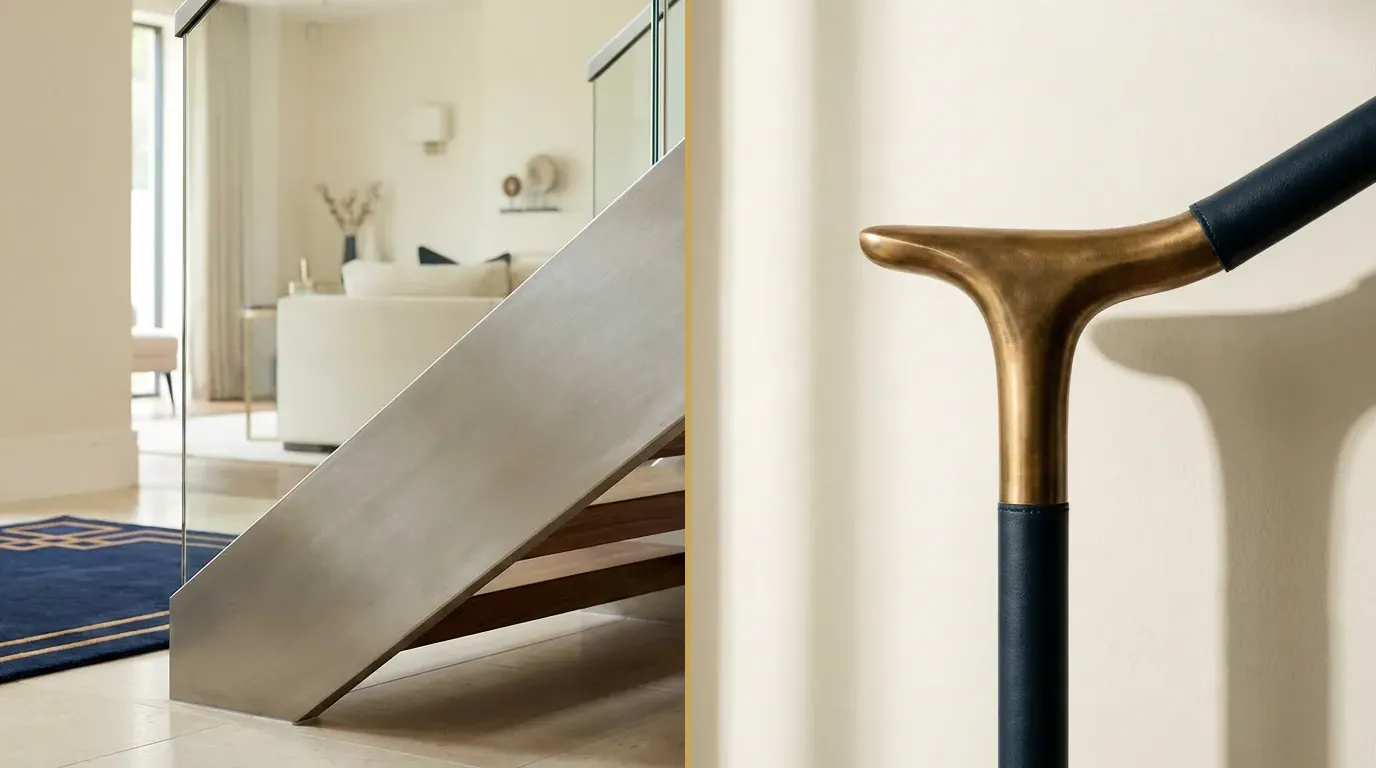
The other escape from the binary is the hybrid: most commonly a tempered-glass infill under a solid timber handrail: transparent where light matters, warm where your hand actually lands. Stainless verticals with a leather-wrapped grip occupy the same logic. Expect a 20-to-40-percent fabrication premium over single-material designs, and judge the fabricator on the joinery where the materials meet. If they cannot show completed mixed-material work with similar details, they are the wrong fabricator for a hybrid.
Whichever way you land, ask for a full-height mockup before committing: a one-metre sample on a stand is enough to tell you whether the proportions work in your specific staircase well. It is the cheapest mistake-prevention in the whole project.
Frequently asked questions
How much does a glass balustrade cost in Singapore?
S$300 to S$900 per linear metre installed, depending on glass thickness (13.5mm or 17.5mm tempered laminated), and the fixing system: point-fixed standoffs, channel mounts, or standoff pins. For a typical three-storey landed home, budget S$8,000 to S$15,000 for a full glass balustrade replacement.
How much does a timber balustrade cost in Singapore?
S$350 to S$800 per linear metre is typical, varying with species and detailing. Chengal, teak, and oak are the common choices. Turned or square balusters with a matching handrail sit at the upper end; simpler square-section designs at the lower.
Is a glass balustrade safe for children?
The panels themselves are safe: tempered or laminated glass will not break dangerously. The real concern is climbability: a flat frameless panel with no top rail is exactly what small children's hands and feet grip. Specify a top rail at 1.0 to 1.2 metres above the tread nosing and avoid horizontal handhold geometry below 1.2 metres, and the risk is designed out.
What does Singapore building code require for balustrades?
Minimum 1.0-metre height on staircase flights and 1.1 metres on landings above a certain height; gaps between balusters no greater than 100mm (child-safe spacing); and the structure must resist a defined horizontal load. Both timber and glass meet code when fabricated and fixed properly.
Do I need a permit to change my balustrade?
No. Swapping the balustrade design, such as replacing timber spindles with tempered glass panels, counts as a cosmetic change provided the structural fixing points are unchanged. It fits within a standard two-to-four-week staircase refresh with one to three days of full lockout during changeover. Structural glass on floating staircases is the exception: those fixings need proper engineering.
How often does a timber balustrade need maintenance?
Recoating every five to eight years is the main task. Skip it and the finish degrades faster than the wood itself; keep the cycle and timber balustrades last generations. Many heritage shophouse staircases in Singapore are still on their original timber after sixty years.
Is stainless steel cheaper than glass for balustrades?
Usually, yes. Stainless balusters with cables or thin rods run S$250 to S$500 per linear metre against glass at S$300 to S$900, and they tolerate Singapore humidity without recoating. The one trap: insist on genuine SS304 or SS316 in writing: 'stainless-effect' plated mild steel corrodes quickly in our climate.
Can I combine timber and glass in one balustrade?
Yes. A tempered-glass infill under a solid timber handrail is the classic hybrid: transparent where light matters, warm where your hand lands. Expect a 20-to-40-percent fabrication premium over single-material designs, and choose a fabricator who can show completed mixed-material work, because hybrid designs live or die on the joinery where the materials meet.
Decision still unclear?
A 10-minute call beats a 10-page comparison
Tell us about your specific home, household, and timeline. We will reply in business hours with a tailored verdict, no obligation, no high-pressure sales.
Related reading
Service
Staircase Renovation
New treads, balustrades and handrails, or a full rebuild. The staircase sets the tone for the whole house.
Buying Guide
Staircase Renovation in Singapore: A Buying Guide
Define staircase scope, finished levels, materials, handrails and structural responsibilities. Plan safe household access, quote comparison and handover.