Comparison
Hydraulic vs Traction Home Lift in Singapore: Which to Pick in 2026
Hydraulic and traction are the two real choices for residential home lifts in Singapore (vacuum is a separate retrofit conversation). The defaults you'll hear, 'hydraulic is cheaper, traction is premium', are technically true and operationally misleading. The actual decision is driven by stops and daily-cycle count, with energy use and ride quality as second-order factors. Hydraulic for 2-3 stops with low daily use, traction (MRL) for 4 stops or heavy daily use, full stop.
Option A
Hydraulic lift
Oil-pressure piston drive. Climbs slowly and confidently, simple mechanically, lowest five-year cost of ownership in the 2-3 stop range.
Best for
Two- and three-storey landed homes with low daily cycle count, lowest capital cost priority, clean shaft already available.
Price range
S$45,000 to S$60,000 (budget) up to S$90,000 (mid-range)
Timeframe
8-10 weeks (clean shaft); 12-16 weeks (retrofit)
Option B
Traction MRL lift
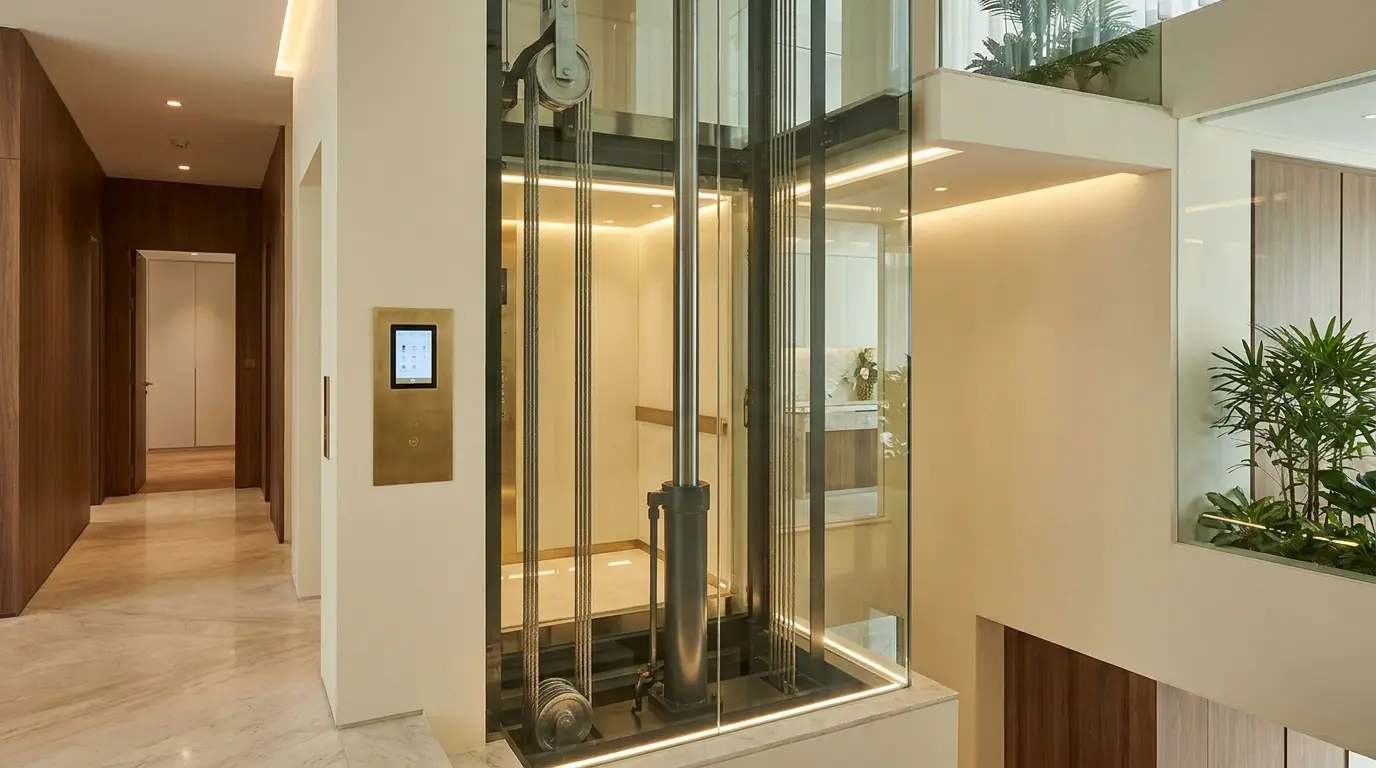
Counterweighted cable system, motor mounted at the top of the shaft (machine-room-less). Smoothest ride, fastest, lowest long-run energy bill, scales to four stops cleanly.
Best for
Four-storey homes, heavy daily multi-floor use, premium ride priority, lowest 20-year energy cost.
Price range
S$65,000 to S$120,000+
Timeframe
8-10 weeks (clean shaft); 12-16 weeks (retrofit)
Hydraulic and traction are the two adult choices for residential home lifts in Singapore. Vacuum is a third option but it solves a different problem (retrofit with no shaft) and lives in its own comparison. Platform lifts are not real home lifts and should be excluded from this decision entirely. Inside the hydraulic-versus-traction question, the framing most people walk in with, 'hydraulic is the cheap one, traction is the premium one', is the wrong axis to decide on. Capital cost matters, but it is rarely the binding constraint. The binding constraints are stops served and daily cycle count.
Hydraulic lifts work by pushing oil under pressure into a piston that drives the cabin upward; gravity (plus a controlled valve release) brings it back down. The mechanism is simple, reliable, and well-suited to 2-to-3 stop installations with moderate use. The downsides are climb speed (capped at 0.15 m/s, which feels fine for two stops and irritating for four) and energy use on the upward stroke (the piston pumps every up-cycle, with no counterweight to help). Traction lifts use a counterweighted cable system with the motor mounted at the top of the shaft (modern residential traction is almost universally machine-room-less, or MRL). They climb at 0.4 to 0.6 m/s, recover energy via the counterweight, and ride smoothly enough that you forget you are moving. They cost more up front and scale to four stops without compromise.
Our verdict before the matrix: hydraulic is the right answer for two-stop and most three-stop installations where daily cycle count is under 20 per day and capital cost is a real constraint. Traction MRL is the right answer for four-stop installations, for households running 30-plus cycles per day, for the smoothest ride quality, and for the lowest 20-year energy bill. The decision is rarely close once you map your actual situation onto stops and cycles; the people who agonize over this comparison are usually conflating it with the budget question instead of asking the technical one.
The verdict
Pick Hydraulic lift
Pick hydraulic if your home is two storeys or three storeys, daily cycle count is under 20, capital cost is meaningful, and the shaft is already provided or easy to construct. The S$20,000-plus savings versus traction is real and the speed difference is barely noticeable on two stops. Hydraulic is the workhorse default for the largest segment of Singapore residential home lifts; most homes we install are hydraulic for these reasons.
Pick Traction MRL lift
Pick traction MRL if your home has four floors served by the lift, daily cycle count is over 30, you want the smoothest ride quality available, or you are optimizing for the lowest 20-year energy and maintenance cost. The capital premium of S$20,000 to S$40,000 over hydraulic earns back over the lift's life through lower energy use and lower mechanical wear per cycle, and the ride quality difference is material enough that occupants notice it on day one.
Side-by-side comparison
The row-by-row matrix. Hover or read the note row for the nuance behind each dimension.
| Dimension | Hydraulic lift | Traction MRL lift |
|---|---|---|
Stops supported (residential) 2-3 (technically supports 4 but the speed becomes punishing) 2-4 (ideal for 4-stop, common for 3-stop premium installs) The hard rule: four-storey homes go traction. Three-storey homes can go either way depending on cycles and budget. | ||
Ride speed 0.15 m/s typical (capped) 0.4-0.6 m/s typical On a four-storey run, traction completes the trip in 18-25 seconds versus 70+ seconds for hydraulic. On a two-storey run, the difference is 8 seconds versus 18: annoying but tolerable. | ||
Capital cost band S$45,000 (budget) to S$90,000 (mid-range) S$65,000 (mid-range) to S$120,000+ (premium) The hydraulic-to-traction premium is typically S$20,000 to S$40,000 for an equivalent cabin specification. Traction-with-glass-cabin runs higher again. | ||
Energy use (20-year) Higher; piston pumps oil on every up-cycle, no counterweight Lower; counterweight balances cabin, regenerative drives recover energy on descent The 20-year energy delta on a heavily-cycled lift can offset 30-50% of the traction capital premium. Light-use households see less of this advantage. | ||
Machine room footprint Small machine room or in-shaft hydraulic power unit (~0.5m × 0.8m) None; MRL puts the motor at the top of the shaft Hydraulic in-shaft power units have closed most of the historical machine-room footprint gap, but they still require a small accessible enclosure for the pump and oil tank. | ||
Smoothness rating Good; soft start and stop, mild deceleration squat Excellent; counterweight balances cabin, near-imperceptible acceleration Traction is the technology used in virtually every commercial lift you have ridden. The ride quality is the most-cited reason owners pick traction over hydraulic on three-stop installs. | ||
Maintenance complexity Lower; oil-pressure mechanism, fewer moving parts, simpler diagnostics Higher; counterweight rails, cable inspection, controller calibration Annual maintenance cost is comparable (S$2,400 to S$4,800 per year) for both systems despite the complexity difference. Hydraulic typically sits at the lower end. | ||
Pit depth required 150-300mm typical 200-400mm typical Both systems need a pit. Vacuum (not in this comparison) is the no-pit option for retrofits. | ||
Headroom required above top landing 2.4m typical 2.4-2.7m typical (slightly more for the MRL motor housing) Most Singapore landed homes have the headroom. Constraint is usually horizontal footprint, not vertical. | ||
Typical applications Most 2-storey and many 3-storey landed homes; resale-positioning installs All 4-storey homes; heavy-use 3-storey homes; premium-tier cabins; clients staying 15+ years Approximately 60% of the residential home lifts we install are hydraulic; the remainder are traction with a small minority vacuum for retrofit cases. | ||
BCA classification Passenger lift, hydraulic drive; standard BCA Permit to Install / Permit to Operate path Passenger lift, traction MRL drive; standard BCA Permit to Install / Permit to Operate path Both are passenger lifts under BCA with identical permit and annual safety inspection requirements. The drive system does not change the regulatory path. | ||
Manufacturer warranty (mechanism) 5 years typical 5 years typical, premium tier extends to 10 years Wear parts (door rollers, hydraulic seals for hydraulic; cable tension monitoring for traction) excluded from warranty on both systems. | ||
The 'stops × cycles' rule
The cleanest way to decide between hydraulic and traction is to multiply the number of stops your lift will serve by the realistic daily cycle count your household runs. A two-stop hydraulic lift running 15 trips a day is approximately 30 daily piston cycles, well within the mechanism's comfort zone. A four-stop hydraulic lift in a household running 40 trips a day is approximately 160 daily cycles in a system designed for moderate use. The pump runs hot, the seals wear faster, the energy bill compounds, and the lift you bought to save S$25,000 over traction is now requiring early seal replacement at year 4 and consuming materially more electricity per year.
The inverse case: a three-stop traction MRL lift in a household running 8 trips per day. The lift is over-engineered for the use case. The counterweight system, the cable monitoring, the regenerative drive: all of it is paying ongoing complexity cost for a use case that hydraulic would have handled at lower capital cost with comparable reliability. You spent S$25,000 on a feature set you do not exercise.
Run the math at the quote stage. Count the stops your lift will actually serve (not 'might serve someday' but the actual planned routine). Estimate the realistic daily cycle count from your household's pattern: each person's typical daily up-and-down counts as 2 cycles, each laundry haul counts as 2, each grocery run counts as 2. Most landed-property households land somewhere between 8 and 25 daily cycles. Multiply by stops, and if the product is under 50 you are comfortably in hydraulic territory; if it is over 80 you are comfortably in traction; the 50-to-80 band is where ride quality preference and budget become the deciding factor.
Energy and 20-year operating cost
Hydraulic lifts consume electricity primarily on the upward stroke (the pump motor lifts the cabin against gravity). The downward stroke is gravity-controlled: the cabin's weight pushes the oil back through a regulated valve. There is no energy recovery on descent. Traction lifts use a counterweight that approximately balances the cabin weight, so the motor only does the work of moving the load imbalance (the difference between cabin-plus-passengers and the counterweight). Modern traction drives are regenerative: they recover energy on descent and feed it back into the building electrical system.
The practical implication: on a heavily-cycled four-storey traction lift, the 20-year electricity cost can be 50% lower than an equivalent hydraulic. On a lightly-cycled two-storey hydraulic lift, the 20-year electricity cost difference is small enough that the capital premium for traction does not earn back over the lift's life. The break-even point depends on your specific electricity tariff, but as a directional rule, traction's energy advantage pays back the capital premium between year 12 and year 18 on heavily-cycled installations and does not pay back at all on light-use ones.
Maintenance cost behaves differently. Annual maintenance contracts price both systems comparably (S$2,400 to S$4,800 per year), with hydraulic typically sitting at the lower end of that band. The maintenance cost gap over 20 years is small (~S$5,000 to S$15,000) and not the deciding factor for most households. Mid-life mechanism refresh costs (oil seal replacement on hydraulic at year 10-12; cable inspection and minor parts on traction at year 12-15) are comparable in magnitude.
When the ride-quality difference actually matters
Ride quality is the most subjective dimension of this comparison and also the most often used as the rationalization for spending more than the technical case requires. Both hydraulic and traction modern lifts are smooth. Traction is smoother. The question is whether the difference is worth the capital premium for your specific household.
The ride-quality difference is most noticeable on three- and four-stop runs where the deceleration cycles compound. A hydraulic lift decelerating at each stop produces a mild squat (the oil pressure adjusts, the cabin settles, there is a moment of equalization before the doors open). Most occupants notice it once, accept it, and stop noticing it within a week. Traction's counterweight-balanced deceleration is essentially imperceptible: the cabin stops, the doors open, the experience is closer to a high-end commercial lift than to a residential mechanism.
Households where ride quality earns the cost premium: families with elderly occupants who are sensitive to motion (the smoother stop reduces fall risk for unsteady users), families using the lift heavily enough that the cumulative cycle experience matters, premium-tier cabin specifications where the lift is part of the architecture and the ride should match the visual finish. Households where ride quality does not earn the premium: light-use two-stop installations where the lift is functional infrastructure rather than experiential, budget-driven projects where the S$25,000 traction premium would compromise other parts of the renovation scope.
Where most people get this comparison wrong
The most common mistake we see is buyers conflating 'premium = traction' with 'premium-finish cabin = traction'. The cabin specification (interior materials, glass walls, lighting, control panel) is largely independent of the drive system. A premium hydraulic lift with a custom timber-veneer cabin and full-glass landing doors is entirely possible, and runs S$80,000 to S$90,000, which is most of the way to a baseline traction installation. If your reason for picking traction is 'I want the lift to feel premium', the cabin specification matters more than the drive system, and a mid-range hydraulic with a premium cabin can deliver 80% of the experience for 60% of the cost.
The second common mistake is over-rotating on energy savings. Traction's energy advantage is real but it scales with use. A light-use household pays a S$25,000 capital premium that recovers over 20 years through electricity savings of perhaps S$300 per year. The math does not work. A heavy-use household pays the same premium and recovers it through electricity savings of perhaps S$1,500 per year. The math works. Run the numbers for your actual cycle count.
The third common mistake is treating this as a purely technical decision when household preference matters. We have installed traction lifts in two-stop low-cycle homes where the household specifically wanted the ride quality and was clear-eyed that they were paying for an experience, not for technical optimization. That is a defensible choice. We have also installed hydraulic lifts in four-stop heavy-cycle homes where the household was budget-constrained and accepted the slower ride and higher electricity bill in exchange for the capital savings. That is also a defensible choice. The wrong move is making the decision without understanding the trade-offs in either direction.
Frequently asked questions
Is a hydraulic or traction home lift better for a Singapore landed property?
Hydraulic is the right default for most two- and three-storey landed homes with low-to-moderate daily cycle counts (under 20 trips per day) where capital cost matters. Traction MRL is the right answer for four-storey homes, heavy-use households (30+ daily cycles), buyers prioritizing the smoothest ride quality, or the lowest 20-year energy bill. Approximately 60% of residential home lifts we install in Singapore landed property are hydraulic; the remainder are traction.
How much more does a traction home lift cost than hydraulic?
The capital premium is typically S$20,000 to S$40,000 for an equivalent cabin specification. Hydraulic budget tier starts around S$45,000 and reaches S$90,000 at mid-range; traction MRL starts around S$65,000 and reaches S$120,000+ at premium tier with full glass cabins and smart-home integration. The premium widens with stops served: a four-stop traction lift versus a four-stop hydraulic shows the largest gap.
Can a hydraulic lift handle four floors?
Technically yes, but the ride speed becomes punishing. A four-storey run at 0.15 m/s takes around 70 seconds versus 18-25 seconds on a traction MRL. The pump also runs hot under heavy four-stop daily cycling, accelerating seal wear. Our recommendation is to switch to traction at the four-stop threshold. The capital premium is recovered over 20 years through energy savings and avoided early seal replacement.
Does a traction home lift need a machine room?
No, not in modern residential installations. Machine-room-less (MRL) traction is the dominant configuration for residential traction lifts: the motor is mounted at the top of the shaft, removing the need for a separate machine room. This is a notable advantage over hydraulic, which requires either a small accessible machine room or an in-shaft power unit enclosure for the pump and oil tank.
Which lift system has lower long-term energy cost?
Traction MRL, in most realistic scenarios. The counterweight balances the cabin weight, so the motor only does the work of moving the load imbalance rather than lifting the full cabin weight on every up-cycle. Modern traction drives are also regenerative: they recover energy on descent. On heavily-cycled four-storey installations, traction's 20-year energy cost can be 50% lower than equivalent hydraulic. On light-use two-stop installations, the energy delta is small enough that capital cost dominates the decision.
Which is more reliable, hydraulic or traction?
Both are highly reliable when correctly specified and properly maintained. Hydraulic has fewer moving parts and simpler diagnostics, which historically translated to lower service-call frequency. Modern traction MRL has narrowed that gap significantly through controller refinement and predictive maintenance via the controller telemetry. Mid-life refresh costs are comparable. The bigger reliability factor is installer quality and the maintenance contract, not the drive system itself.
Does the BCA permit process differ for hydraulic vs traction?
No. Both are classified as passenger lifts under the BCA framework and follow the same Permit to Install / Permit to Operate path, with the same engineering drawing requirements (PE-endorsed structural calculations, electrical loading documentation, lift specifications). The annual safety inspection requirement is identical. Drive system does not change the regulatory pathway.
Decision still unclear?
Get help comparing the options for your home
Tell us which options you are considering, what matters to your household and when you hope to start. Share photos or plans on WhatsApp if you have them.
Related reading
Compare
Stairlift vs Home lift
A stairlift rides up the staircase you already have. A home lift needs its own way up through your floors, and it is the one that can take a wheelchair or a carer when it is big enough.
Compare
Vacuum (pneumatic) lift vs Hydraulic lift
Vacuum lifts and hydraulic lifts solve the same problem (vertical transport between floors in a landed home) with two completely different engineering paths. The shorthand most people use, 'vacuum is for retrofit, hydraulic is for new build', is roughly right and worth understanding properly. The trade-off is real: vacuum buys you minimal structural intervention at the cost of a smaller cabin; hydraulic buys you a larger cabin and full wheelchair access at the cost of substantial structural work in retrofit cases.
Service
Home Lifts
A lift inside your own house. We build the shaft, install the lift and finish everything around it.
Buying Guide
Home Lifts in Singapore: A Landed Home Buying Guide
Compare home-lift suitability, landing space, building works, quotations, BCA owner duties and ongoing care before choosing a system.